van Loo B, Salehi S S, Henke S, Shamloo A, Kamperman T, Karperien M, Leijten J
Department of Developmental BioEngineering, Faculty of Science and Technology, Technical Medical Centre, University of Twente, Drienerlolaan 5, 7522, NB Enschede, the Netherlands.
School of Mechanical Engineering, Sharif University of Technology, Tehran, Iran.
Mater Today Bio. 2020 Mar 6;6:100047. doi: 10.1016/j.mtbio.2020.100047. eCollection 2020 Mar.
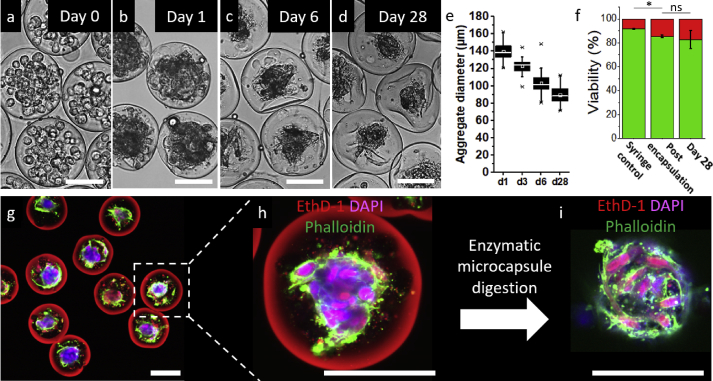
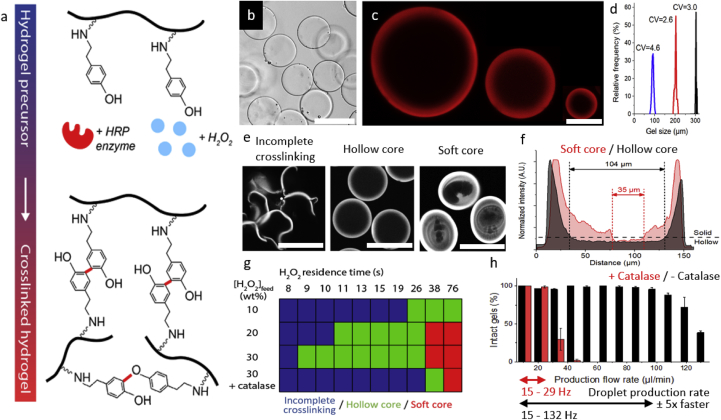
Cell-laden hydrogel microcapsules enable the high-throughput production of cell aggregates, which are relevant for three-dimensional tissue engineering and drug screening applications. However, current microcapsule production strategies are limited by their throughput, multistep protocols, and limited amount of compatible biomaterials. We here present a single-step process for the controlled microfluidic production of single-core microcapsules using enzymatic outside-in cross-linking of tyramine-conjugated polymers. It was hypothesized that a physically, instead of the conventionally explored biochemically, controlled enzymatic cross-linking process would improve the reproducibility, operational window, and throughput of shell formation. Droplets were flown through a silicone delay line, which allowed for highly controlled diffusion of the enzymatic cross-linking initiator. The microcapsules' cross-linking density and shell thickness is strictly depended on the droplet's retention time in the delay line, which is predictably controlled by flow rate. The here presented hydrogel cross-linking method allows for facile and cytocompatible production of cell-laden microcapsules compatible with the formation and biorthogonal isolation of long-term viable cellular spheroids for tissue engineering and drug screening applications.
载细胞水凝胶微胶囊能够高通量生产细胞聚集体,这与三维组织工程和药物筛选应用相关。然而,目前的微胶囊生产策略受到其通量、多步方案以及兼容生物材料数量有限的限制。我们在此提出一种单步工艺,用于通过对酪胺共轭聚合物进行酶促由外向内交联来控制微流控生产单核微胶囊。据推测,一种物理控制而非传统探索的生化控制的酶促交联过程将提高壳形成的可重复性、操作窗口和通量。液滴流经硅胶延迟线,这允许酶促交联引发剂进行高度可控的扩散。微胶囊的交联密度和壳厚度严格取决于液滴在延迟线中的保留时间,而这可通过流速进行可预测的控制。本文提出的水凝胶交联方法能够简便且具有细胞相容性地生产载细胞微胶囊,适用于组织工程和药物筛选应用中与长期存活细胞球体的形成及生物正交分离兼容的情况。