Center for Preventive Doping Research - Institute of Biochemistry, German Sport University Cologne, Am Sportpark Müngersdorf 6, 50933, Cologne, Germany.
European Monitoring Center for Emerging Doping Agents (EuMoCEDA), Cologne/Bonn, Germany.
Anal Bioanal Chem. 2020 Jun;412(15):3765-3777. doi: 10.1007/s00216-020-02634-4. Epub 2020 Apr 16.
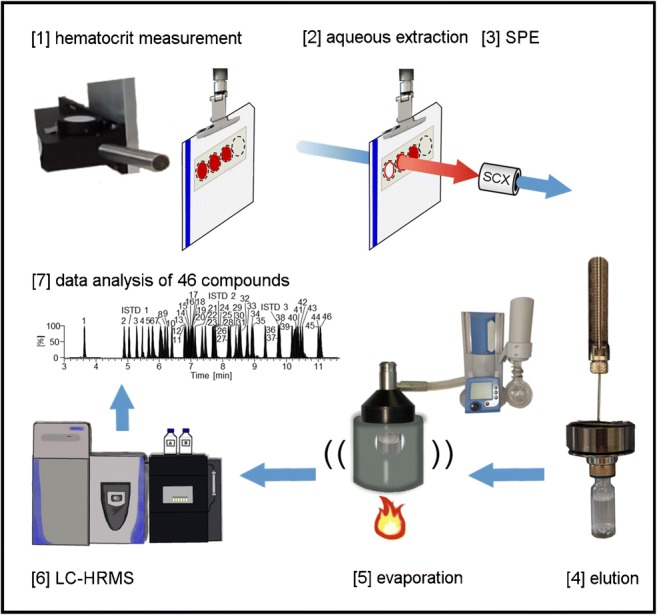
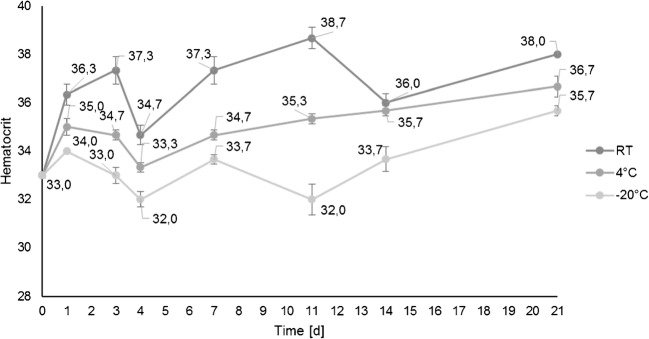
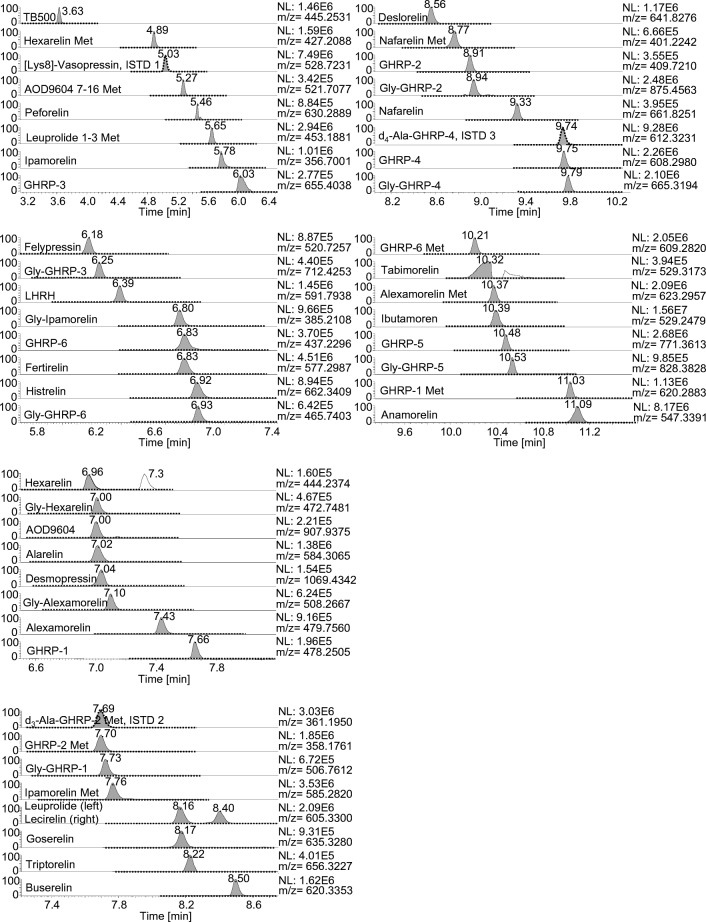
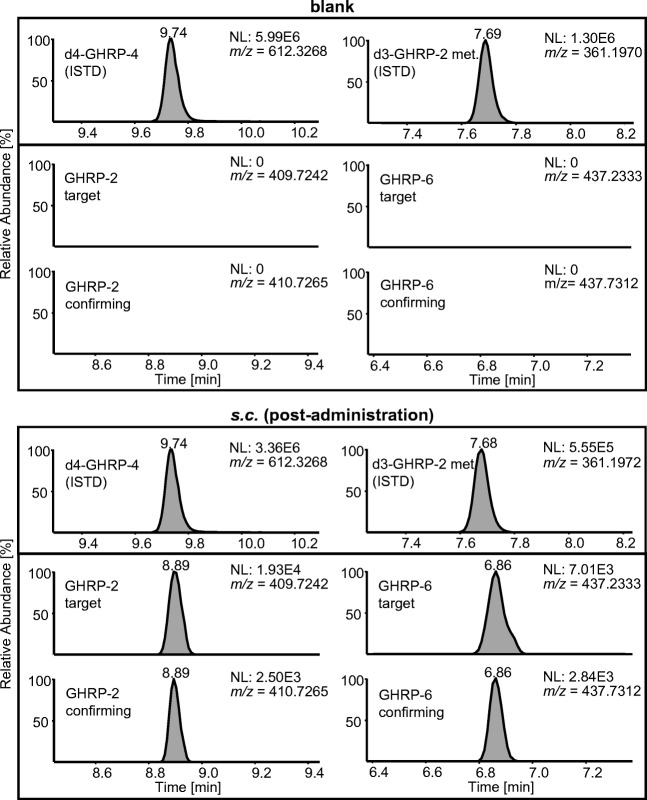
The added value of dried blood spot (DBS) samples complementing the information obtained from commonly routine doping control matrices is continuously increasing in sports drug testing. In this project, a robotic-assisted non-destructive hematocrit measurement from dried blood spots by near-infrared spectroscopy followed by a fully automated sample preparation including strong cation exchange solid-phase extraction and evaporation enabled the detection of 46 lower molecular mass (< 2 kDa) peptide and non-peptide drugs and drug candidates by means of LC-HRMS. The target analytes included, amongst others, agonists of the gonadotropin-releasing hormone receptor, the ghrelin receptor, the human growth hormone receptor, and the antidiuretic hormone receptor. Furthermore, several glycine derivatives of growth hormone-releasing peptides (GHRPs), arguably designed to undermine current anti-doping testing approaches, were implemented to the presented detection method. The initial testing assay was validated according to the World Anti-Doping Agency guidelines with estimated LODs between 0.5 and 20 ng/mL. As a proof of concept, authentic post-administration specimens containing GHRP-2 and GHRP-6 were successfully analyzed. Furthermore, DBS obtained from a sampling device operating with microneedles for blood collection from the upper arm were analyzed and the matrix was cross-validated for selected parameters. The introduction of the hematocrit measurement method can be of great value for doping analysis as it allows for quantitative DBS applications by managing the well-recognized "hematocrit effect." Graphical abstract.
干血斑(DBS)样本的附加值不断增加,可补充运动药物检测中通常常规兴奋剂控制矩阵获得的信息。在这个项目中,通过近红外光谱对干血斑进行机器人辅助的非破坏性红细胞压积测量,然后通过全自动样品制备,包括强阳离子交换固相萃取和蒸发,实现了通过 LC-HRMS 检测 46 种低分子量(<2 kDa)肽和非肽药物和药物候选物。目标分析物包括促性腺激素释放激素受体、胃饥饿素受体、人生长激素受体和抗利尿激素受体激动剂等。此外,还将几种生长激素释放肽(GHRP)的甘氨酸衍生物(据称旨在破坏当前的反兴奋剂检测方法)纳入到提出的检测方法中。初始测试分析根据世界反兴奋剂机构的指南进行验证,估计 LOD 在 0.5 到 20 ng/mL 之间。作为概念验证,成功分析了含有 GHRP-2 和 GHRP-6 的真实给药后样本。此外,还分析了从用于从上臂采集血液的微针采样装置获得的 DBS,并对选定参数进行了基质交叉验证。红细胞压积测量方法的引入对于兴奋剂分析非常有价值,因为它可以通过管理众所周知的“红细胞压积效应”实现定量 DBS 应用。