Maryland Psychiatric Research Center, Department of Psychiatry, University of Maryland School of Medicine, Baltimore, Maryland, USA.
Psychiatry Neuroimaging Laboratory, Brigham & Women's Hospital, Boston, Massachusetts, USA.
Hum Brain Mapp. 2022 Jan;43(1):194-206. doi: 10.1002/hbm.24998. Epub 2020 Apr 16.
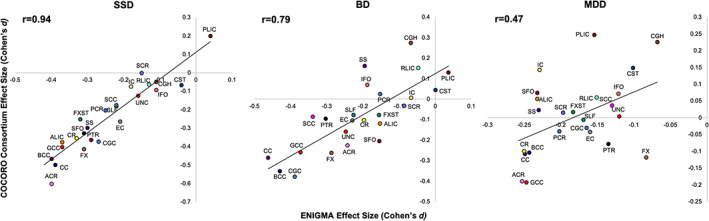
The ENIGMA-DTI (diffusion tensor imaging) workgroup supports analyses that examine the effects of psychiatric, neurological, and developmental disorders on the white matter pathways of the human brain, as well as the effects of normal variation and its genetic associations. The seven ENIGMA disorder-oriented working groups used the ENIGMA-DTI workflow to derive patterns of deficits using coherent and coordinated analyses that model the disease effects across cohorts worldwide. This yielded the largest studies detailing patterns of white matter deficits in schizophrenia spectrum disorder (SSD), bipolar disorder (BD), major depressive disorder (MDD), obsessive-compulsive disorder (OCD), posttraumatic stress disorder (PTSD), traumatic brain injury (TBI), and 22q11 deletion syndrome. These deficit patterns are informative of the underlying neurobiology and reproducible in independent cohorts. We reviewed these findings, demonstrated their reproducibility in independent cohorts, and compared the deficit patterns across illnesses. We discussed translating ENIGMA-defined deficit patterns on the level of individual subjects using a metric called the regional vulnerability index (RVI), a correlation of an individual's brain metrics with the expected pattern for a disorder. We discussed the similarity in white matter deficit patterns among SSD, BD, MDD, and OCD and provided a rationale for using this index in cross-diagnostic neuropsychiatric research. We also discussed the difference in deficit patterns between idiopathic schizophrenia and 22q11 deletion syndrome, which is used as a developmental and genetic model of schizophrenia. Together, these findings highlight the importance of collaborative large-scale research to provide robust and reproducible effects that offer insights into individual vulnerability and cross-diagnosis features.
ENIGMA-DTI(弥散张量成像)工作组支持分析研究精神疾病、神经疾病和发育障碍对人类大脑白质通路的影响,以及正常变异及其遗传关联的影响。七个 ENIGMA 疾病导向工作组使用 ENIGMA-DTI 工作流程,通过协调整合的分析来得出缺陷模式,这些分析模型跨越全球队列研究疾病的影响。这产生了最大规模的研究,详细描述了精神分裂症谱系障碍(SSD)、双相情感障碍(BD)、重度抑郁症(MDD)、强迫症(OCD)、创伤后应激障碍(PTSD)、创伤性脑损伤(TBI)和 22q11 缺失综合征的白质缺陷模式。这些缺陷模式反映了潜在的神经生物学,并在独立队列中具有可重复性。我们回顾了这些发现,证明了它们在独立队列中的可重复性,并比较了不同疾病之间的缺陷模式。我们讨论了使用区域易损性指数(RVI)这一指标,在个体层面上对 ENIGMA 定义的缺陷模式进行翻译,这是一个与个体大脑指标与疾病预期模式相关的指标。我们讨论了 SSD、BD、MDD 和 OCD 之间白质缺陷模式的相似性,并提出了在跨诊断神经精神病学研究中使用该指数的理由。我们还讨论了特发性精神分裂症和 22q11 缺失综合征之间缺陷模式的差异,后者被用作精神分裂症的发育和遗传模型。总之,这些发现强调了合作开展大规模研究的重要性,以便提供稳健且可重复的影响,从而深入了解个体易损性和跨诊断特征。