Maryland Psychiatric Research Center, Department of Psychiatry, University of Maryland School of Medicine, Baltimore, Maryland, USA.
Beijing Huilongguan Hospital, Peking University Huilongguan Clinical Medical School, Beijing, People's Republic of China.
Hum Brain Mapp. 2022 Jan;43(1):566-575. doi: 10.1002/hbm.25045. Epub 2020 May 28.
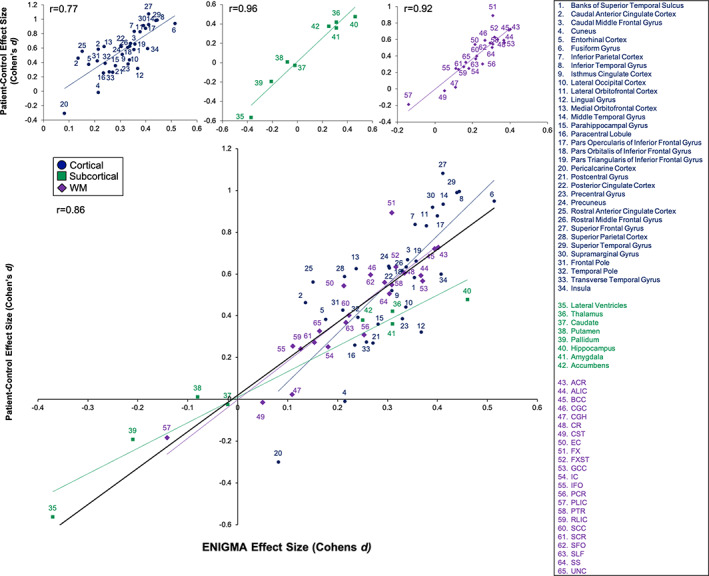
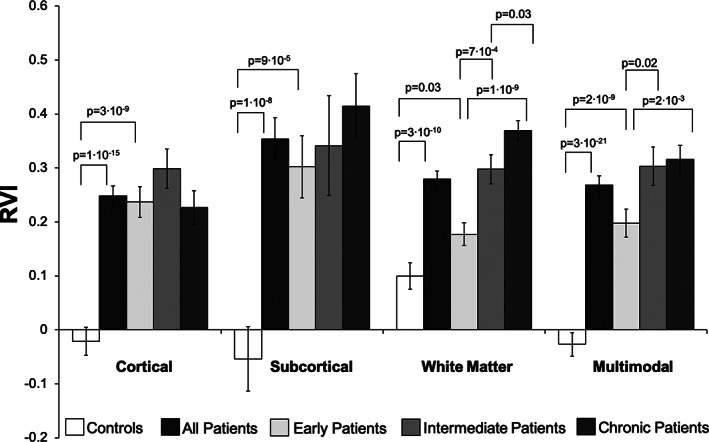
Patients with schizophrenia have patterns of brain deficits including reduced cortical thickness, subcortical gray matter volumes, and cerebral white matter integrity. We proposed the regional vulnerability index (RVI) to translate the results of Enhancing Neuro Imaging Genetics Meta-Analysis studies to the individual level. We calculated RVIs for cortical, subcortical, and white matter measurements and a multimodality RVI. We evaluated RVI as a measure sensitive to schizophrenia-specific neuroanatomical deficits and symptoms and studied the timeline of deficit formations in: early (≤5 years since diagnosis, N = 45, age = 28.8 ± 8.5); intermediate (6-20 years, N = 30, age 43.3 ± 8.6); and chronic (21+ years, N = 44, age = 52.5 ± 5.2) patients and healthy controls (N = 76, age = 38.6 ± 12.4). All RVIs were significantly elevated in patients compared to controls, with the multimodal RVI showing the largest effect size, followed by cortical, white matter and subcortical RVIs (d = 1.57, 1.23, 1.09, and 0.61, all p < 10 ). Multimodal RVI was significantly correlated with multiple cognitive variables including measures of visual learning, working memory and the total score of the MATRICS consensus cognitive battery, and with negative symptoms. The multimodality and white matter RVIs were significantly elevated in the intermediate and chronic versus early diagnosis group, consistent with ongoing progression. Cortical RVI was stable in the three disease-duration groups, suggesting neurodevelopmental origins of cortical deficits. In summary, neuroanatomical deficits in schizophrenia affect the entire brain; the heterochronicity of their appearance indicates both the neurodevelopmental and progressive nature of this illness. These deficit patterns may be useful for early diagnosis and as quantitative targets for more effective treatment strategies aiming to alter these neuroanatomical deficit patterns.
精神分裂症患者存在大脑缺陷模式,包括皮质厚度减少、皮质下灰质体积减少和大脑白质完整性降低。我们提出了区域易损性指数(RVI),以将增强神经影像学遗传学荟萃分析研究的结果转化为个体水平。我们计算了皮质、皮质下和白质测量的 RVI 和多模态 RVI。我们评估了 RVI 作为一种敏感的精神分裂症特异性神经解剖缺陷和症状的测量方法,并研究了缺陷形成的时间线:早期(≤5 年诊断,N=45,年龄=28.8±8.5);中期(6-20 年,N=30,年龄 43.3±8.6);和慢性(21 年以上,N=44,年龄=52.5±5.2)患者和健康对照组(N=76,年龄=38.6±12.4)。与对照组相比,所有 RVI 在患者中均显著升高,多模态 RVI 显示出最大的效应量,其次是皮质、白质和皮质下 RVI(d=1.57、1.23、1.09 和 0.61,均 p<10)。多模态 RVI 与多个认知变量显著相关,包括视觉学习、工作记忆和 MATRICS 共识认知电池的总分,以及与阴性症状相关。在中间和慢性与早期诊断组相比,多模态和白质 RVI 显著升高,与持续进展一致。皮质 RVI 在三个疾病持续时间组中均保持稳定,表明皮质缺陷具有神经发育起源。总之,精神分裂症的神经解剖缺陷影响整个大脑;它们出现的异时性表明这种疾病具有神经发育和进展的性质。这些缺陷模式可能有助于早期诊断,并作为更有效的治疗策略的定量靶点,旨在改变这些神经解剖缺陷模式。