Section of Health Care Research and Rehabilitation Research, Medical Center, Faculty of Medicine, University of Freiburg, Freiburg, Germany.
Medical Data Science, Institute of Medical Biometry and Medical Statistics, Medical Center, Faculty of Medicine, University of Freiburg, Freiburg, Germany.
JMIR Mhealth Uhealth. 2020 Apr 17;8(4):e15514. doi: 10.2196/15514.
Mobile health apps have great potential to support the self-management of chronic conditions such as allergic diseases, which constitute significant challenges in health care. However, the health app market is confusing for users, as it is vast, dynamic, and lacks scientific evidence regarding the effectiveness of the apps on offer. To our knowledge, no health app for pollen-related allergic rhinitis has been evaluated.
The aim of our study was to evaluate the Husteblume mobile phone health app, developed in Germany to facilitate the self-management of pollen-related allergic rhinitis.
We evaluated usability and changes in quality of life, health literacy, and self-efficacy for managing one's chronic disease. We conducted 2 online surveys of registered users of the app, 1 before and 1 after the 2017 pollen season, allowing for the analysis of both cross-sectional and longitudinal data in a field setting.
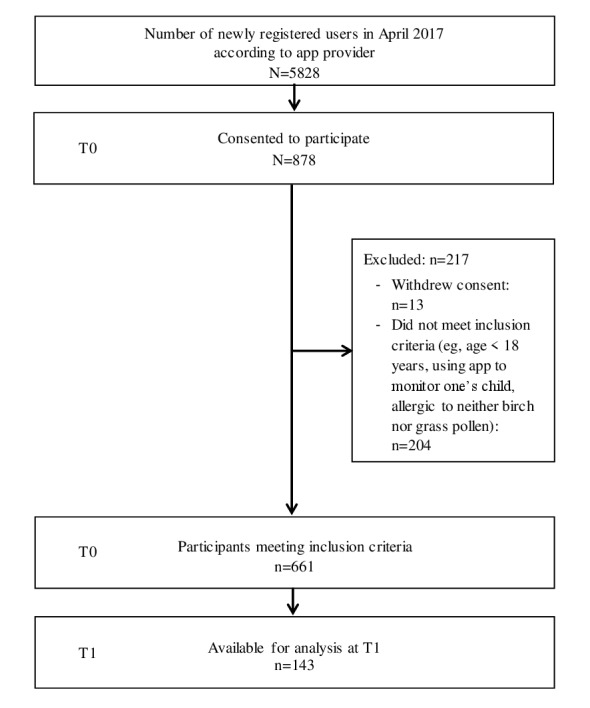
The sample comprised 661 app users at the first measurement point and 143 users at follow-up. The subgroup of study participants at follow-up rated the usability of the app as good or very good. There were no significant changes in patient-reported outcomes such as quality of life, health literacy, and self-efficacy between the 2 measurement points (P>.05). However, those reached at follow-up perceived subjective improvements due to the app: 55.9% (80/143) reported being subjectively better informed about their allergy, 27.3% (39/143) noted improved quality of life, 33.6% (48/143) reported subjectively better coping with their allergy, and 28.0% (40/143) felt better prepared for the consultation with their physician. Finally, 90.9% (130/143) users did not identify any adverse effects of the app.
Despite some methodological caveats, the results of the evaluation of the Husteblume app are encouraging for the subgroup using the app in the long term. However, further studies evaluating the effectiveness of the app are needed.
German Clinical Trials Register DRKS00011897; https://tinyurl.com/yxxrg9av.
移动健康应用在支持过敏等慢性病的自我管理方面具有巨大潜力,过敏是医疗保健面临的重大挑战。然而,由于健康应用市场庞大、动态且缺乏有关现有应用有效性的科学证据,用户对其感到困惑。据我们所知,尚无针对花粉相关性过敏性鼻炎的健康应用进行评估。
我们的研究旨在评估 Husteblume 手机健康应用,该应用在德国开发,用于促进花粉相关性过敏性鼻炎的自我管理。
我们评估了可用性以及生活质量、健康素养和管理慢性病自我效能的变化。我们对该应用的注册用户进行了 2 项在线调查,1 项在 2017 年花粉季之前,1 项在之后,允许在现场环境中分析横断面和纵向数据。
第一次测量点的样本包括 661 名应用用户,随访点的样本包括 143 名用户。随访组的研究参与者亚组对应用的可用性评价为好或非常好。在 2 个测量点之间,患者报告的结果(如生活质量、健康素养和自我效能)没有显著变化(P>.05)。然而,随访组的参与者认为应用带来了主观上的改善:55.9%(80/143)报告说对过敏有了更好的了解,27.3%(39/143)注意到生活质量有所提高,33.6%(48/143)报告说能够更好地应对过敏,28.0%(40/143)感到对与医生的咨询做好了更充分的准备。最后,90.9%(130/143)的用户未发现应用有任何不良反应。
尽管存在一些方法学上的缺陷,但对长期使用 Husteblume 应用的用户亚组进行的应用评估结果令人鼓舞。然而,仍需要进一步研究来评估该应用的有效性。
德国临床试验注册中心 DRKS00011897;https://tinyurl.com/yxxrg9av。