Cossu Vanessa, Bauckneht Matteo, Bruno Silvia, Orengo Anna Maria, Emionite Laura, Balza Enrica, Castellani Patrizia, Piccioli Patrizia, Miceli Alberto, Raffa Stefano, Borra Anna, Donegani Maria Isabella, Carlone Sebastiano, Morbelli Silvia, Ravera Silvia, Sambuceti Gianmario, Marini Cecilia
Nuclear Medicine, IRCCS Ospedale Policlinico San Martino, Genova, Italy; Department of Health Sciences, University of Genoa, Italy.
Department Experimental Medicine, University of Genoa, Italy.
Transl Oncol. 2020 May;13(5):100752. doi: 10.1016/j.tranon.2020.100752. Epub 2020 Apr 14.
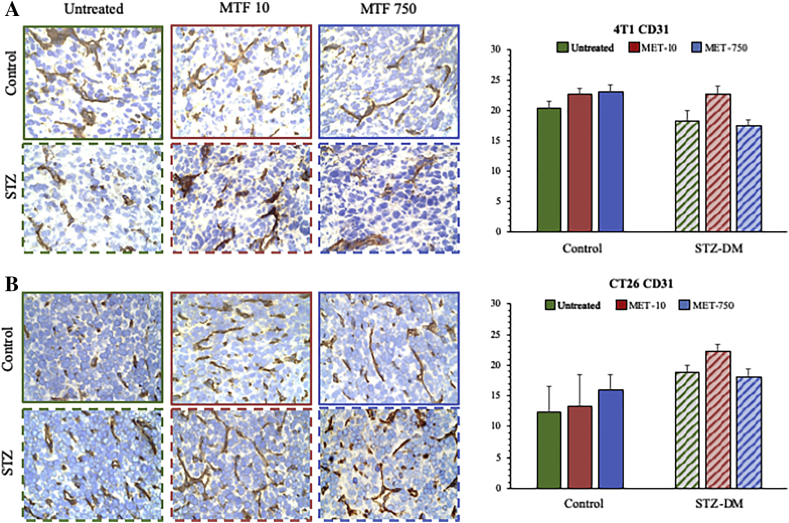
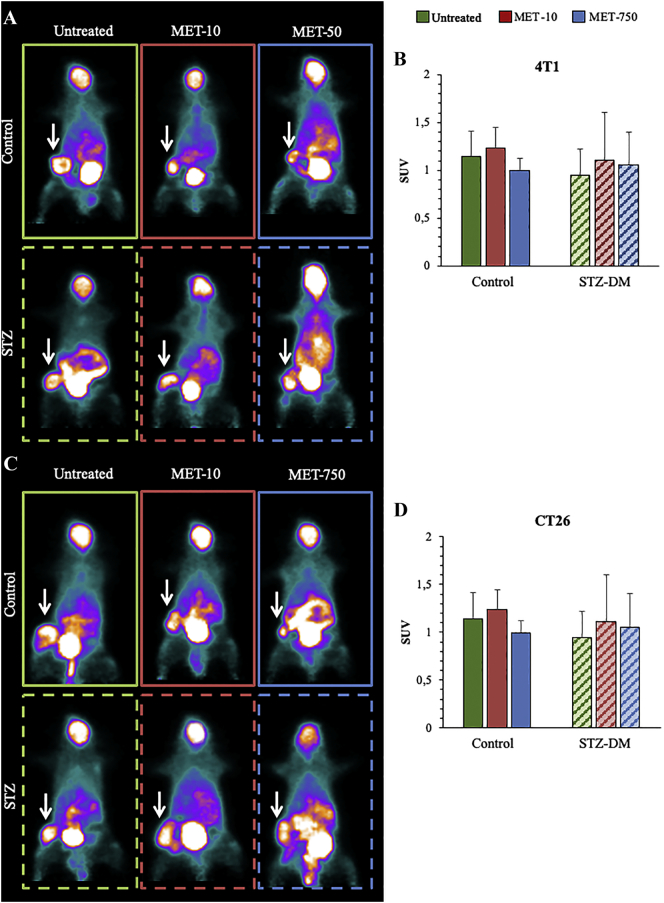
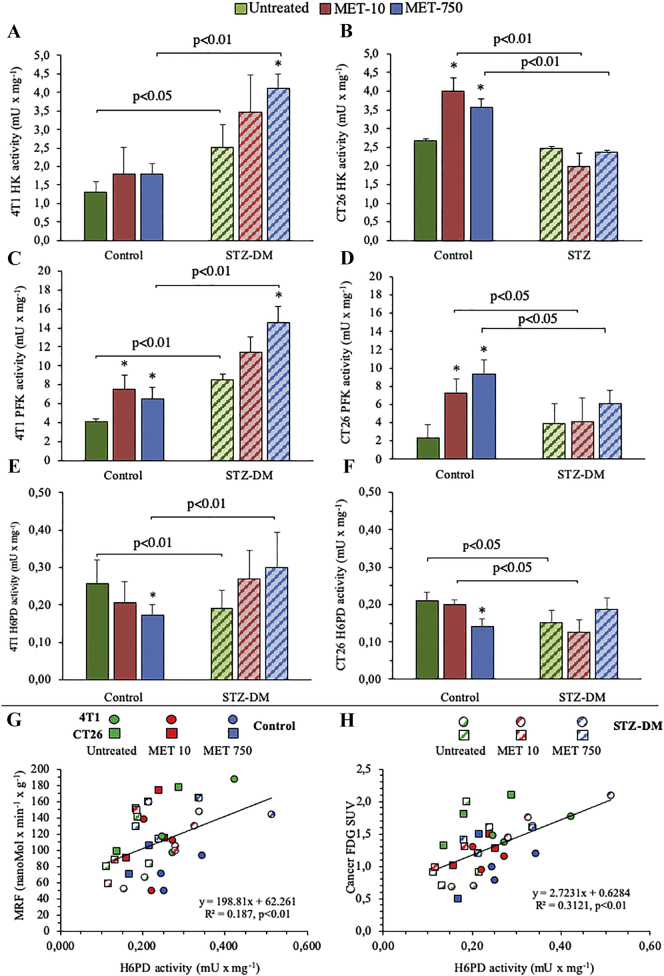
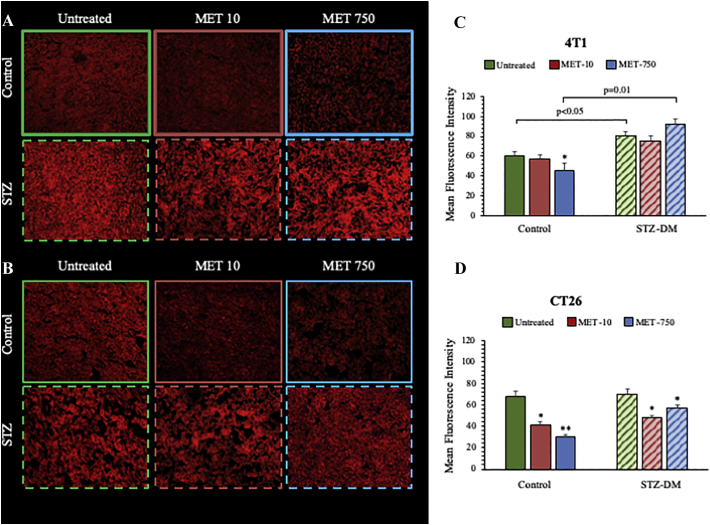
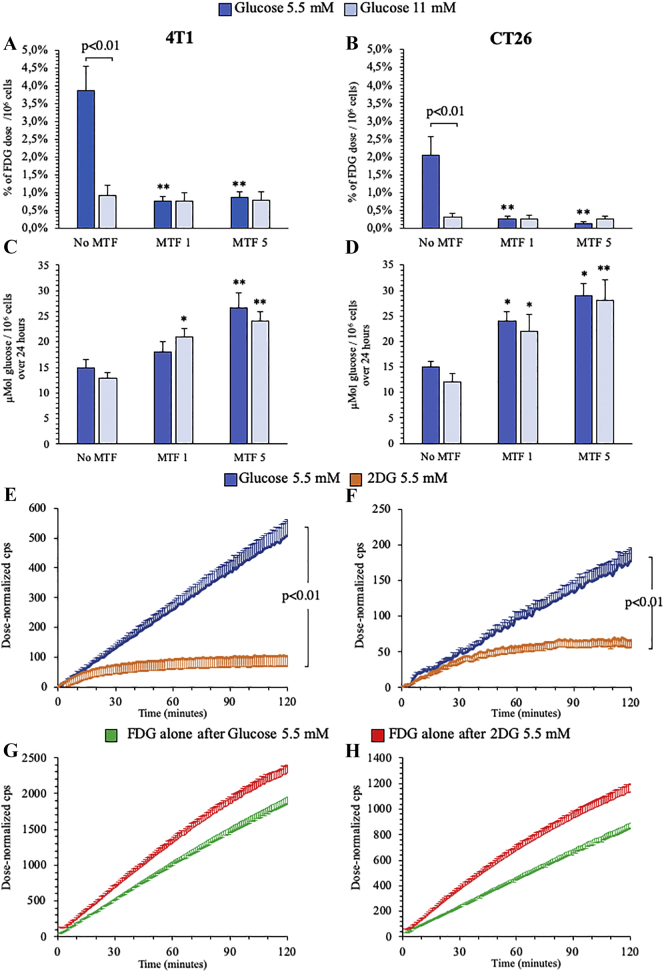
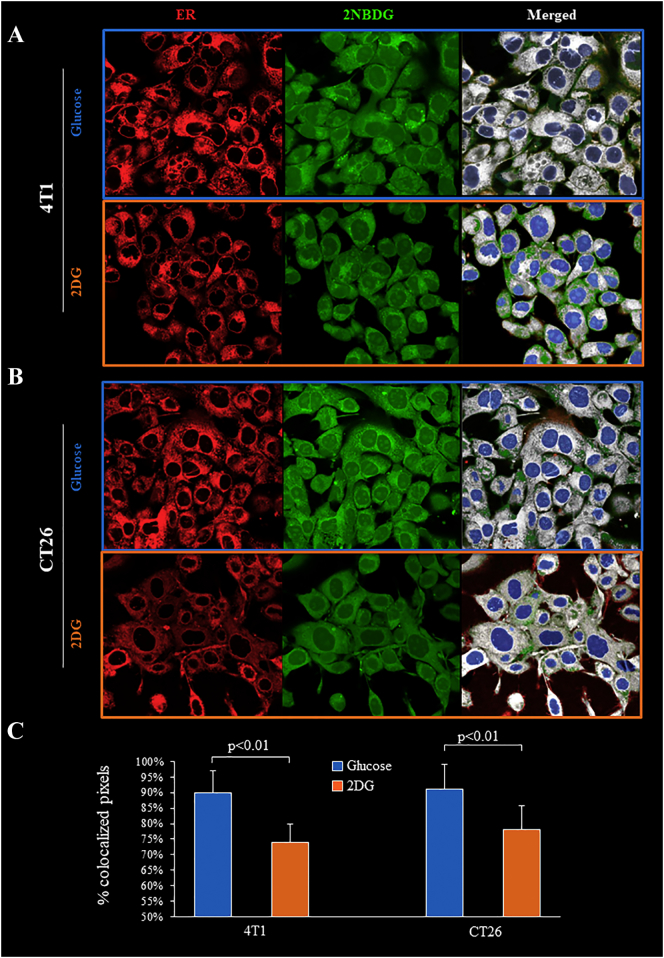
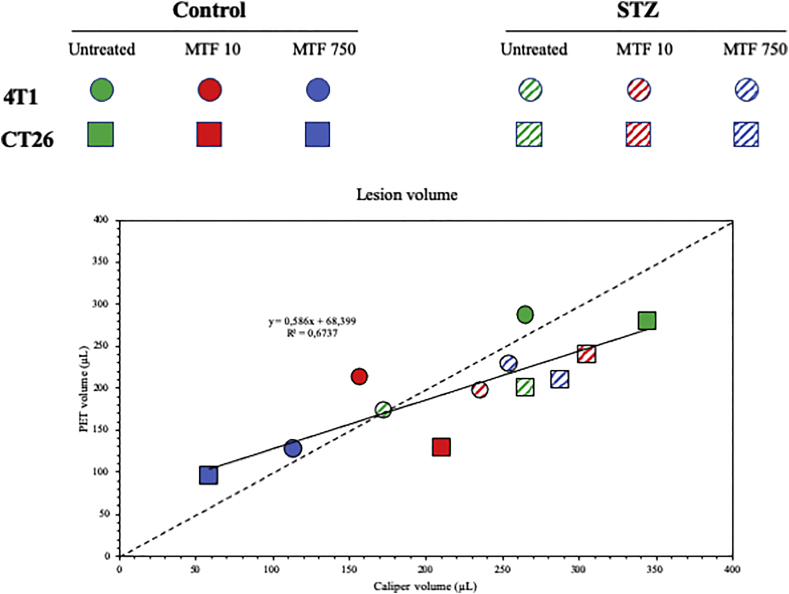
This study aims to verify in experimental models of hyperglycemia induced by streptozotocin (STZ-DM) to what degree the high competition between unlabeled glucose and metformin (MET) treatment might affect the accuracy of cancer FDG imaging. The study included 36 "control" and 36 "STZ-DM" Balb/c mice, undergoing intraperitoneal injection of saline or streptozotocin, respectively. Two-weeks later, mice were subcutaneously implanted with breast (4 T1) or colon (CT26) cancer cells and subdivided in three subgroups for treatment with water or with MET at 10 or 750 mg/Kg/day. Two weeks after, mice were submitted to micro-PET imaging. Enzymatic pathways and response to oxidative stress were evaluated in harvested tumors. Finally, competition by glucose, 2-deoxyglucose (2DG) and the fluorescent analog 2-[N-(7-nitrobenz-2-oxa-1,3-diazol-4-yl)amino]-2-deoxyglucose (2-NBDG) on FDG uptake was studied in 4 T1 and CT26 cultured cells. STZ-DM slightly decreased cancer volume and FDG uptake rate (MRF). More importantly, it also abolished MET capability to decelerate lesion growth and MRF. This metabolic reprogramming closely agreed with the activity of hexose-6-phosphate dehydrogenase within the endoplasmic reticulum. Finally, co-incubation with 2DG virtually abolished FDG and 2-NBDG uptake within the endoplasmic reticulum in cultured cells. These data challenge the current dogma linking FDG uptake to glycolytic flux and introduce a new model to explain the relation between glucose analogue uptake and hexoses reticular metabolism. This selective fate of FDG contributes to the preserved sensitivity of PET imaging in oncology even in chronic moderate hyperglycemic conditions.
本研究旨在通过链脲佐菌素诱导的高血糖实验模型(STZ-DM)验证未标记葡萄糖与二甲双胍(MET)治疗之间的高竞争程度可能在何种程度上影响癌症FDG成像的准确性。该研究纳入了36只“对照”和36只“STZ-DM”Balb/c小鼠,分别接受腹腔注射生理盐水或链脲佐菌素。两周后,小鼠皮下植入乳腺癌(4T1)或结肠癌细胞(CT26),并分为三个亚组,分别用水或10或750mg/Kg/天的MET进行治疗。两周后,对小鼠进行微型PET成像。对收获的肿瘤评估酶促途径和对氧化应激的反应。最后,在4T1和CT26培养细胞中研究葡萄糖、2-脱氧葡萄糖(2DG)和荧光类似物2-[N-(7-硝基苯并-2-恶唑-1,3-二氮杂环丁烷-4-基)氨基]-2-脱氧葡萄糖(2-NBDG)对FDG摄取的竞争。STZ-DM略微降低了癌体积和FDG摄取率(MRF)。更重要的是,它还消除了MET减缓病变生长和MRF的能力。这种代谢重编程与内质网中己糖-6-磷酸脱氢酶的活性密切相关。最后,在培养细胞中与2DG共同孵育实际上消除了内质网中FDG和2-NBDG的摄取。这些数据挑战了目前将FDG摄取与糖酵解通量联系起来的教条,并引入了一个新模型来解释葡萄糖类似物摄取与己糖网状代谢之间的关系。FDG的这种选择性命运有助于PET成像在肿瘤学中即使在慢性中度高血糖条件下仍保持敏感性。