WHO Collaborating Centre on eHealth, School of Public Health & Community Medicine, UNSW Sydney, Botany Road, Kensington, NSW 2033, Australia.
Clnical Informatics and Health Outcomes Research Group, Nuffield Department of Primary Care Health Sciences, University of Oxford, Eagle House, 7 Walton Well Road, Oxford, OX2 6ED, UK.
Yearb Med Inform. 2020 Aug;29(1):51-57. doi: 10.1055/s-0040-1701980. Epub 2020 Apr 17.
To create practical recommendations for the curation of routinely collected health data and artificial intelligence (AI) in primary care with a focus on ensuring their ethical use.
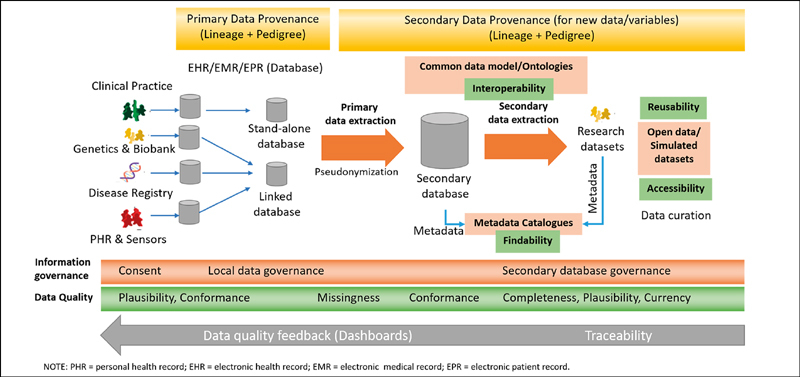
We defined data curation as the process of management of data throughout its lifecycle to ensure it can be used into the future. We used a literature review and Delphi exercises to capture insights from the Primary Care Informatics Working Group (PCIWG) of the International Medical Informatics Association (IMIA).
We created six recommendations: (1) Ensure consent and formal process to govern access and sharing throughout the data life cycle; (2) Sustainable data creation/collection requires trust and permission; (3) Pay attention to Extract-Transform-Load (ETL) processes as they may have unrecognised risks; (4) Integrate data governance and data quality management to support clinical practice in integrated care systems; (5) Recognise the need for new processes to address the ethical issues arising from AI in primary care; (6) Apply an ethical framework mapped to the data life cycle, including an assessment of data quality to achieve effective data curation.
The ethical use of data needs to be integrated within the curation process, hence running throughout the data lifecycle. Current information systems may not fully detect the risks associated with ETL and AI; they need careful scrutiny. With distributed integrated care systems where data are often used remote from documentation, harmonised data quality assessment, management, and governance is important. These recommendations should help maintain trust and connectedness in contemporary information systems and planned developments.
制定切实可行的建议,以规范初级保健中常规收集的健康数据和人工智能(AI)的管理,重点是确保其合理使用。
我们将数据管理定义为数据在其整个生命周期中的管理过程,以确保其在未来可以使用。我们使用文献综述和 Delphi 练习来捕捉国际医学信息学协会(IMIA)初级保健信息学工作组(PCIWG)的见解。
我们提出了六条建议:(1)确保在整个数据生命周期中获得同意并建立正式程序,以管理访问和共享;(2)可持续的数据创建/收集需要信任和许可;(3)注意提取、转换、加载(ETL)过程,因为它们可能存在未知风险;(4)将数据治理和数据质量管理集成起来,以支持综合护理系统中的临床实践;(5)认识到需要新的流程来解决初级保健中 AI 引发的伦理问题;(6)应用映射到数据生命周期的数据伦理框架,包括对数据质量进行评估,以实现有效的数据管理。
数据的合理使用需要纳入管理流程,因此贯穿整个数据生命周期。当前的信息系统可能无法完全检测到与 ETL 和 AI 相关的风险;需要仔细审查。在分布式综合护理系统中,数据通常在远离文档的地方使用,因此需要对数据质量进行协调一致的评估、管理和治理。这些建议应有助于维护当代信息系统和计划开发中的信任和连接性。