Peripheral Nerve Injury Research Unit, Royal National Orthopaedic Hospital, Stanmore, UK.
Department of Pharmacology, UCL School of Pharmacy, University College London, London, WC1N 1AX, UK.
Acta Neuropathol Commun. 2020 Apr 17;8(1):51. doi: 10.1186/s40478-020-00921-w.
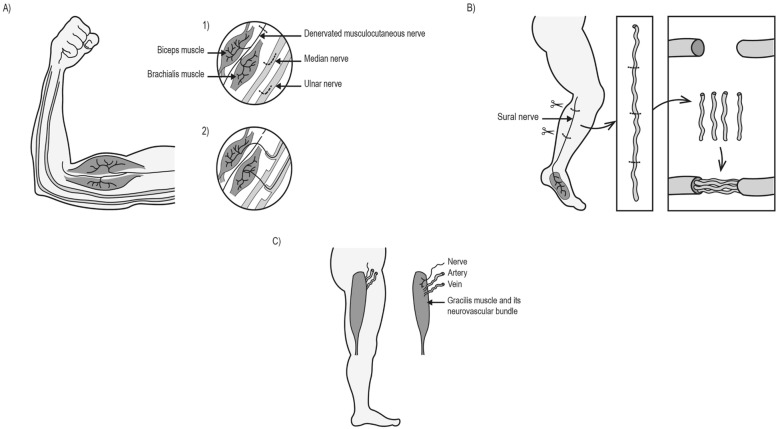
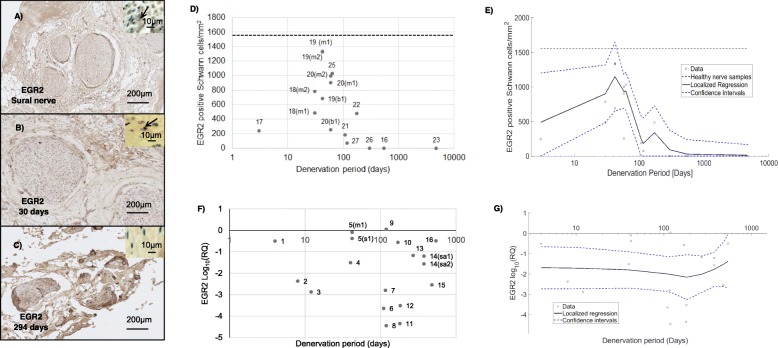
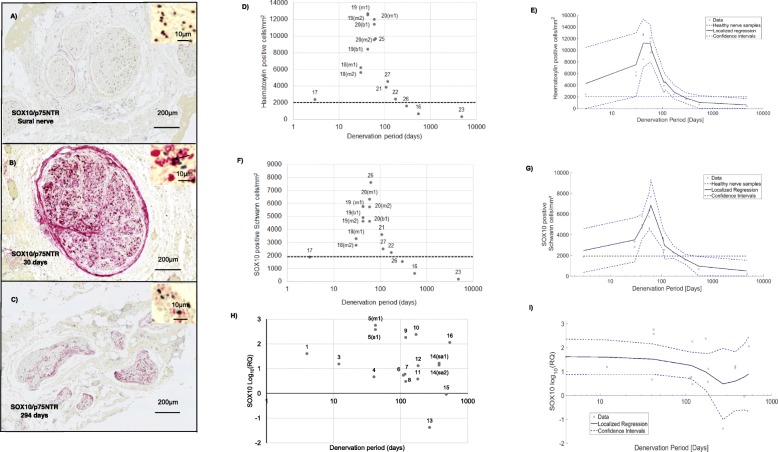
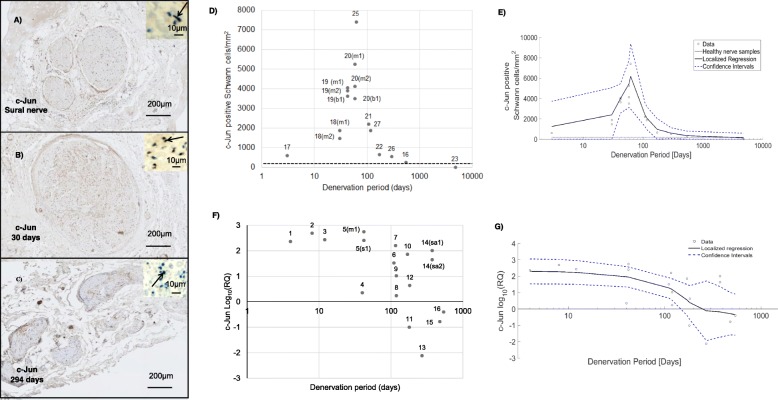
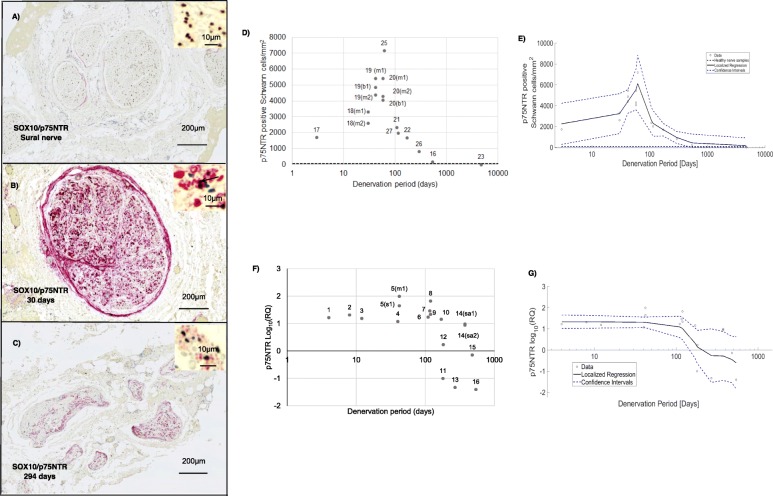
Nerve regeneration is a key biological process in those recovering from neural trauma. From animal models it is known that the regenerative capacity of the peripheral nervous system (PNS) relies heavily on the remarkable ability of Schwann cells to undergo a phenotypic shift from a myelinating phenotype to one that is supportive of neural regeneration. In rodents, a great deal is known about the molecules that control this process, such as the transcription factors c-Jun and early growth response protein 2 (EGR2/KROX20), or mark the cells and cellular changes involved, including SOX10 and P75 neurotrophin receptor (p75NTR). However, ethical and practical challenges associated with studying human nerve injury have meant that little is known about human nerve regeneration.The present study addresses this issue, analysing 34 denervated and five healthy nerve samples from 27 patients retrieved during reconstructive nerve procedures. Using immunohistochemistry and Real-Time quantitative Polymerase Chain Reaction (RT-qPCR), the expression of SOX10, c-Jun, p75NTR and EGR2 was assessed in denervated samples and compared to healthy nerve. Nonparametric smoothing linear regression was implemented to better visualise trends in the expression of these markers across denervated samples.It was found, first, that two major genes associated with repair Schwann cells in rodents, c-Jun and p75NTR, are also up-regulated in acutely injured human nerves, while the myelin associated transcription factor EGR2 is down-regulated, observations that encourage the view that rodent models are relevant for learning about human nerve injury. Second, as in rodents, the expression of c-Jun and p75NTR declines during long-term denervation. In rodents, diminishing c-Jun and p75NTR levels mark the general deterioration of repair cells during chronic denervation, a process thought to be a major obstacle to effective nerve repair. The down-regulation of c-Jun and p75NTR reported here provides the first molecular evidence that also in humans, repair cells deteriorate during chronic denervation.
神经再生是神经创伤后恢复的关键生物学过程。从动物模型可知,周围神经系统(PNS)的再生能力在很大程度上依赖于施万细胞经历表型转变的显著能力,从髓鞘形成表型转变为支持神经再生的表型。在啮齿动物中,人们对控制这一过程的分子有了很多了解,例如转录因子 c-Jun 和早期生长反应蛋白 2(EGR2/KROX20),或者标记涉及的细胞和细胞变化,包括 SOX10 和 P75 神经营养因子受体(p75NTR)。然而,与研究人类神经损伤相关的伦理和实际挑战意味着,人们对人类神经再生知之甚少。本研究解决了这个问题,分析了 27 名患者在重建性神经手术中获取的 34 个去神经支配和 5 个健康神经样本。通过免疫组织化学和实时定量聚合酶链反应(RT-qPCR),在去神经支配样本中评估了 SOX10、c-Jun、p75NTR 和 EGR2 的表达,并与健康神经进行了比较。实施了非参数平滑线性回归,以更好地观察这些标记物在去神经支配样本中的表达趋势。结果发现,首先,与修复 Schwann 细胞相关的两种主要基因在啮齿动物中,c-Jun 和 p75NTR,也在急性损伤的人类神经中上调,而与髓鞘相关的转录因子 EGR2 下调,这些观察结果鼓励人们认为啮齿动物模型与学习人类神经损伤有关。其次,与啮齿动物一样,c-Jun 和 p75NTR 的表达在长期去神经支配期间下降。在啮齿动物中,c-Jun 和 p75NTR 水平的降低标志着修复细胞在慢性去神经支配过程中的普遍恶化,这一过程被认为是有效神经修复的主要障碍。这里报道的 c-Jun 和 p75NTR 的下调提供了第一个分子证据,表明在人类中,修复细胞在慢性去神经支配过程中也会恶化。