Cong Meng, Wu Xia, Zhu Lingjie, Gu Guohao, Ding Fei, Li Guicai, Shi Haiyan
Key Laboratory of Neuroregenration of Jiangsu and Ministry of Education and Co-Innovation Center of Neuroregeneration, Nantong University, Nantong 226001, China.
Department of Pathophysiology, School of Medicine, Nantong University, Nantong 226001, China.
Regen Biomater. 2024 Jan 27;11:rbae005. doi: 10.1093/rb/rbae005. eCollection 2024.
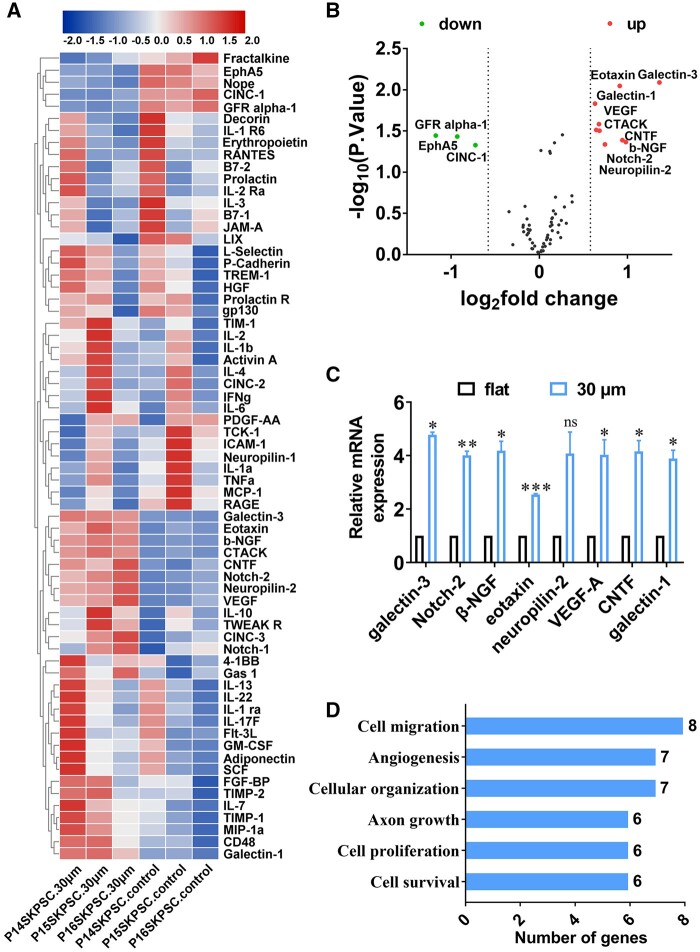
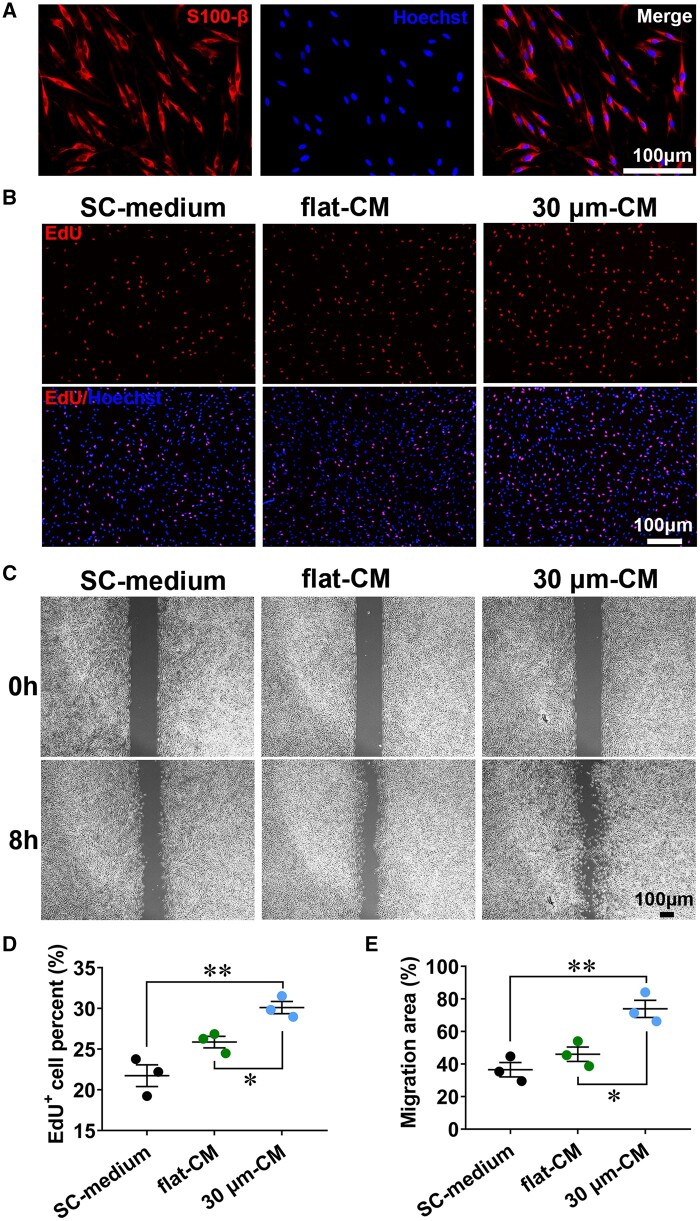
For repairing peripheral nerve and spinal cord defects, biomaterial scaffold-based cell-therapy was emerged as an effective strategy, requiring the positive response of seed cells to biomaterial substrate and environment signals. Previous work highlighted that the imposed surface properties of scaffold could provide important guidance cues to adhered cells for polarization. However, the insufficiency of native Schwann cells and unclear cellular response mechanisms remained to be addressed. Given that, this study aimed to illuminate the micropatterned chitosan-film action on the rat skin precursor-derived Schwann cells (SKP-SCs). Chitosan-film with different ridge/groove size was fabricated and applied for the SKP-SCs induction. Results indicated that SKP-SCs cultured on 30 μm size microgroove surface showed better oriented alignment phenotype. Induced SKP-SCs presented similar genic phenotype as repair Schwann cells, increasing expression of c-Jun, neural cell adhesion molecule, and neurotrophic receptor p75. Moreover, SKP-SC-secretome was subjected to cytokine array GS67 assay, data indicated the regulation of paracrine phenotype, a panel of cytokines was verified up-regulated at secreted level and gene expression level in induced SKP-SCs. These up-regulated cytokines exhibit a series of promotive neural regeneration functions, including cell survival, cell migration, cell proliferation, angiogenesis, axon growth, and cellular organization etc. through bioinformatics analysis. Furthermore, the effectively polarized SKP-SCs-sourced secretome, promoted the proliferation and migration capacity of the primarily cultured native rat Schwann cells, and augmented neurites growth of the cultured motoneurons, as well as boosted axonal regrowth of the axotomy-injured motoneurons. Taken together, SKP-SCs obtained pro-neuroregeneration phenotype in adaptive response to the anisotropic topography surface of chitosan-film, displayed the oriented parallel growth, the transition towards repair Schwann cell genic phenotype, and the enhanced paracrine effect on neural regeneration. This study provided novel insights into the potency of anisotropic microtopography surface to Schwann-like cells phenotype regulation, that facilitating to provide promising engineered cell-scaffold in neural injury therapies.
对于修复周围神经和脊髓缺损,基于生物材料支架的细胞疗法已成为一种有效的策略,这需要种子细胞对生物材料基质和环境信号产生积极反应。先前的研究强调,支架的表面特性可以为黏附细胞的极化提供重要的引导线索。然而,天然雪旺细胞的不足以及细胞反应机制尚不清楚的问题仍有待解决。鉴于此,本研究旨在阐明微图案化壳聚糖膜对大鼠皮肤前体细胞来源的雪旺细胞(SKP-SCs)的作用。制备了具有不同脊/槽尺寸的壳聚糖膜,并将其应用于SKP-SCs的诱导。结果表明,在30μm尺寸微槽表面培养的SKP-SCs表现出更好的定向排列表型。诱导后的SKP-SCs呈现出与修复性雪旺细胞相似的基因表型,c-Jun、神经细胞黏附分子和神经营养受体p75的表达增加。此外,对SKP-SC分泌组进行细胞因子阵列GS67分析,数据表明旁分泌表型受到调控,一组细胞因子在诱导后的SKP-SCs的分泌水平和基因表达水平上被证实上调。通过生物信息学分析,这些上调的细胞因子表现出一系列促进神经再生的功能,包括细胞存活、细胞迁移、细胞增殖、血管生成、轴突生长和细胞组织等。此外,有效极化的SKP-SCs来源的分泌组促进了原代培养的天然大鼠雪旺细胞的增殖和迁移能力,增强了培养的运动神经元的神经突生长,以及促进了轴突切断损伤的运动神经元的轴突再生。综上所述,SKP-SCs在对壳聚糖膜各向异性形貌表面的适应性反应中获得了促神经再生表型,表现出定向平行生长、向修复性雪旺细胞基因表型的转变以及对神经再生增强的旁分泌作用。本研究为各向异性微形貌表面对雪旺样细胞表型调控的潜力提供了新的见解,有助于在神经损伤治疗中提供有前景的工程化细胞支架。