Scheinost Dustin, Spann Marisa N, McDonough Laraine, Peterson Bradley S, Monk Catherine
Yale School of Medicine, 300 Cedar Street, New Haven, CT, 06520-8043, USA.
Columbia University Irving Medical Center, 622 West 168th Street, New York, NY, 10032, USA.
Neuropsychopharmacology. 2020 Jul;45(8):1272-1279. doi: 10.1038/s41386-020-0677-0. Epub 2020 Apr 18.
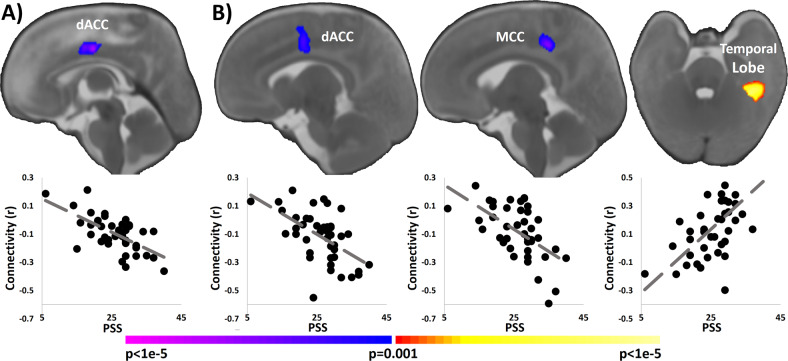
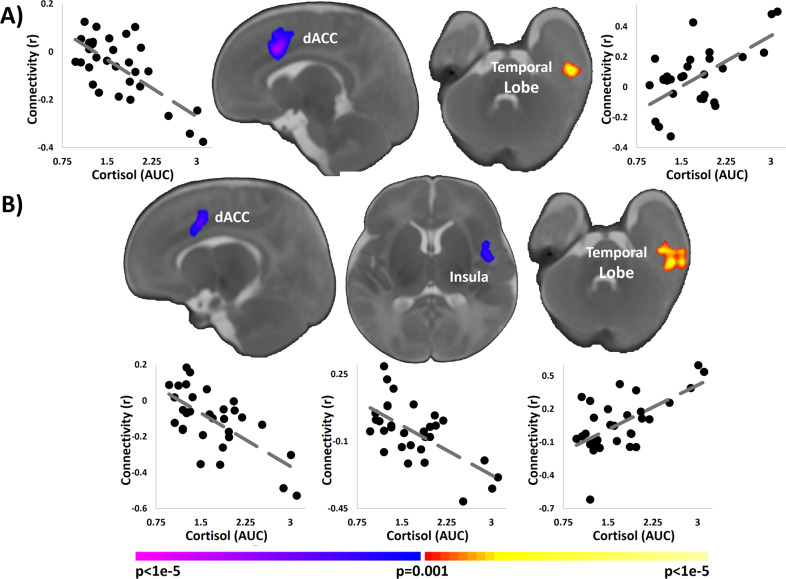
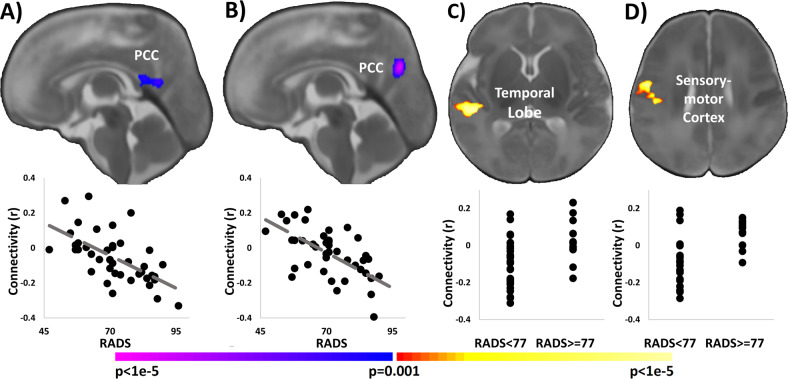
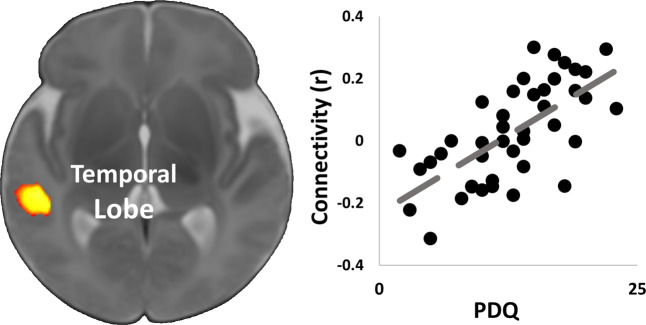
Prenatal maternal distress-an umbrella concept encompassing multiple negative psychological states including stress, anxiety, and depression-is a substantial prenatal exposure. Consistent across preclinical and human studies, the hippocampus displays alterations due to prenatal distress. Nevertheless, most prenatal distress studies do not focus on multiple dimensions of, have not examined hippocampal functional connectivity in association with, and do not consider observer-based functional outcomes related to distress. We investigated the effects of different dimensions of prenatal distress in pregnant adolescents, a population at high risk for distress, in association with neonatal hippocampal connectivity and infant memory. In pregnant adolescents (n = 42), we collected four measures of distress (perceived stress, depression, pregnancy-specific distress, and 24-h ambulatory salivary cortisol) during the 2nd and 3rd trimesters. Resting-state imaging data were acquired in their infants at 40-44 weeks post-menstrual age. Functional connectivity was measured from hippocampal seeds. Memory abilities were obtained at 4 months using the mobile conjugate reinforcement task. Shared across different dimensions of maternal distress, increased 3rd trimester maternal distress associated with weaker hippocampal-cingulate cortex connectivity and stronger hippocampal-temporal lobe connectivity. Perceived stress inversely correlated while hippocampal-cingulate cortex connectivity positively correlated with infant memory. Increased cortisol-collected during the 2nd, but not the 3rd, trimester-associated with weaker hippocampal-cingulate cortex connectivity and stronger hippocampal-temporal lobe connectivity. Different dimensions of prenatal maternal distress likely contribute shared and unique effects to shaping infant brain and behavior.
产前母亲情绪困扰是一个涵盖压力、焦虑和抑郁等多种负面心理状态的总体概念,是一种重要的产前暴露因素。临床前研究和人体研究均一致表明,产前情绪困扰会导致海马体发生改变。然而,大多数产前情绪困扰研究并未关注其多个维度,未研究海马体功能连接与情绪困扰的关联,也未考虑基于观察者的与情绪困扰相关的功能结果。我们调查了处于情绪困扰高风险的怀孕青少年中产前情绪困扰不同维度与新生儿海马体连接性及婴儿记忆之间的关系。在42名怀孕青少年中,我们在孕中期和孕晚期收集了四项情绪困扰指标(感知压力、抑郁、特定孕期困扰和24小时动态唾液皮质醇)。在其婴儿出生后40 - 44周龄时采集静息态成像数据。从海马体种子点测量功能连接性。在婴儿4个月大时使用移动共轭强化任务评估记忆能力。孕晚期母亲情绪困扰增加与海马体 - 扣带回皮质连接性减弱及海马体 - 颞叶连接性增强有关,这在母亲情绪困扰的不同维度中具有共性。感知压力与海马体 - 扣带回皮质连接性呈负相关,而海马体 - 扣带回皮质连接性与婴儿记忆呈正相关。孕中期而非孕晚期收集的皮质醇增加与海马体 - 扣带回皮质连接性减弱及海马体 - 颞叶连接性增强有关。产前母亲情绪困扰的不同维度可能对塑造婴儿大脑和行为产生共同和独特的影响。