Centre for the Developing Brain, Department of Perinatal Imaging and Health, School of Biomedical Engineering and Imaging Sciences, King's College London, London, SE1 7EH, UK.
Department for Forensic and Neurodevelopmental Sciences, Institute of Psychiatry, Psychology and Neuroscience, King's College London, London, SE5 8AF, UK.
Cereb Cortex. 2020 Jul 30;30(9):4800-4810. doi: 10.1093/cercor/bhaa069.
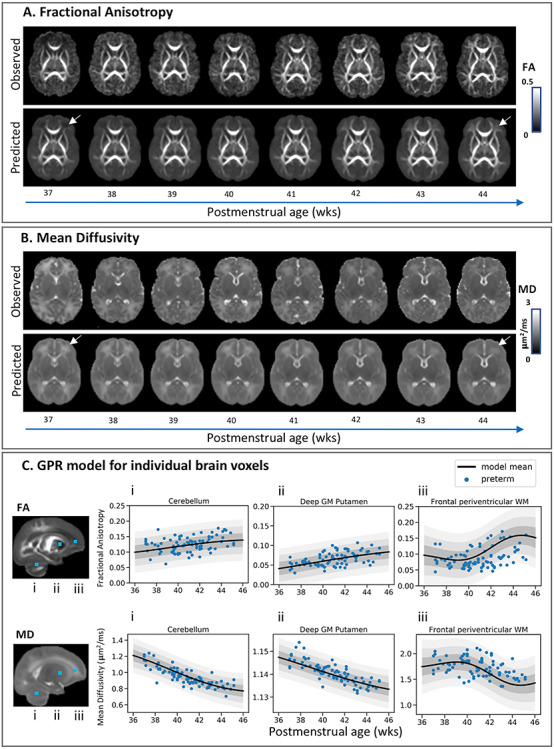
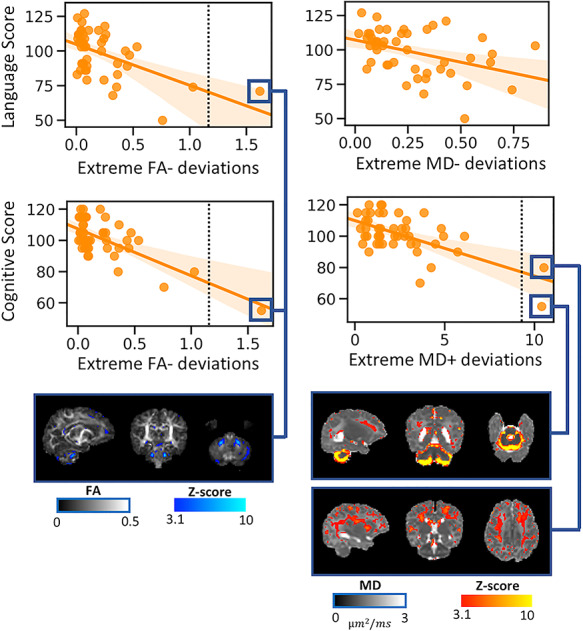
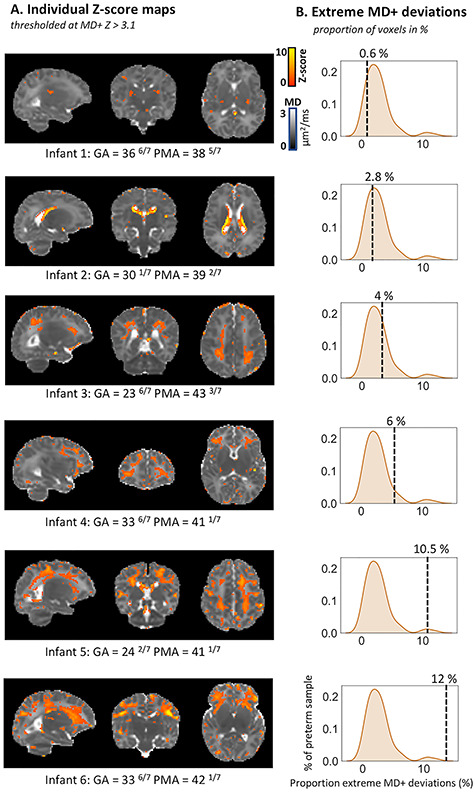
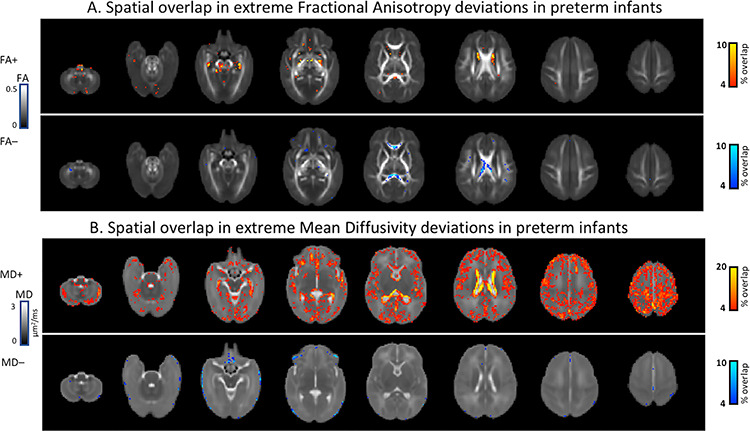
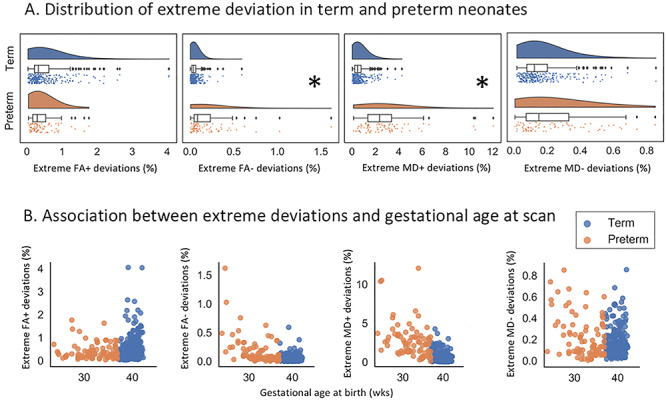
Preterm-born children are at increased risk of lifelong neurodevelopmental difficulties. Group-wise analyses of magnetic resonance imaging show many differences between preterm- and term-born infants but do not reliably predict neurocognitive prognosis for individual infants. This might be due to the unrecognized heterogeneity of cerebral injury within the preterm group. This study aimed to determine whether atypical brain microstructural development following preterm birth is significantly variable between infants. Using Gaussian process regression, a technique that allows a single-individual inference, we characterized typical variation of brain microstructure using maps of fractional anisotropy and mean diffusivity in a sample of 270 term-born neonates. Then, we compared 82 preterm infants to these normative values to identify brain regions with atypical microstructure and relate observed deviations to degree of prematurity and neurocognition at 18 months. Preterm infants showed strikingly heterogeneous deviations from typical development, with little spatial overlap between infants. Greater and more extensive deviations, captured by a whole brain atypicality index, were associated with more extreme prematurity and predicted poorer cognitive and language abilities at 18 months. Brain microstructural development after preterm birth is highly variable between individual infants. This poorly understood heterogeneity likely relates to both the etiology and prognosis of brain injury.
早产儿患终身神经发育障碍的风险增加。磁共振成像的组间分析显示,早产儿和足月儿之间存在许多差异,但不能可靠地预测个体婴儿的神经认知预后。这可能是由于未识别的早产儿脑损伤异质性。本研究旨在确定早产儿出生后非典型脑微观结构发育在婴儿之间是否存在显著差异。使用高斯过程回归,这是一种允许个体推断的技术,我们使用 270 名足月新生儿的各向异性分数和平均弥散率图来描述脑微观结构的典型变化。然后,我们将 82 名早产儿与这些正常值进行比较,以确定具有非典型微观结构的脑区,并将观察到的偏差与 18 个月时的早产程度和神经认知相关联。早产儿表现出与典型发育明显不同的显著异质性,婴儿之间的空间重叠很少。通过全脑非典型指数捕获的更大和更广泛的偏差与更极端的早产相关,并预测 18 个月时认知和语言能力较差。早产儿出生后脑微观结构发育在个体婴儿之间差异很大。这种尚未被充分了解的异质性可能与脑损伤的病因和预后有关。