Singh Monika, Bains Vivek Kumar, Jhingran Rajesh, Srivastava Ruchi, Madan Rohit, Maurya Shubhash Chandra, Rizvi Iram
Department of Periodontology, Saraswati Dental College and Hospital, Lucknow, Uttar Pradesh, India.
Department of Medicine, Dr. Ram Manohar Lohia Combined Hospital, Lucknow, Uttar Pradesh, India.
Contemp Clin Dent. 2019 Apr-Jun;10(2):349-357. doi: 10.4103/ccd.ccd_652_18.
The aim of this study was to determine the prevalence of periodontal disease in type 2 diabetes mellitus (T2DM) patients of North India.
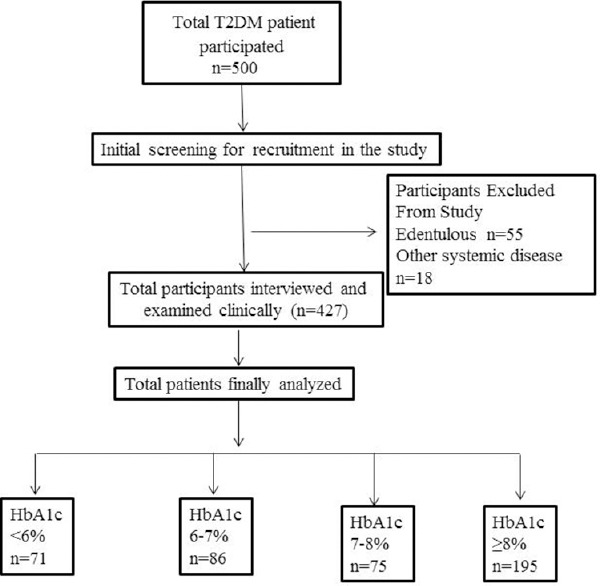
A total of 500 patients fulfilling the selection criteria were initially given a health questionnaire to gather information regarding their demographic characteristics, attitude for oral hygiene, and disease status. Based on eligibility 427 patients were finally recruited for statistical analysis. A partial-mouth periodontal examination (PMPE) protocol which assessed one maxillary quadrant and one mandibular quadrant was used to examine three fixed sites per tooth (mesiobuccal, midbuccal, and distobuccal). Gingival Index, Oral Hygiene Index-Simplified, Debris Index-Simplified, Calculus Index-Simplified (CI-S), probing pocket depth, and clinical attachment level were examined.
More than 90% (95.1%) of the total diabetic participants had some degree of periodontal destruction. Of the total population, 27.1% of participants had good oral hygiene, 68.8% had fair oral hygiene, and 3.9% had poor oral hygiene status. The prevalence of severe periodontitis in participants with good, fair, and poor oral hygiene status was reported as 0.8%, 17%, and 29.4%, respectively. The prevalence of severe periodontitis in participants with good, fair, and poor oral hygiene status with poor glycemic control (glycated hemoglobin ≥8%) was 2.5%, 28.1%, and 30.7%, respectively.
This single-centered cross-sectional study represents that more than 95% of type 2 diabetic patients have some periodontal destruction. These results may act as baseline data to promote the collaborative integrated management of diabetes for reducing its burden on society.
本研究旨在确定印度北部2型糖尿病(T2DM)患者中牙周疾病的患病率。
共有500名符合入选标准的患者最初接受了一份健康问卷,以收集有关其人口统计学特征、口腔卫生态度和疾病状况的信息。根据入选标准,最终招募了427名患者进行统计分析。采用部分口腔牙周检查(PMPE)方案,评估一个上颌象限和一个下颌象限,每颗牙检查三个固定部位(近中颊侧、颊侧中点和远中颊侧)。检查牙龈指数、简化口腔卫生指数、简化牙石指数、简化牙菌斑指数(CI-S)、探诊深度和临床附着水平。
超过90%(95.1%)的糖尿病参与者有一定程度的牙周破坏。在总人群中,27.1%的参与者口腔卫生良好,68.8%的参与者口腔卫生一般,3.9%的参与者口腔卫生状况较差。口腔卫生良好、一般和较差的参与者中,重度牙周炎的患病率分别为0.8%、17%和29.4%。血糖控制不佳(糖化血红蛋白≥8%)的口腔卫生良好、一般和较差的参与者中,重度牙周炎的患病率分别为2.5%、28.1%和30.7%。
这项单中心横断面研究表明,超过95%的2型糖尿病患者有一定的牙周破坏。这些结果可作为基线数据,以促进糖尿病的协同综合管理,减轻其对社会的负担。