Sardar Begum Dental College, Gandhara University, Peshawar, Pakistan.
Dental Surgery Department, Qazi Hussain Ahmed Medical Complex (MTI), Nowshera, Pakistan.
BMC Oral Health. 2023 Jul 2;23(1):442. doi: 10.1186/s12903-023-03042-7.
Diabetes Mellitus and periodontitis are chronic diseases with known reciprocal association. Studies have shown that uncontrolled diabetes increases the risk of development and progression of periodontal disease. This study aimed to explore the association and severity of periodontal clinical parameters and oral hygiene with HbA1c levels in non-diabetics and T2DM patients.
In this cross-sectional study, the periodontal status of 144 participants, categorized into non-diabetics, controlled T2DM, and uncontrolled T2DM and were assessed via the Community Periodontal Index (CPI), Loss of Attachment Index (LOA index), and the number of missing teeth, while oral hygiene was measured by utilizing the Oral Hygiene Index Simplified (OHI-S). SPSS was used for data analysis. Chi-square test was used to find out the association of different independent variables with HbA1c groups, while ANOVA and post-hoc tests were run for inter-group and intra-group comparison respectively.
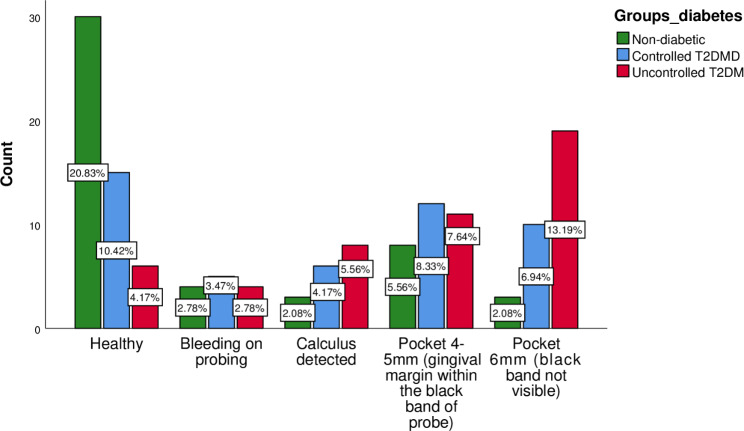
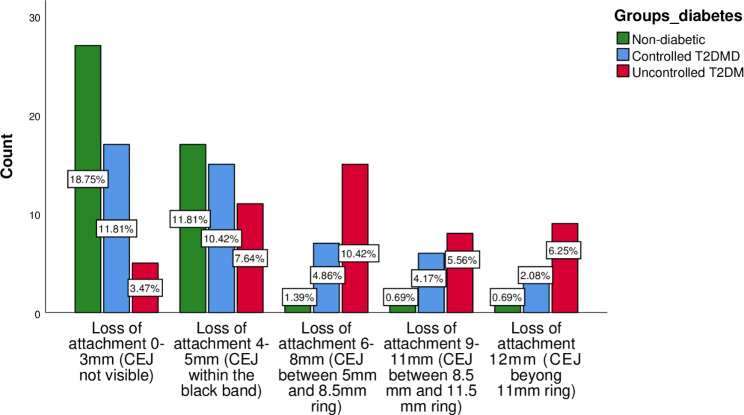
Out of 144 participants, the missing dentition was prevalent in uncontrolled T2DM with mean 2.64 ± 1.97 (95% CI 2.07-3.21; p = 0.01) followed by controlled T2DM 1.70 ± 1.79 (95% CI 1.18-2.23; p = 0.01) and non-diabetics 1.35 ± 1.63 (95% CI 0.88-1.82; p = 0.01) respectively. Furthermore, non-diabetics had a higher proportion of CPI score 0 (Healthy) [30 (20.8%); p = 0.001] as compared to uncontrolled T2DM [6 (4.2%); p = 0.001], while CPI score 3 was more prevalent in uncontrolled T2DM in comparison to non-diabetics. Loss of attachment (codes-2,3 and 4) was also frequently observed in uncontrolled T2DM compared to non-diabetics (p = 0.001). Similarly, based on Oral Hygiene Index- Simplified (OHI-S), the result showed that poor oral hygiene was most commonly observed in uncontrolled T2DM 29 (20.1%) followed by controlled T2DM patients 22 (15.3%) and non-diabetic [14 (9.7%); p = 0.03].
This study showed that periodontal status and oral hygiene status were deteriorated in uncontrolled T2DM patients compared to non-diabetic participants and controlled T2DM.
糖尿病和牙周炎是两种慢性疾病,已知它们之间存在相互关联。研究表明,未得到控制的糖尿病会增加牙周病发展和恶化的风险。本研究旨在探讨非糖尿病和 2 型糖尿病(T2DM)患者的牙周临床参数和口腔卫生与糖化血红蛋白(HbA1c)水平之间的关联和严重程度。
在这项横断面研究中,通过使用社区牙周指数(CPI)、附着丧失指数(LOA 指数)和失牙数评估了 144 名参与者的牙周状况,这些参与者被分为非糖尿病患者、控制良好的 T2DM 患者和未控制的 T2DM 患者。同时,利用简化口腔卫生指数(OHI-S)测量了口腔卫生状况。使用 SPSS 进行数据分析。卡方检验用于发现不同独立变量与 HbA1c 组之间的关联,而方差分析和事后检验分别用于组间和组内比较。
在 144 名参与者中,未控制的 T2DM 患者缺失牙齿的情况最为普遍,平均为 2.64±1.97(95%置信区间 2.07-3.21;p=0.01),其次是控制良好的 T2DM 患者 1.70±1.79(95%置信区间 1.18-2.23;p=0.01)和非糖尿病患者 1.35±1.63(95%置信区间 0.88-1.82;p=0.01)。此外,非糖尿病患者的 CPI 评分 0(健康)比例更高[30(20.8%);p=0.001],而非控制的 T2DM 患者[6(4.2%);p=0.001],而 CPI 评分 3 在未控制的 T2DM 患者中更为常见。与非糖尿病患者相比,未控制的 T2DM 患者的附着丧失(代码 2、3 和 4)也更为常见(p=0.001)。同样,根据简化口腔卫生指数(OHI-S),结果显示,未控制的 T2DM 患者的口腔卫生状况较差,占 29(20.1%),其次是控制良好的 T2DM 患者 22(15.3%)和非糖尿病患者 14(9.7%);p=0.03)。
本研究表明,与非糖尿病参与者和控制良好的 T2DM 患者相比,未控制的 T2DM 患者的牙周状况和口腔卫生状况恶化。