Owolabi Joshua Oladele, Fabiyi Oluseyi Sunday, Adelakin Lola Adeola, Ekwerike Miriammillicent Chinenyenwa
Department of Anatomy, Ben Carson School of Medicine, Babcock University, Ilishan-Remo, Nigeria.
Department of Anatomy, University of Global Health Equity, Butaro, Rwanda.
Clin Cosmet Investig Dermatol. 2020 Apr 6;13:283-289. doi: 10.2147/CCID.S233185. eCollection 2020.
Skin bleaching is the act of using steroid- and chemical-containing products to lighten the skin. Hydroquinone and kojic acid are often used in skin bleaching creams. Hydroquinone was suspected to be harmful. This study investigated the effects of kojic acid and hydroquinone on the skin of adult female Wistar rats and the potential use of aloe vera for amelioration.
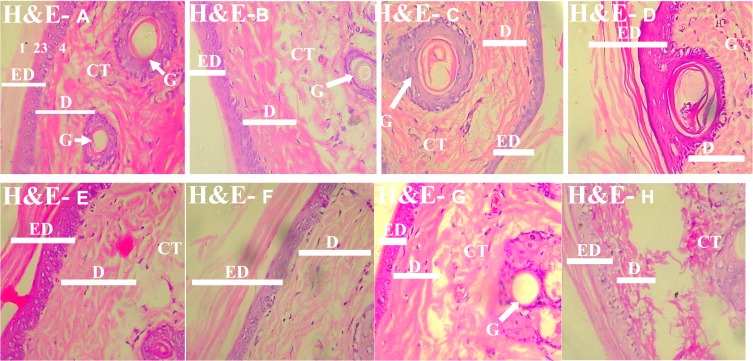
Eighty [n=80] adult female Wistar rats with an average weight of 120 g were randomly divided into eight groups, marked A, B, C, D, E, F, G, and H. Group A animals served as the control group; group B was treated with 2% hydroquinone, group C was treated with 2% kojic acid, group D was treated with 4% hydroquinone, group E was treated with 4% kojic acid, group F was treated with 2% hydroquinone and 2% kojic acid, group G was treated with 4% hydroquinone and 4% kojic acid, and group H was treated with 4% hydroquinone, 4% kojic acid, and aloe vera. The preparations were applied to the tail skin and treatment lasted 28 days. Skin samples were excised and processed using H&E, Masson's trichrome, and p65 immunohistochemical assays on tissue sections.
Hydroquinone caused structural disruptions of the stratum corneum of the epidermis and the overlying keratin. p65 was also prominently expressed in the treated groups. Hydroquinone reduced skin thickness and caused epidermis disruption.
The prominent expression of p65 in the sections indicated deleterious effects of hydroquinone. Kojic acid was not found to have deleterious effects. Aloe vera prevented extensive disruption of stratum corneum by hydroquinone. The use of hydroquinone in skin lightening creams might raise health concerns. Aloe vera could be protective against hydroquinone.
皮肤美白是指使用含类固醇和化学物质的产品来提亮肤色。对苯二酚和曲酸常用于美白面霜中。对苯二酚被怀疑有害。本研究调查了曲酸和对苯二酚对成年雌性Wistar大鼠皮肤的影响,以及芦荟在改善方面的潜在用途。
80只平均体重为120克的成年雌性Wistar大鼠被随机分为八组,标记为A、B、C、D、E、F、G和H。A组动物作为对照组;B组用2%的对苯二酚处理,C组用2%的曲酸处理,D组用4%的对苯二酚处理,E组用4%的曲酸处理,F组用2%的对苯二酚和2%的曲酸处理,G组用4%的对苯二酚和4%的曲酸处理,H组用4%的对苯二酚、4%的曲酸和芦荟处理。将制剂涂抹于大鼠尾部皮肤,处理持续28天。切除皮肤样本,并对组织切片进行苏木精-伊红染色(H&E)、马松三色染色和p65免疫组织化学分析。
对苯二酚导致表皮角质层和上层角蛋白的结构破坏。p65在处理组中也有显著表达。对苯二酚降低了皮肤厚度并导致表皮破坏。
切片中p65的显著表达表明对苯二酚具有有害作用。未发现曲酸有有害作用。芦荟可防止对苯二酚对角质层的广泛破坏。在美白面霜中使用对苯二酚可能会引发健康问题。芦荟可能对对苯二酚具有保护作用。