Deo Kirti S, Dash Kedar N, Sharma Yugal K, Virmani Neha C, Oberai Chetan
Department of Dermatology, Padmashree Dr. D.Y. Patil Medical College and Hospital (Dr. D. Y Patil Vidyapeeth) Pimpri, Pune, India.
Indian J Dermatol. 2013 Jul;58(4):281-5. doi: 10.4103/0019-5154.113940.
Melasma is a relatively common, acquired symmetric hypermelanosis characterized by irregular light to gray-brown macules involving sun-exposed areas. Kojic acid, with its depigmenting potential due to tyrosinase inhibition and suppression of melanogenesis, has become a vital component of the dermatologists' armamentarium against melasma.
To study and compare the efficacy of kojic acid 1% alone, vis-a-vis its separate combinations with 2% hydroquinone or 0.1% betamethasone valerate and a combination of all these three agents with respect to the duration of symptoms and level of pigmentation in the therapy of melasma.
Eighty patients from a single tertiary care center objectively assessed by calculating the melasma area severity index (MASI) and randomized (simple randomization) into four parallel groups (A, B, C, and D) of 20 each were prescribed once daily local application at night, (participants blinded regarding the difference in identity of interventions), as follows: Group A - kojic acid 1% cream. Group B - kojic acid 1% and hydroquinone 2% cream. Group C - kojic acid 1% and betamethasone valerate 0.1% cream. Group D - kojic acid 1%, hydroquinone 2%, and betamethasone valerate 0.1% cream. Strict photoprotection and use of a SPF 15 sunscreen was advised during the day. Patients were evaluated every 2 weeks and a fall in MASI score was calculated at the end of the study period of 12 weeks by the same investigator.
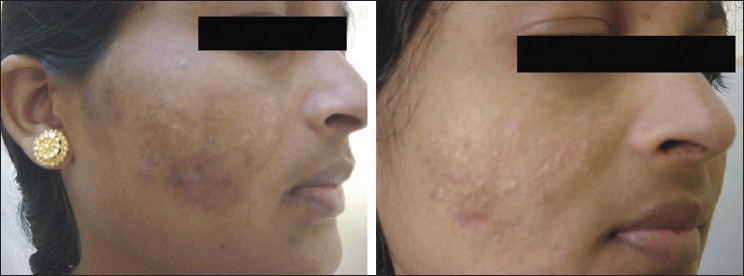
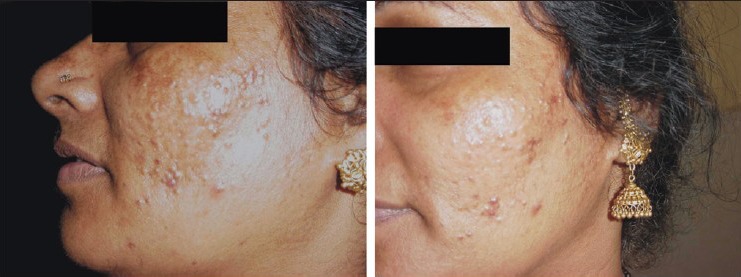
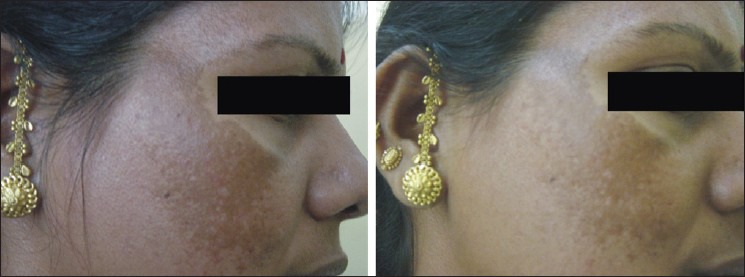
The response was compared according to percentage decrease in MASI score. Efficacy was evaluated among the groups at the end of 3 months using bivariate analysis and calculated by using the paired 't' test. The clinical efficacy of group B was the highest followed closely by group D and group A, that of group C being the lowest.
Kojic acid in synergy with hydroquinone is a superior depigmenting agent as compared with other combinations.
黄褐斑是一种相对常见的后天性对称性色素沉着过度,其特征为累及暴露于阳光下区域的不规则淡褐色至灰棕色斑疹。曲酸因其抑制酪氨酸酶和抑制黑色素生成的色素脱失潜力,已成为皮肤科医生治疗黄褐斑的重要药物组成部分。
研究并比较1%曲酸单独使用、与2%氢醌或0.1%戊酸倍他米松分别联合使用以及这三种药物联合使用对黄褐斑治疗中症状持续时间和色素沉着程度的疗效。
来自单一三级医疗中心的80名患者通过计算黄褐斑面积严重程度指数(MASI)进行客观评估,并随机(简单随机化)分为四组平行组(A、B、C和D),每组20人,每晚每日一次局部用药(参与者对干预措施的差异不知情),如下:A组 - 1%曲酸乳膏。B组 - 1%曲酸和2%氢醌乳膏。C组 - 1%曲酸和0.1%戊酸倍他米松乳膏。D组 - 1%曲酸、2%氢醌和0.1%戊酸倍他米松乳膏。建议白天严格防晒并使用防晒系数为15的防晒霜。每2周对患者进行评估,由同一名研究者在12周的研究期结束时计算MASI评分的下降情况。
根据MASI评分的下降百分比比较反应情况。在3个月结束时,使用双变量分析对各组间的疗效进行评估,并通过配对“t”检验进行计算。B组的临床疗效最高,紧随其后的是D组和A组,C组最低。
与其他组合相比,曲酸与氢醌协同作用是一种更优的色素脱失剂。