Araya Shambel, Tesfaye Betelhem, Fente Desalegn
Department of Medical Laboratory Sciences, College of Health Sciences, Addis Ababa University, Addis Ababa, Ethiopia.
Rank Higher Specialized Dermatology Clinic, Addis Ababa, Ethiopia.
Clin Cosmet Investig Dermatol. 2020 Apr 8;13:291-297. doi: 10.2147/CCID.S246183. eCollection 2020.
Dermatophytosis represents one of the common infectious diseases worldwide and it is a major public health problem around the globe. The disease causes considerable morbidity and still continues to increase especially in developing countries.
This study was undertaken to determine the prevalence of dermatophytes and the spectrum of fungal agents in patients attending Rank Higher Specialized Dermatology Clinic.
A cross-sectional study has been conducted, in which 318 samples from 318 suspected patients were collected. Samples include hair, nail, and skin. A portion of each sample was examined microscopically and the remaining portion of each sample was cultured onto plates of Sabouraud's dextrose agar containing chloramphenicol with and without cycloheximide. Isolates were identified by studying the macroscopic and microscopic characteristics of the colonies.
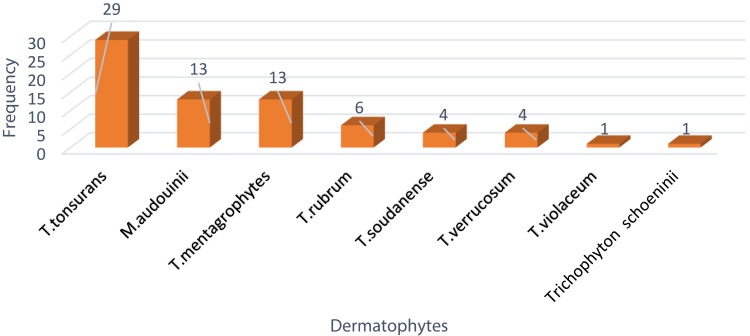
Tinea capitis was the predominant clinical manifestation accounting for 53.4% of the cases. Patients with age group 1-14 years were more affected. Of 318 samples, fungi were detected in 133 (54.4%) by direct wet mount while 148/315 (46.5%) of them were culture positive. From these 72/148 (46.8%) were dermatophytes. was the most common pathogen in tinea capitis, whereas was the most common pathogen in tinea corporis. Among dermatophyte isolates, 29/72 (40.2%) was the most common cause of infection. Among non-dermatophyte molds, spp. 21/63 (33.3%) was predominant isolate followed by 11/63 (17.4%) and spp. 9/63 (14.2%), respectively. Yeasts also account for 13 (8.7%) of the total suspects of dermatophytosis.
In this study, the prevalence of dermatophytes was higher in tinea capitis 46/72 (63.8%) and 29/72 (40%) was the dominant-isolated dermatophyte. Recovery of a large number of dermatophytes and non-dermatophyte fungi in our study showed that non-dermatophyte fungi are emerging as important causes of dermatophytosis warranting further intensive epidemiological studies that have public health significance are needed.
皮肤癣菌病是全球常见的传染病之一,也是全球主要的公共卫生问题。该疾病导致相当高的发病率,并且仍在持续上升,尤其是在发展中国家。
本研究旨在确定在兰克高级专科皮肤科诊所就诊患者中皮肤癣菌的患病率以及真菌病原体的种类。
开展了一项横断面研究,收集了318例疑似患者的318份样本。样本包括毛发、指甲和皮肤。每份样本的一部分进行显微镜检查,其余部分接种在含有氯霉素的沙氏葡萄糖琼脂平板上,分别添加和不添加放线菌酮进行培养。通过研究菌落的宏观和微观特征来鉴定分离株。
头癣是主要的临床表现,占病例的53.4%。1 - 14岁年龄组的患者受影响更大。在318份样本中,直接湿片检查发现133份(54.4%)有真菌,而315份样本中有148份(46.5%)培养阳性。其中72/148份(46.8%)为皮肤癣菌。是头癣最常见的病原体,而 是体癣最常见的病原体。在皮肤癣菌分离株中,29/72份(40.2%)是最常见的感染原因。在非皮肤癣菌霉菌中,spp. 21/63份(33.3%)是主要分离株,其次分别是11/63份(17.4%)和spp. 9/63份(14.2%)。酵母菌也占皮肤癣菌病总疑似病例的13份(8.7%)。
在本研究中,头癣中皮肤癣菌的患病率较高,46/72份(63.8%),29/72份(40%)是主要分离出的皮肤癣菌。在我们的研究中发现大量皮肤癣菌和非皮肤癣菌真菌,表明非皮肤癣菌真菌正在成为皮肤癣菌病的重要病因,需要开展具有公共卫生意义的进一步深入流行病学研究。