Department of Orthopaedics and Trauma Surgery, University of Duisburg - Essen, Hufelandstr 55, 45147, Essen, Germany.
Institute of Medical Psychology and Behavioral Immunobiology, University Hospital Essen, University of Duisburg-Essen, Essen, Germany.
BMC Musculoskelet Disord. 2020 Apr 20;21(1):257. doi: 10.1186/s12891-020-03266-6.
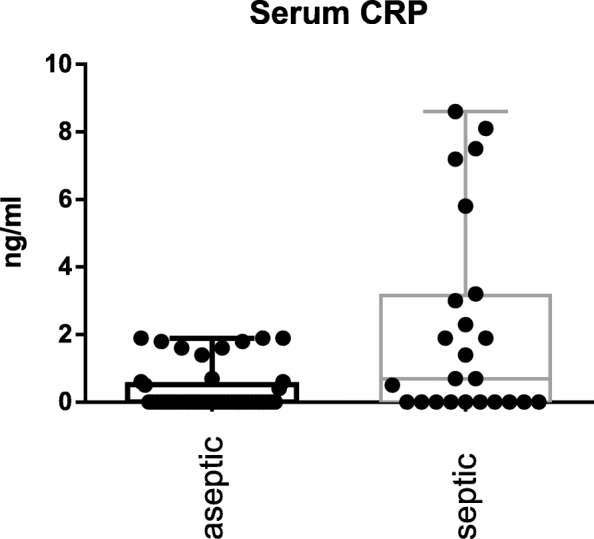
Since a "gold-standard" is missing, diagnosing periprosthetic joint infection (PJI) remains a challenge in orthopedic surgery. The purpose of this study was to evaluate the accuracy of serum and synovial fluid Procalcitonin (S-PCT and SF-PCT) as a diagnostic parameter and to compare it to the biomarkers recommended in the 2018 Definition of periprosthetic hip and knee infection.
Between August 2018 and July 2019, a prospective cohort study was conducted in 70 patients with painful hip, shoulder and knee arthroplasty. Besides medical history, clinical and laboratory data was gathered. PJI was diagnosed based on the 2018 Definition of periprosthetic hip and knee infection. Preoperative blood and synovial joint fluid were taken for PCT measurement. S-PCT and SF-PCT levels were measured using standard quantitative PCT enzyme immunoassays.
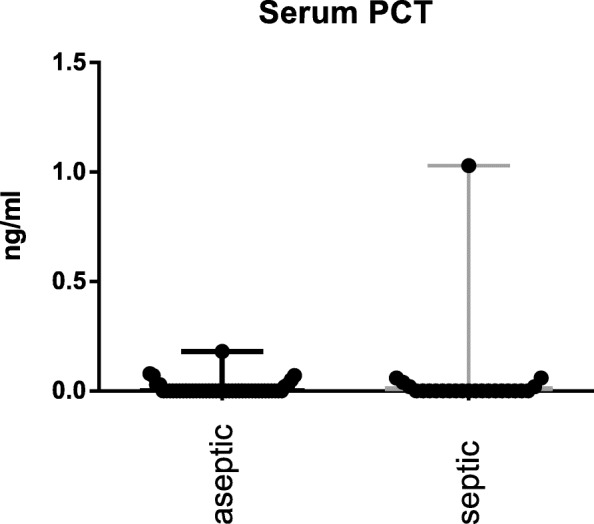
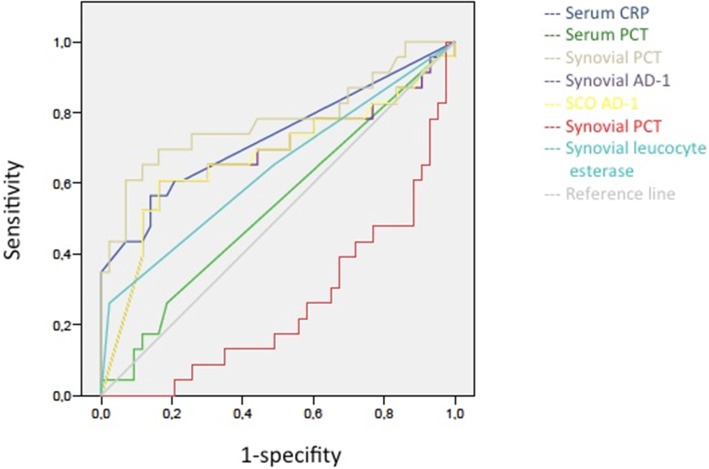
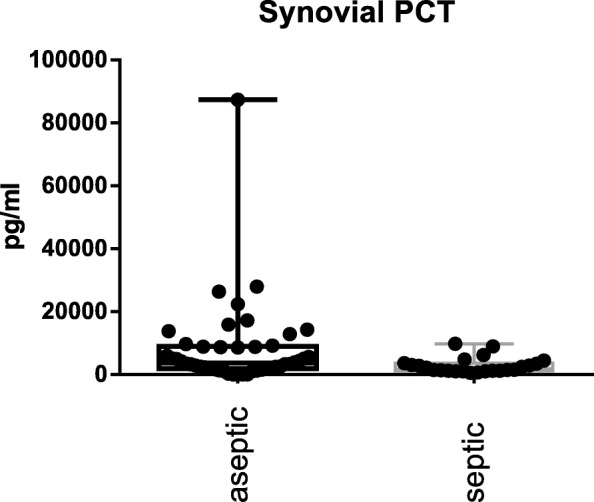
Twenty three patients (33%) were classified as the PJI group and fourty seven patient (67%) as the aseptic group. The mean levels of S-PCT were significantly (p < 0.001) higher in the PJI group than those in the aseptic group (PJI 0.05 ± 0.21 ng/mL (0.0-1.03) vs. aseptic 0.02 ± 0.03 ng/mL (0.0-0.18)). In synovial fluid, the mean PCT values in the aseptic group were significantly higher (p < 0.001) than those of PJI group (PJI 2.7 ± 1.4 ng/mL (0.53-9.7) vs. aseptic 8.7 ± 2.5 ng/mL (0.25-87.9)). S- PCT, with a cut-off level of 0.5 ng/mL, had a sensitivity of 13.0% and a specificity of 91.0%. SF-PCT, with a cut-off level of 5.0 ng/mL, had a sensitivity of 13.0% and a specificity of 52.0%.
S-PCT and SF-PCT appeared to be no reliable biomarkers in the differential diagnosis of PJI from aseptic loosening in total joint arthroplasty.
由于缺乏“金标准”,诊断假体周围关节感染(PJI)仍然是骨科手术中的一个挑战。本研究的目的是评估血清和滑液降钙素原(S-PCT 和 SF-PCT)作为诊断参数的准确性,并将其与 2018 年假体周围髋膝关节感染定义中推荐的生物标志物进行比较。
2018 年 8 月至 2019 年 7 月,对 70 例患有疼痛性髋关节、肩关节和膝关节置换术的患者进行了前瞻性队列研究。除了病史外,还收集了临床和实验室数据。根据 2018 年假体周围髋膝关节感染定义诊断 PJI。术前采集血液和关节滑液进行 PCT 测量。使用标准定量 PCT 酶免疫分析法测量 S-PCT 和 SF-PCT 水平。
23 例(33%)患者被归类为 PJI 组,47 例(67%)患者为无菌组。PJI 组 S-PCT 水平明显(p < 0.001)高于无菌组(PJI 0.05 ± 0.21 ng/mL(0.0-1.03)vs.无菌 0.02 ± 0.03 ng/mL(0.0-0.18))。在滑液中,无菌组 PCT 值明显高于 PJI 组(p < 0.001)(PJI 2.7 ± 1.4 ng/mL(0.53-9.7)vs.无菌 8.7 ± 2.5 ng/mL(0.25-87.9))。S-PCT 的截断值为 0.5 ng/mL 时,灵敏度为 13.0%,特异性为 91.0%。SF-PCT 的截断值为 5.0 ng/mL 时,灵敏度为 13.0%,特异性为 52.0%。
S-PCT 和 SF-PCT 似乎不能作为全关节置换术后 PJI 与无菌性松动的鉴别诊断的可靠生物标志物。