Department of Orthopaedics and Trauma Surgery, Philippusstift Essen, Hülsmannstr. 17, 45355, Essen, Germany.
Chair of Orthopaedics and Trauma Surgery University of Duisburg-Essen, Essen, Germany.
BMC Musculoskelet Disord. 2022 Jun 28;23(1):620. doi: 10.1186/s12891-022-05560-x.
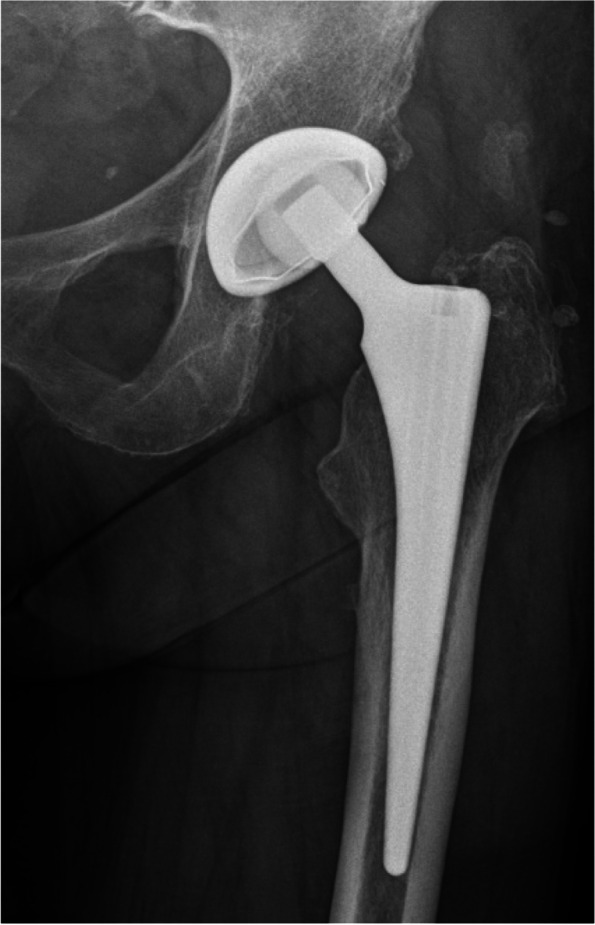
In the past, radiographic imaging was of minor relevance in the diagnosis of periprosthetic joint infections (PJI). Since metal artefact reduction sequences (MARS) are available, magnetic resonance imaging (MRI) has become a promising diagnostic tool for the evaluation of hip arthroplasty implants. The purpose of the present study was to evaluate the efficacy of MARS-MRI in comparison to established diagnostic tools to distinguish between aseptic failure and PJI.
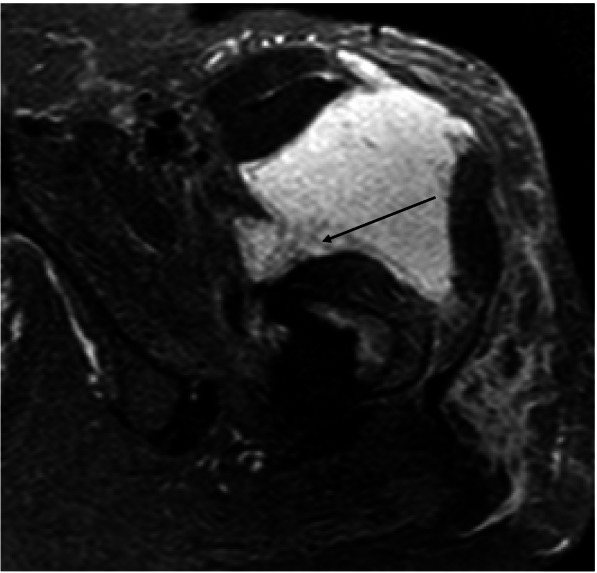
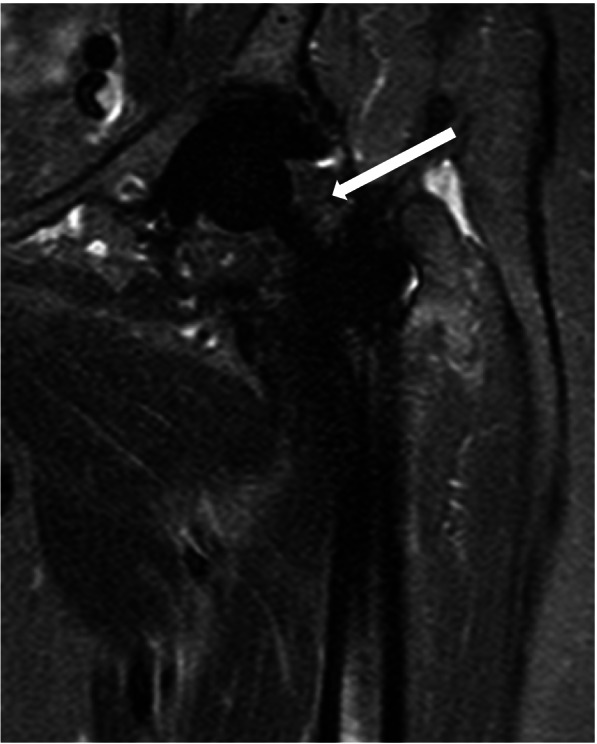
From July 2018 to September 2019, 33 patients classified as having an aseptic joint effusion were recruited into the study. The group included 22 women and 11 men with a mean age of 70.4 ± 13.7 (42-88) years. In the same period, 12 patients were classified as having a PJI. The group consisted of 9 women and 3 men with a mean age of 72.5 ± 10.6 (54-88) years. MARS-MRI was conducted using the optimized parameters at 1.5 T in a coronal and axial STIR (short-tau-inversion recovery), a non-fat-saturated T2 in coronal view and a non-fat-saturated T1 in transverse view in 45 patients with painful hip after total hip arthroplasty (THA). Normally distributed continuous data were shown as mean ± standard deviation (SD) and compared using student's t-test. Non-normally distributed continuous data were shown as mean and compared using the Mann-Whitney U test.
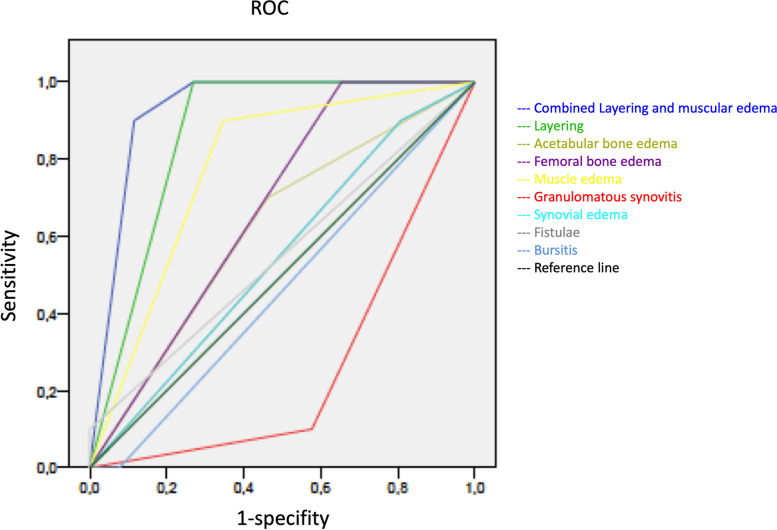
Synovial layering and muscle edema were significant features of periprosthetic joint infection, with sensitivities of 100% and specifities of 63.0-75.0%. The combined specifity and sensitivity levels of synovial layering and muscular edema was 88.0% and 90.0%. Granulomatous synovitis was a significant feature for aseptic failure, with 90.0% sensitivity and 57.0% specifity.
MARS-MRI is as suitable as standard diagnostic tools to distinguish between aseptic failure and PJI in patients with THA. Further studies with larger patient numbers have to prove whether MARS-MRI could be integral part of PJI diagnostic.
在过去,放射性影像学在假体周围关节感染(PJI)的诊断中意义不大。由于有了金属伪影降低序列(MARS),磁共振成像(MRI)已成为评估髋关节置换植入物的有前途的诊断工具。本研究的目的是评估 MARS-MRI 在区分无菌性失败和 PJI 方面与既定诊断工具的疗效。
从 2018 年 7 月至 2019 年 9 月,招募了 33 名被归类为无菌性关节积液的患者进行研究。该组包括 22 名女性和 11 名男性,平均年龄为 70.4±13.7(42-88)岁。同期,有 12 名患者被归类为患有 PJI。该组由 9 名女性和 3 名男性组成,平均年龄为 72.5±10.6(54-88)岁。在 45 名因全髋关节置换(THA)后出现髋关节疼痛的患者中,使用优化参数在 1.5T 下进行冠状位和轴位 STIR(短 tau 反转恢复)、冠状位非脂肪饱和 T2 和横断位非脂肪饱和 T1 进行 MARS-MRI。正态分布的连续数据表示为均值±标准差(SD),并使用学生 t 检验进行比较。非正态分布的连续数据表示为均值,并使用 Mann-Whitney U 检验进行比较。
滑膜分层和肌肉水肿是假体周围关节感染的显著特征,其敏感性为 100%,特异性为 63.0-75.0%。滑膜分层和肌肉水肿的联合特异性和敏感性水平为 88.0%和 90.0%。肉芽性滑膜炎是无菌性失败的一个显著特征,敏感性为 90.0%,特异性为 57.0%。
MARS-MRI 与标准诊断工具一样适合区分 THA 患者的无菌性失败和 PJI。需要进一步的研究来证明 MARS-MRI 是否可以成为 PJI 诊断的一部分。