Brabant Trauma Registry, Network Emergency Care Brabant, Hilvarenbeekseweg 60, 5022 GC, Tilburg, The Netherlands.
Department Trauma TopCare, ETZ hospital, Tilburg, The Netherlands.
Scand J Trauma Resusc Emerg Med. 2020 Apr 20;28(1):29. doi: 10.1186/s13049-020-00719-8.
While survival rates after a trauma are increasing a considerable part of the trauma population are still at risk for both short and long term disabilities. Little is known about prognostic factors over time after a severe trauma. The aim of the present prospective cohort study was to examine trauma and patient related prognostic factors for a lower health status over time after a severe trauma.
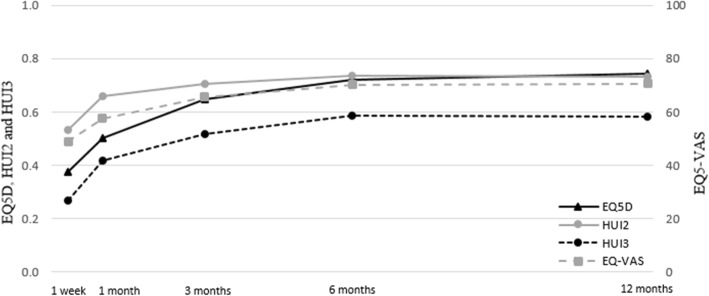
A multicentre prospective observational cohort study was conducted. Adult trauma patients with severe injuries (ISS ≥ 16) were included from August 2015 until November 2016 if admitted to one of the hospitals in Noord-Brabant (the Netherlands). Outcome measure was health status, measured by the EuroQol-5D (EQ-5D utility and EQ-Visual analogue scale) and the Health Utilities Index (HUI2 and HUI3) one week and one, three, six, and twelve months after injury. Patient and trauma characteristics were analysed as prognostic factors with linear mixed models. The effect of each prognostic factor over time was analysed by adding the interaction term between the prognostic factor and time point in a multivariable linear mixed model, adjusted for confounders. Additionally, the risk factors for problems in the EQ-5 dimensions of HS and cognition were analysed.
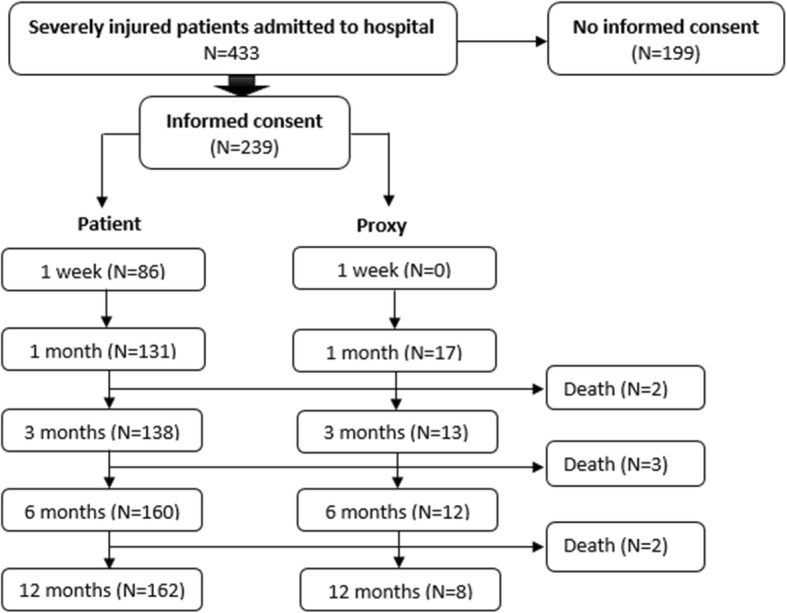
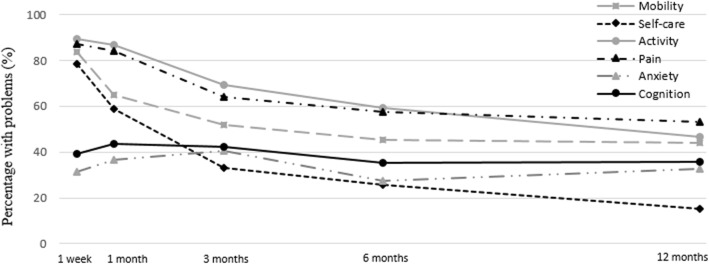
In total 239 severely injured patients participated. Pre-injury health status, hospital length of stay, ISS and comorbidities were significant prognostic factors for a lower health status. A younger age and extremity injury were prognostic factors for a lower health status until one month after trauma and unemployment before trauma and comorbidities six until twelve months after trauma. In the EQ-5 dimensions 44.1% remained problems in mobility, 15.3% in self-care, 46.4% in activity, 53.3% in pain, 32.5% in anxiety and 35.7% in cognition.
Lower pre-injury health status, longer hospital length of stay, higher ISS, and comorbidities were significant prognostic factors for a lower health status during one year after a severe injury. A younger age and an extremity injury were short-term prognostic factors and unemployment before trauma and comorbidities were long-term prognostic factors. Even after twelve months patients in our population reported more problems in all EQ-5D dimensions when compared to the Dutch reference population.
尽管创伤后的生存率在不断提高,但仍有相当一部分创伤人群面临短期和长期残疾的风险。关于严重创伤后随时间推移的预后因素知之甚少。本前瞻性队列研究的目的是研究创伤和患者相关的预后因素,以了解严重创伤后随时间推移健康状况的下降情况。
进行了一项多中心前瞻性观察性队列研究。如果 2015 年 8 月至 2016 年 11 月期间严重受伤(ISS≥16)的成年创伤患者被收入北布拉班特(荷兰)的一家医院,将其纳入研究。结局测量指标是健康状况,使用欧洲五维健康量表(EQ-5D 效用和 EQ-视觉模拟量表)和健康效用指数(HUI2 和 HUI3)在受伤后一周、一个月、三个月、六个月和十二个月进行测量。分析患者和创伤特征作为预后因素,使用线性混合模型进行分析。通过在多变量线性混合模型中添加预后因素和时间点之间的交互项,调整混杂因素,分析每个预后因素随时间的变化。还分析了 EQ-5D 维度中 HS 和认知问题的危险因素。
共纳入 239 例严重受伤患者。受伤前的健康状况、住院时间、ISS 和合并症是健康状况较差的显著预后因素。年轻的年龄和四肢损伤是创伤后一个月内健康状况较差的预后因素,而创伤前失业和合并症是创伤后六个月至十二个月内健康状况较差的预后因素。在 EQ-5D 维度中,44.1%的患者仍存在移动性问题,15.3%的患者存在自理能力问题,46.4%的患者存在活动能力问题,53.3%的患者存在疼痛问题,32.5%的患者存在焦虑问题,35.7%的患者存在认知问题。
受伤前健康状况较低、住院时间较长、ISS 较高和合并症是严重创伤后一年内健康状况较差的显著预后因素。年轻的年龄和四肢损伤是短期预后因素,而创伤前失业和合并症是长期预后因素。即使在 12 个月后,与荷兰参考人群相比,我们人群中的患者在所有 EQ-5D 维度上仍报告了更多的问题。