Department of Trauma Surgery, University Medical Center Utrecht, Suite: G04.228, Heidelberglaan 100, 3584 CX, Utrecht, The Netherlands.
Scand J Trauma Resusc Emerg Med. 2017 Apr 14;25(1):41. doi: 10.1186/s13049-017-0375-z.
It is suggested in literature to use the Health Related Quality of Life (HRQoL) as an outcome indicator for evaluating trauma centre performances. In order to predict HRQoL, characteristics that could be of influence on a predictive model should be identified. This study identifies patient and injury characteristics associated with the HRQoL in a general trauma population.
Retrospective study of trauma patients admitted from 1st January 2007 through 31th December 2012. Patients were aged ≥18 years and discharged alive from the level I trauma centre. A combined health survey (SF-36 and EQ-5D) was sent to all traceable patients. The subdomain outcomes and EQ-5D index value (EQ-5Di) were compared with the reference population. A linear regression analysis was performed to identify parameters associated parameters with the HRQoL outcome.
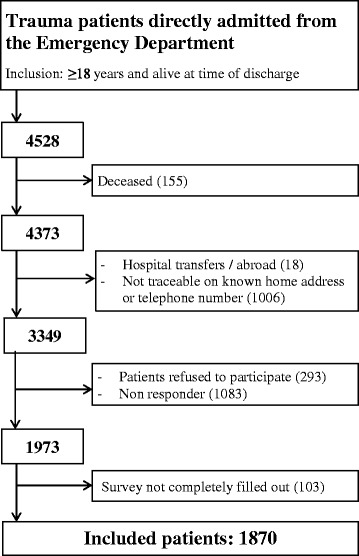
A total of 1870 patients were included for analyses. Compared to the eligible population, included patients were significantly older, more severely injured, more often admitted in the ICU and had a longer admission duration. The SF-36 and EQ-5Di were significantly lower compared to the Dutch reference population. The variables age, Injury Severity Score, hospital length of stay, ICU length of stay, Revised Trauma Score, probability of survival, and severe injury to the head and extremities were associated with the HRQoL in the majority of the subdomains.
In order to use HRQoL as an indicator for trauma centre performances, there should be a consensus of the ideal timing for the measurement of HRQoL post-injury and the appropriate HRQoL instrument. Furthermore, standardised HRQoL outcomes must be developed.
This study revealed eight factors (described above) which could be used to predict the HRQoL in trauma patients.
文献中建议使用健康相关生活质量(HRQoL)作为评估创伤中心绩效的结果指标。为了预测 HRQoL,应该确定可能对预测模型产生影响的特征。本研究确定了与一般创伤人群 HRQoL 相关的患者和损伤特征。
这是一项回顾性研究,纳入了 2007 年 1 月 1 日至 2012 年 12 月 31 日期间收入一级创伤中心的成年(年龄≥18 岁)创伤患者。向所有可追踪患者发送了一份综合健康调查(SF-36 和 EQ-5D)。比较亚域结局和 EQ-5D 指数值(EQ-5Di)与参考人群。进行线性回归分析以确定与 HRQoL 结局相关的参数。
共纳入 1870 例患者进行分析。与合格人群相比,纳入的患者年龄更大,损伤更严重,更常入住 ICU,住院时间更长。SF-36 和 EQ-5Di 明显低于荷兰参考人群。年龄、损伤严重程度评分、住院时间、ICU 时间、修订创伤评分、生存概率以及头部和四肢严重损伤等变量与大多数亚域的 HRQoL 相关。
为了将 HRQoL 用作创伤中心绩效的指标,应该就损伤后测量 HRQoL 的理想时间以及适当的 HRQoL 工具达成共识。此外,必须制定标准化的 HRQoL 结局。
本研究揭示了八项因素(上述),可用于预测创伤患者的 HRQoL。