Oncogenomics and Epigenetics, IRCSS Regina Elena National Cancer Institute, Via Elio Chianesi, 53, 00144, Rome, Italy.
Oncogenomics Division, Eurofins Genoma Group, Via Castel Giubileo, 11, 00138, Rome, Italy.
J Exp Clin Cancer Res. 2020 Apr 20;39(1):69. doi: 10.1186/s13046-020-01569-z.
Liquid biopsy (LB) in early-stage, non-metastatic colorectal cancer (CRC) must be sensitive enough to detect extremely low circulating tumor DNA (ctDNA) levels. This challenge has been seldom and non-systematically investigated.
Next generation sequencing (NGS) and digital PCR (dPCR) were combined to test tumor DNAs (tDNAs) and paired ctDNAs collected at surgery from 39 patients, 12 of whom were also monitored during the immediate post-surgery follow up. Patients treated for metastatic disease (n = 14) were included as controls.
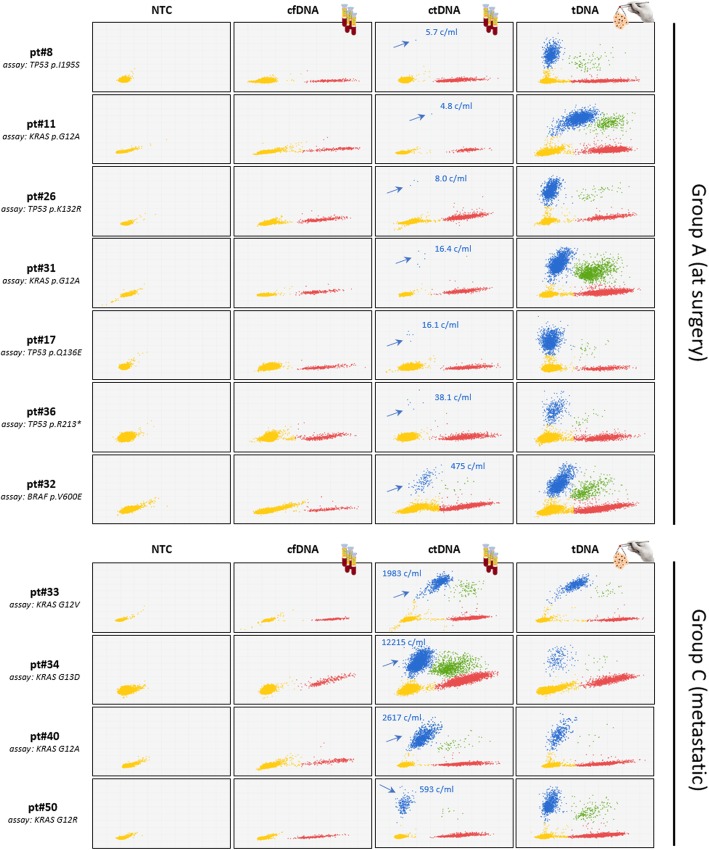
NGS and dPCR concordantly (100% agreement) called at least one single nucleotide variant (SNV) in 34 tDNAs, estimated differences in allelic frequencies being negligible (±1.4%). However, despite dPCR testing, SNVs were only detectable in 15/34 (44.1%) ctDNAs from patients at surgery, as opposed to 14/14 (100%) metastatic patients. This was likely due to striking differences (average 10 times, up to 500) in ctDNA levels between groups. NGS revealed blood-only SNVs, suggesting spatial heterogeneity since pre-surgery disease stages, and raising the combined NGS/dPCR sensitivity to 58.8%. ctDNA levels at surgery correlated with neither tumor size, stage, grade, or nodal status, nor with variant abundance in paired tDNA. LB sensitivity reached 63.6% when ctDNA was combined with CEA. Finally, persistence and absence of ctDNA on the first conventional (month 3) post-surgery follow-up were associated with fast relapse and a disease-free status in 3 and 7 patients, respectively.
A simple clinical NGS/dPCR/CEA combination effectively addresses the LB challenge in a fraction of non-metastatic CRC patients.
在早期非转移性结直肠癌(CRC)中,液体活检(LB)必须足够敏感,以检测到极低水平的循环肿瘤 DNA(ctDNA)。然而,这一挑战尚未得到充分研究。
本研究联合使用下一代测序(NGS)和数字 PCR(dPCR)技术,对 39 名患者手术时采集的肿瘤 DNA(tDNA)和配对 ctDNA 进行检测,其中 12 名患者在术后随访期间也接受了监测。同时纳入了 14 名转移性疾病患者作为对照。
NGS 和 dPCR 检测结果一致(100%相符),在 34 个 tDNA 中检测到至少一个单核苷酸变异(SNV),等位基因频率差异可忽略不计(±1.4%)。然而,尽管进行了 dPCR 检测,只有 15/34(44.1%)的手术 ctDNA 可检测到 SNV,而 14/14(100%)的转移性患者均能检测到。这可能是由于手术组 ctDNA 水平存在明显差异(平均相差 10 倍,最高相差 500 倍)。NGS 检测到仅存在于血液中的 SNV,提示存在术前疾病分期的空间异质性,并使联合 NGS/dPCR 的敏感性提高至 58.8%。手术时的 ctDNA 水平与肿瘤大小、分期、分级或淋巴结状态均无相关性,与配对 tDNA 中的变异丰度也无相关性。当 ctDNA 与 CEA 联合使用时,LB 敏感性达到 63.6%。最后,3 名患者在首次常规(术后第 3 个月)随访时 ctDNA 持续存在,7 名患者 ctDNA 消失,这两组患者分别快速复发和无疾病状态。
一种简单的临床 NGS/dPCR/CEA 组合可有效解决部分非转移性 CRC 患者的 LB 挑战。