University of Bordeaux, Bordeaux, France.
Interdisciplinary Institute for Neuroscience, CNRS UMR 5297, Bordeaux, France.
Nat Commun. 2020 Apr 20;11(1):1906. doi: 10.1038/s41467-020-15648-4.
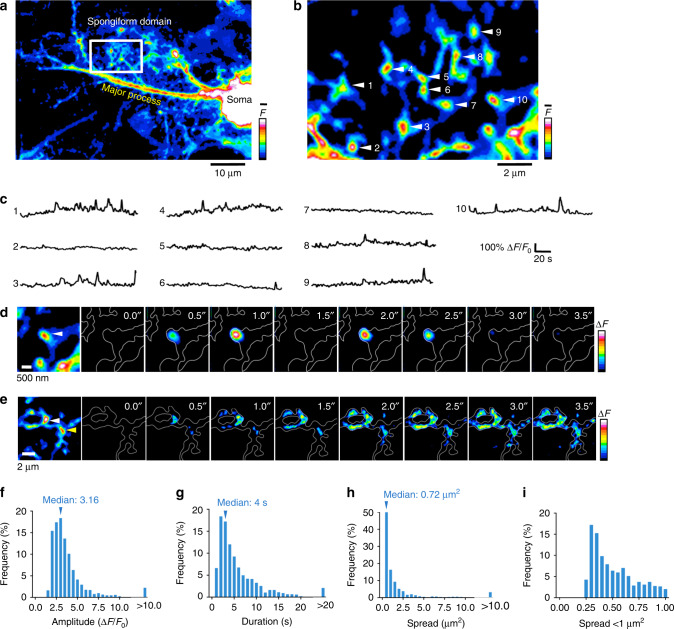
Astrocytic Ca signals can be fast and local, supporting the idea that astrocytes have the ability to regulate single synapses. However, the anatomical basis of such specific signaling remains unclear, owing to difficulties in resolving the spongiform domain of astrocytes where most tripartite synapses are located. Using 3D-STED microscopy in living organotypic brain slices, we imaged the spongiform domain of astrocytes and observed a reticular meshwork of nodes and shafts that often formed loop-like structures. These anatomical features were also observed in acute hippocampal slices and in barrel cortex in vivo. The majority of dendritic spines were contacted by nodes and their sizes were correlated. FRAP experiments and Ca imaging showed that nodes were biochemical compartments and Ca microdomains. Mapping astrocytic Ca signals onto STED images of nodes and dendritic spines showed they were associated with individual synapses. Here, we report on the nanoscale organization of astrocytes, identifying nodes as a functional astrocytic component of tripartite synapses that may enable synapse-specific communication between neurons and astrocytes.
星形胶质细胞的 Ca 信号可以快速且局限,这支持了星形胶质细胞具有调节单个突触的能力的观点。然而,由于难以解析大多数三突触所在的星形胶质细胞的海绵状区域,这种特定信号的解剖学基础仍不清楚。使用活脑器官切片中的 3D-STED 显微镜,我们对星形胶质细胞的海绵状区域进行成像,观察到节点和轴组成的网状结构,这些结构经常形成环状结构。这些解剖学特征也在急性海马切片和体内桶状皮层中观察到。大多数树突棘被节点接触,其大小相关。FRAP 实验和 Ca 成像表明节点是生化隔室和 Ca 微区。将星形胶质细胞的 Ca 信号映射到节点和树突棘的 STED 图像上表明,它们与单个突触相关。在这里,我们报告了星形胶质细胞的纳米级组织,确定节点是三突触的功能性星形胶质细胞成分,这可能使神经元和星形胶质细胞之间能够进行特定于突触的通信。