Richardson Joshua E, Middleton Blackford, Platt Jodyn E, Blumenfeld Barry H
Applied Health Informatics Program RTI International Chicago Illinois.
Apervita, Inc Chicago Illinois.
Learn Health Syst. 2019 Dec 11;4(2):e10208. doi: 10.1002/lrh2.10208. eCollection 2020 Apr.
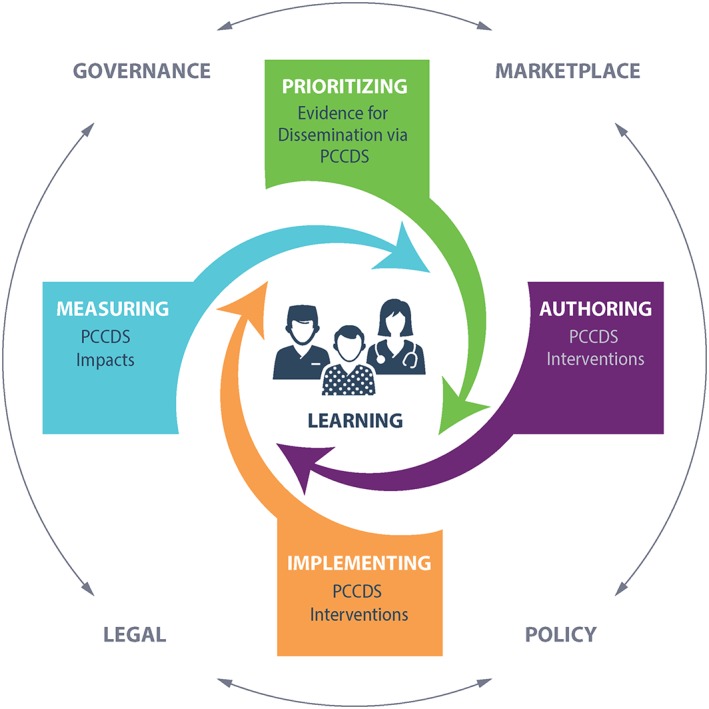
Knowledge artifacts in digital repositories for clinical decision support (CDS) can promote the use of CDS in clinical practice. However, stakeholders will benefit from knowing which they can trust before adopting artifacts from knowledge repositories. We discuss our investigation into trust for knowledge artifacts and repositories by the Patient-Centered CDS Learning Network's Trust Framework Working Group (TFWG). The TFWG identified 12 actors (eg, vendors, clinicians, and policy makers) within a CDS ecosystem who each may play a meaningful role in prioritizing, authoring, implementing, or evaluating CDS and developed 33 recommendations distributed across nine "trust attributes." The trust attributes and recommendations represent a range of considerations such as the "Competency" of knowledge artifact engineers and the "Organizational Capacity" of institutions that develop and implement CDS. The TFWG findings highlight an initial effort to make trust explicit and embedded within CDS knowledge artifacts and repositories and thus more broadly accepted and used.
用于临床决策支持(CDS)的数字存储库中的知识工件可以促进CDS在临床实践中的应用。然而,在从知识存储库采用工件之前,利益相关者若能知道哪些是他们可以信任的,将会从中受益。我们讨论了以患者为中心的CDS学习网络的信任框架工作组(TFWG)对知识工件和存储库信任度的调查。TFWG确定了CDS生态系统中的12个参与者(如供应商、临床医生和政策制定者),他们各自可能在CDS的优先级确定、编写、实施或评估中发挥重要作用,并制定了分布在九个“信任属性”中的33条建议。这些信任属性和建议代表了一系列考量因素,如知识工件工程师的“能力”以及开发和实施CDS的机构的“组织能力”。TFWG的研究结果突出了一项初步努力,即让信任在CDS知识工件和存储库中变得明确且得以体现,从而得到更广泛的认可和应用。