Andremont Olivier, Armand-Lefevre Laurence, Dupuis Claire, de Montmollin Etienne, Ruckly Stéphane, Lucet Jean-Christophe, Smonig Roland, Magalhaes Eric, Ruppé Etienne, Mourvillier Bruno, Lebut Jordane, Lermuzeaux Mathilde, Sonneville Romain, Bouadma Lila, Timsit Jean-François
Medical and Infectious Diseases ICU (MI2), Bichat-Claude Bernard University Hospital, Assistance Publique - Hôpitaux de Paris, Paris, France.
UMR 1137, IAME, INSERM/Université Paris Diderot, Sorbonne Paris Cité, Paris, France.
Intensive Care Med. 2020 Jun;46(6):1232-1242. doi: 10.1007/s00134-020-06029-y. Epub 2020 Apr 20.
In ICU patients with carriage of extended spectrum beta-lactamase producing Enterobacterales (ESBL-E) and suspected Gram-negative bacilli ventilator-associated pneumonia (GNB-VAP), the quantification of the rectal and throat ESBL-E carriage might predict the ESBL-E involvement in GNB-VAP. Our aim was to evaluate whether a semi-quantitative assessment of rectal/throat ESBL-E carriage can predict ESBL-E-associated VAP in medical ICU patients.
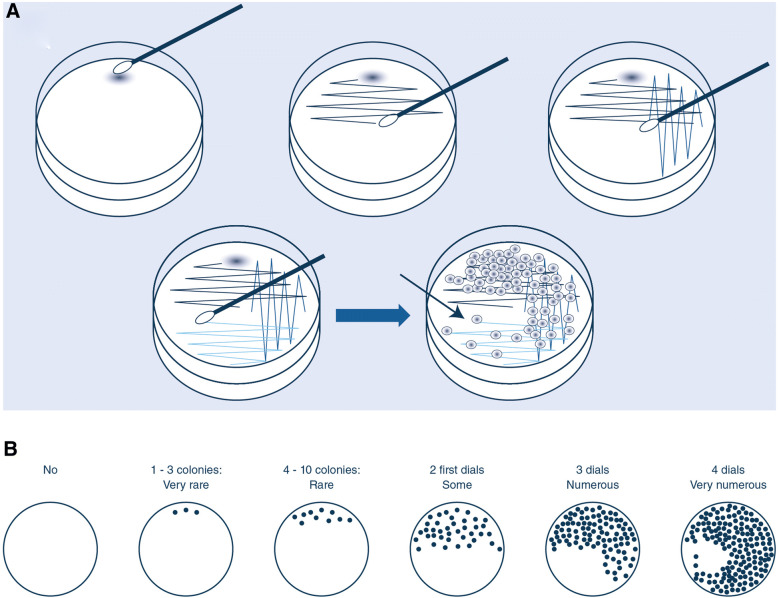
From May 2014 to May 2017, all ESBL-E carriers had a semi-quantitative assessment of ESBL-E density in swabs cultures. For those who developed GNB-VAP (diagnosed using bronchoalveolar lavage or plugged telescopic catheter with significant quantitative culture), the last positive swab collected at least 48 h before GNB-VAP onset was selected. Clinical data were extracted from a prospectively collected database.
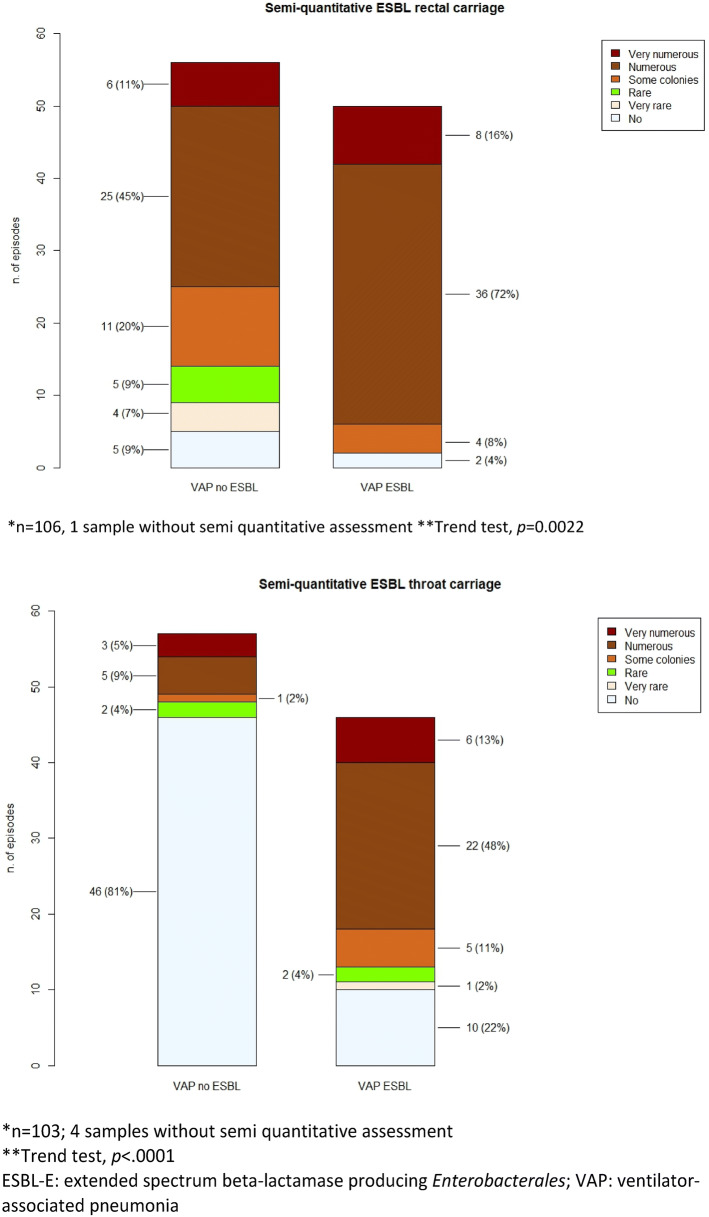
Among 365 ESBL-E carriers, 82 developed 107 episodes of GNB-VAP (ESBL-E VAP, n = 50; and non-ESBL-E GNB-VAP, n = 57) after 13 days of mechanical ventilation in median. Antimicrobials use before VAP onset was similar between groups. The last swabs were collected 5 days in median before VAP onset. ESBL-E. coli carriers developed ESBL-E VAP less frequently (n = 13, 34%) than others (n = 32, 67.3%, p < .01). Throat swab positivity (39 (78%) vs. 12 (23%), p < .01) was more frequent for ESBL-E VAP. ESBL-E VAP was associated with significantly higher ESBL-E density in rectal swabs. In multivariate models, non-E. coli ESBL-E carriage and rectal ESBL-E carriage density, or throat carriage, remained associated with ESBL-E VAP.
In carriers of ESBL-E other than E. coli, ESBL-E throat carriage or a high-density ESBL-E rectal carriage are risk factors of ESBL-E VAP in case of GNB-VAP.
在携带产超广谱β-内酰胺酶肠杆菌科细菌(ESBL-E)且疑似革兰氏阴性杆菌呼吸机相关性肺炎(GNB-VAP)的重症监护病房(ICU)患者中,直肠和咽喉部ESBL-E携带量的量化可能预测ESBL-E在GNB-VAP中的参与情况。我们的目的是评估直肠/咽喉部ESBL-E携带情况的半定量评估能否预测内科ICU患者中与ESBL-E相关的VAP。
2014年5月至2017年5月,所有ESBL-E携带者均对拭子培养物中的ESBL-E密度进行了半定量评估。对于发生GNB-VAP的患者(采用支气管肺泡灌洗或带定量培养的堵塞式伸缩导管诊断)选择在GNB-VAP发作前至少48小时采集的最后一份阳性拭子。临床数据从前瞻性收集的数据库中提取得出。
365名ESBL-E携带者中,82人在机械通气中位数13天后发生了107次GNB-VAP发作(ESBL-E VAP,n = 50;非ESBL-E GNB-VAP,n = 57)。VAP发作前抗菌药物的使用在各组之间相似。最后一份拭子在VAP发作前中位数5天采集。ESBL-E大肠杆菌携带者发生ESBL-E VAP的频率(n = 13例,34%)低于其他携带者(n = 32例67.3%,p < 0.01)ESBL-E VAP患者咽喉拭子阳性率更高(39例(78%)对12例(23%),p < 0.01)。ESBL-E VAP与直肠拭子中显著更高的ESBL-E密度相关。在多变量模型中,非大肠杆菌ESBL-E携带以及直肠ESBL-E携带密度或咽喉部携带,仍与ESBL-E VAP相关。
在非大肠杆菌的ESBL-E携带者中,ESBL-E咽喉部携带或高密度的直肠ESBL-E携带是发生GNB-VAP时ESBL-E VAP的危险因素。