Department of Cardiology, University of Groningen, University Medical Center Groningen, 9700 RB, Groningen, The Netherlands.
Department of Genetics, University of Groningen, University Medical Center Groningen, 9700 RB, Groningen, The Netherlands.
Nat Commun. 2020 Apr 21;11(1):1770. doi: 10.1038/s41467-020-15553-w.
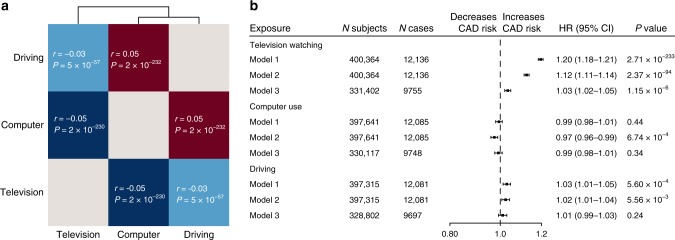
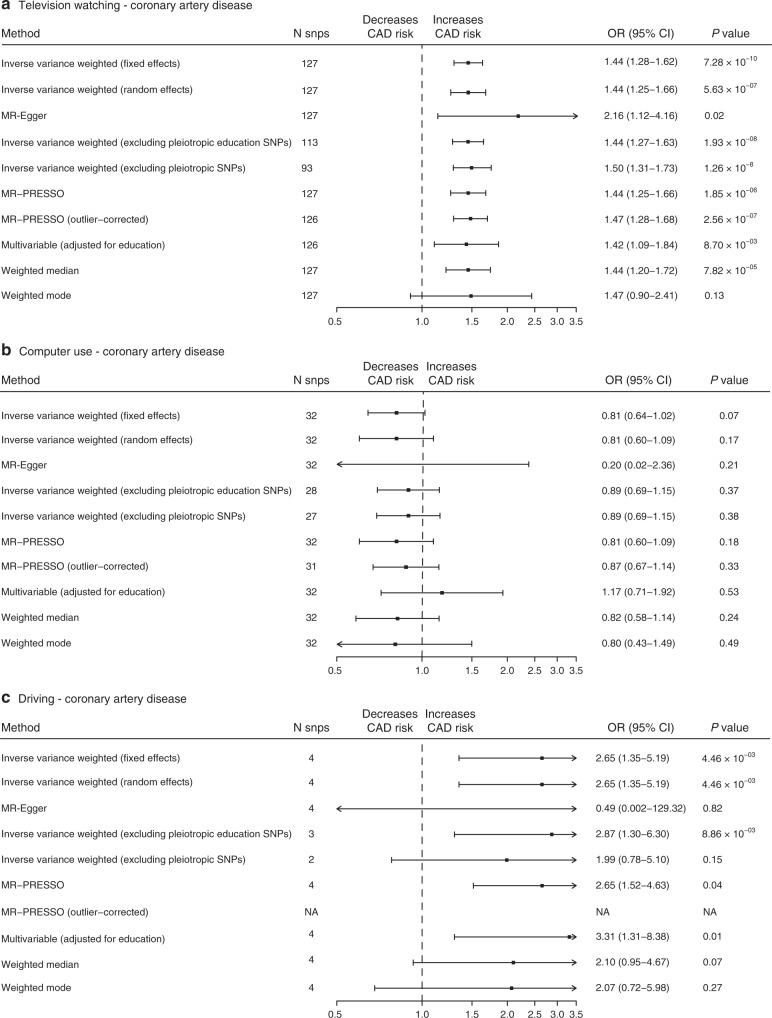
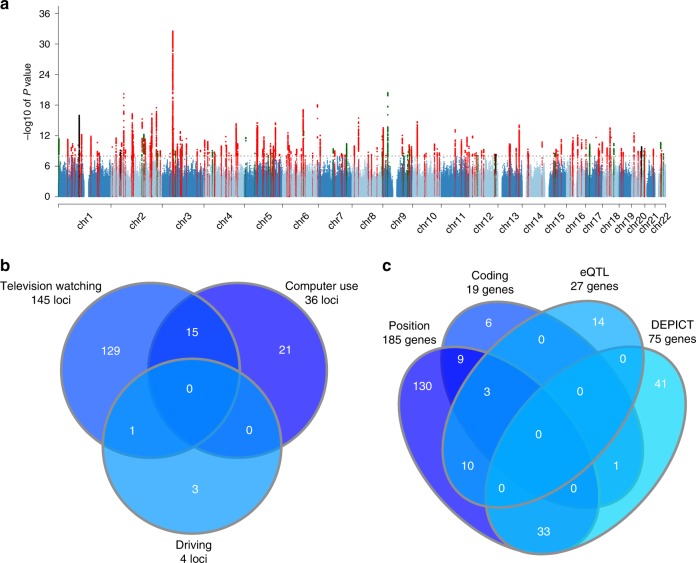
Leisure sedentary behaviours are associated with increased risk of cardiovascular disease, but whether this relationship is causal is unknown. The aim of this study is to identify genetic determinants associated with leisure sedentary behaviours and to estimate the potential causal effect on coronary artery disease (CAD). Genome wide association analyses of leisure television watching, leisure computer use and driving behaviour in the UK Biobank identify 145, 36 and 4 genetic loci (P < 1×10), respectively. High genetic correlations are observed between sedentary behaviours and neurological traits, including education and body mass index (BMI). Two-sample Mendelian randomization (MR) analysis estimates a causal effect between 1.5 hour increase in television watching and CAD (OR 1.44, 95%CI 1.25-1.66, P = 5.63 × 10), that is partially independent of education and BMI in multivariable MR analyses. This study finds independent observational and genetic support for the hypothesis that increased sedentary behaviour by leisure television watching is a risk factor for CAD.
休闲久坐行为与心血管疾病风险增加有关,但这种关系是否具有因果关系尚不清楚。本研究旨在确定与休闲久坐行为相关的遗传决定因素,并估计其对冠心病(CAD)的潜在因果影响。英国生物库中对休闲看电视、休闲使用电脑和驾驶行为的全基因组关联分析分别确定了 145、36 和 4 个遗传位点(P < 1×10)。在久坐行为和神经学特征(包括教育和体重指数(BMI))之间观察到高度的遗传相关性。两样本孟德尔随机化(MR)分析估计,看电视时间增加 1.5 小时与 CAD 之间存在因果关系(OR 1.44,95%CI 1.25-1.66,P = 5.63×10),在多变量 MR 分析中,这与教育和 BMI 部分独立。本研究从观察性研究和遗传学两方面为久坐的休闲看电视行为是 CAD 的一个危险因素的假说提供了支持。