Laucius Ovidijus, Balnytė Renata, Petrikonis Kęstutis, Matijošaitis Vaidas, Jucevičiūtė Neringa, Vanagas Tadas, Danielius Vytautas
Department of Neurology, Lithuanian University of Health Sciences, Eivenių str. 2, LT-50009 Kaunas, Lithuania.
Faculty of Medicine, Medical Academy, Lithuanian University of Health Sciences, Mickevičiaus str. 9, LT 44307 Kaunas, Lithuania.
Parkinsons Dis. 2020 Mar 31;2020:2627471. doi: 10.1155/2020/2627471. eCollection 2020.
It is currently impossible to diagnose Parkinson's disease (PD) in the premotor phase even though at the time of motor symptom onset the number of already degenerated dopaminergic substantia nigra neurons is considerable. Degeneration of the dorsal nucleus of the vagus nerve (VN) has been reported early in the disease course, and it could lead to impaired function of the VN, resulting in certain nonmotor symptoms of PD. Therefore, we raised a hypothesis that the loss of VN neurons could result in a smaller diameter of the VN among PD patients.
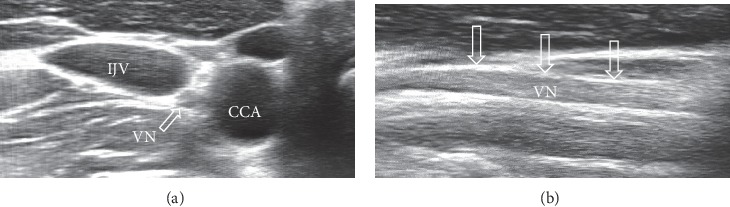
20 PD patients and 20 age- and gender-matched individuals without any neurodegenerative disease were enrolled in a pilot study. The diameters of the right and left VNs were measured using ultrasonography, their average was calculated, and the narrower VN diameter was noted separately.
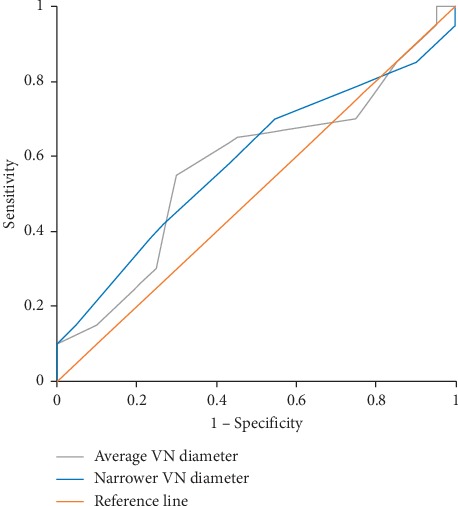
No difference was found between the PD and control groups neither in the average VN diameter (mean 1.17; 95% confidence interval (CI) 1.10-1.24 vs. 1.13; 1.07-1.18, mm; =0.353) nor in the narrower VN diameter (mean 1.11; 95% confidence interval (CI) 1.02-1.20 vs. 1.07; 1.02-1.13, mm; =0.421). The narrower VN diameter and the average VN diameter were not able to distinguish between PD patients and controls (area under curve (AUC) = 0.588, 95% CI = 0.408-0.767, and =0.344; and AUC = 0.578, 95% CI = 0.396-0.759, and =0.402).
To conclude, no differences were found in VN diameter between the PD and control groups. Therefore, our data do not support the hypothesis that PD could be associated with a smaller diameter of the VN.
尽管在运动症状出现时,已经退化的多巴胺能黑质神经元数量相当可观,但目前仍无法在帕金森病(PD)的运动前期进行诊断。迷走神经背核(VN)的退化在疾病进程早期就已被报道,它可能导致VN功能受损,从而引发PD的某些非运动症状。因此,我们提出一个假设,即PD患者中VN神经元的丧失可能导致VN直径变小。
一项初步研究纳入了20例PD患者和20例年龄及性别匹配、无任何神经退行性疾病的个体。使用超声测量左右VN的直径,计算其平均值,并分别记录较窄的VN直径。
PD组和对照组之间,无论是平均VN直径(平均值1.17;95%置信区间(CI)1.10 - 1.24对1.13;1.07 - 1.18,mm;P = 0.353)还是较窄的VN直径(平均值1.11;95%置信区间(CI)1.02 - 1.20对1.07;1.02 - 1.13,mm;P = 0.421)均未发现差异。较窄的VN直径和平均VN直径无法区分PD患者和对照组(曲线下面积(AUC) = 0.588,95% CI = 0.408 - 0.767,P = 0.344;以及AUC = 0.578,95% CI = 0.396 - 0.759,P = 0.402)。
总之,PD组和对照组之间在VN直径上未发现差异。因此,我们的数据不支持PD可能与VN直径较小有关的假设。