Xu Lingjia, Pu Jiali
Department of Neurology, 2nd Affiliated Hospital, School of Medicine, Zhejiang University, Hangzhou, Zhejiang 310009, China.
Parkinsons Dis. 2016;2016:1720621. doi: 10.1155/2016/1720621. Epub 2016 Aug 17.
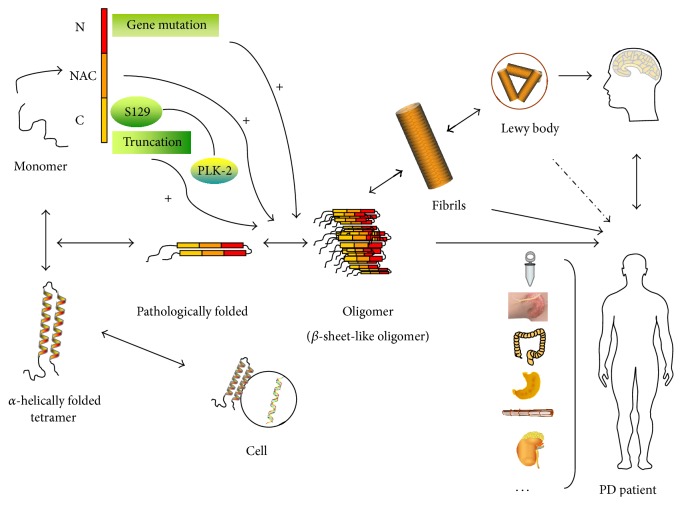
Parkinson's disease is a neurodegenerative disease/synucleinopathy that develops slowly; however, there is no efficient method of early diagnosis, nor is there a cure. Progressive dopaminergic neuronal cell loss in the substantia nigra pars compacta and widespread aggregation of the α-synuclein protein (encoded by the SNCA gene) in the form of Lewy bodies and Lewy neurites are the neuropathological hallmarks of Parkinson's disease. The SNCA gene has undergone gene duplications, triplications, and point mutations. However, the specific mechanism of α-synuclein in Parkinson's disease remains obscure. Recent research showed that various α-synuclein oligomers, pathological aggregation, and propagation appear to be harmful in certain areas in Parkinson's disease patients. This review summarizes our current knowledge of the pathogenetic dysfunction of α-synuclein associated with Parkinson's disease and highlights current approaches that seek to develop this protein as a possible diagnostic biomarker and therapeutic target.
帕金森病是一种进展缓慢的神经退行性疾病/突触核蛋白病;然而,目前尚无有效的早期诊断方法,也无法治愈。黑质致密部多巴胺能神经元进行性丢失以及α-突触核蛋白(由SNCA基因编码)以路易小体和路易神经突的形式广泛聚集是帕金森病的神经病理学特征。SNCA基因发生了基因重复、三倍体化和点突变。然而,α-突触核蛋白在帕金森病中的具体机制仍不清楚。最近的研究表明,各种α-突触核蛋白寡聚体、病理性聚集和传播在帕金森病患者的某些区域似乎是有害的。本综述总结了我们目前对与帕金森病相关的α-突触核蛋白致病功能障碍的认识,并强调了目前试图将该蛋白开发为可能的诊断生物标志物和治疗靶点的方法。