Department of Pediatrics, University of California, San Diego, La Jolla, California, USA
Department of Pediatrics, University of California, San Diego, La Jolla, California, USA.
mSphere. 2020 Apr 22;5(2):e00932-19. doi: 10.1128/mSphere.00932-19.
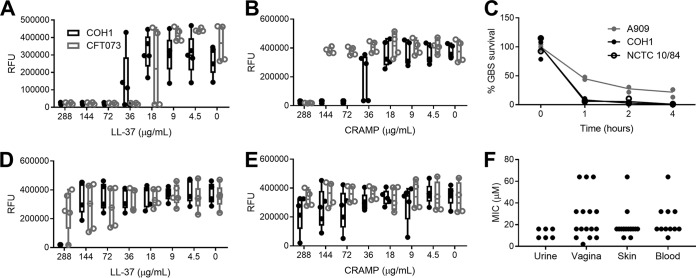
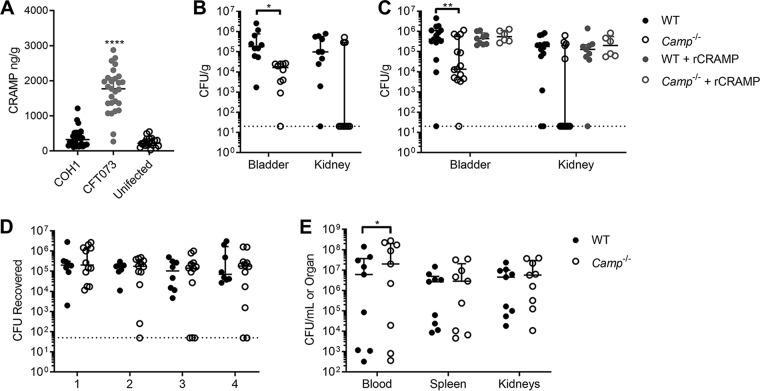
Group B (GBS) causes frequent urinary tract infection (UTI) in susceptible populations, including individuals with type 2 diabetes and pregnant women; however, specific host factors responsible for increased GBS susceptibility in these populations are not well characterized. Here, we investigate cathelicidin, a cationic antimicrobial peptide, known to be critical for defense during UTI with uropathogenic (UPEC). We observed a loss of antimicrobial activity of human and mouse cathelicidins against GBS and UPEC in synthetic urine and no evidence for increased cathelicidin resistance in GBS urinary isolates. Furthermore, we found that GBS degrades cathelicidin in a protease-dependent manner. Surprisingly, in a UTI model, cathelicidin-deficient () mice showed decreased GBS burdens and mast cell recruitment in the bladder compared to levels in wild-type (WT) mice. Pharmacologic inhibition of mast cells reduced GBS burdens and histamine release in WT but not mice. Streptozotocin-induced diabetic mice had increased bladder cathelicidin production and mast cell recruitment at 24 h postinfection with GBS compared to levels in nondiabetic controls. We propose that cathelicidin is an important immune regulator but ineffective antimicrobial peptide against GBS in urine. Combined, our findings may in part explain the increased frequency of GBS UTI in diabetic and pregnant individuals. Certain populations such as diabetic individuals are at increased risk for developing urinary tract infections (UTI), although the underlying reasons for this susceptibility are not fully known. Additionally, diabetics are more likely to become infected with certain types of bacteria, such as group B (GBS). In this study, we find that an antimicrobial peptide called cathelicidin, which is thought to protect the bladder from infection, is ineffective in controlling GBS and alters the type of immune cells that migrate to the bladder during infection. Using a mouse model of diabetes, we observe that diabetic mice are more susceptible to GBS infection even though they also have more infiltrating immune cells and increased production of cathelicidin. Taken together, our findings identify this antimicrobial peptide as a potential contributor to increased susceptibility of diabetic individuals to GBS UTI.
B 群(GBS)在易感人群中经常引起尿路感染(UTI),包括 2 型糖尿病患者和孕妇;然而,导致这些人群中 GBS 易感性增加的特定宿主因素尚未得到很好的描述。在这里,我们研究了一种阳离子抗菌肽——抗菌肽,已知在尿路感染(UTI)中对抗尿路致病性大肠杆菌(UPEC)至关重要。我们观察到,在合成尿液中,人源和鼠源抗菌肽对 GBS 和 UPEC 的抗菌活性丧失,并且在 GBS 尿分离株中没有发现抗菌肽耐药性增加的证据。此外,我们发现 GBS 以依赖蛋白酶的方式降解抗菌肽。令人惊讶的是,在 UTI 模型中,与野生型(WT)小鼠相比,抗菌肽缺陷()小鼠的膀胱 GBS 负荷和肥大细胞募集减少。肥大细胞的药理学抑制降低了 WT 小鼠但不能降低 小鼠的 GBS 负荷和组胺释放。链脲佐菌素诱导的糖尿病小鼠在感染 GBS 后 24 小时,与非糖尿病对照相比,膀胱中 cathelicidin 的产生和肥大细胞募集增加。我们提出,抗菌肽是一种重要的免疫调节剂,但在尿液中对 GBS 不是有效的抗菌肽。综上所述,我们的研究结果可能部分解释了糖尿病患者和孕妇中 GBS UTI 发生率增加的原因。某些人群,如糖尿病患者,更容易发生尿路感染(UTI),尽管导致这种易感性的原因尚不完全清楚。此外,糖尿病患者更容易感染某些类型的细菌,如 B 群(GBS)。在这项研究中,我们发现一种叫做抗菌肽的抗菌肽,它被认为可以保护膀胱免受感染,但在控制 GBS 方面是无效的,并且改变了感染期间迁移到膀胱的免疫细胞类型。使用糖尿病小鼠模型,我们观察到糖尿病小鼠更容易感染 GBS,尽管它们也有更多浸润的免疫细胞和抗菌肽的产生增加。总之,我们的研究结果表明,这种抗菌肽可能是导致糖尿病患者易患 GBS UTI 的一个潜在因素。