Sriman Rajasekaran, Venkatesh K, Mathew Cherian, Pankaj Mehta, Shankar Radhakrishnan
Kovai Medical Center and Hospital (KMCH), Coimbatore, India.
Vinayaka Mission's Kirupananda Variyar Medical College (VMKVMCH), Salem, India.
Pol J Radiol. 2020 Mar 14;85:e137-e143. doi: 10.5114/pjr.2020.93669. eCollection 2020.
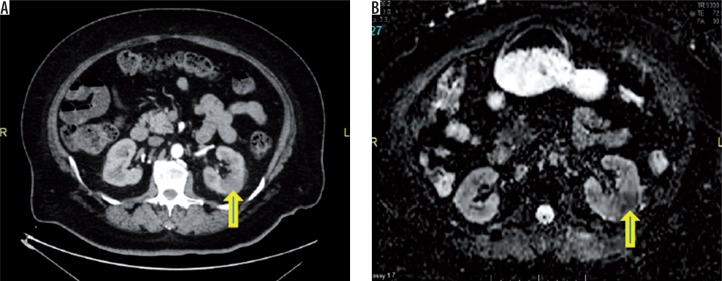
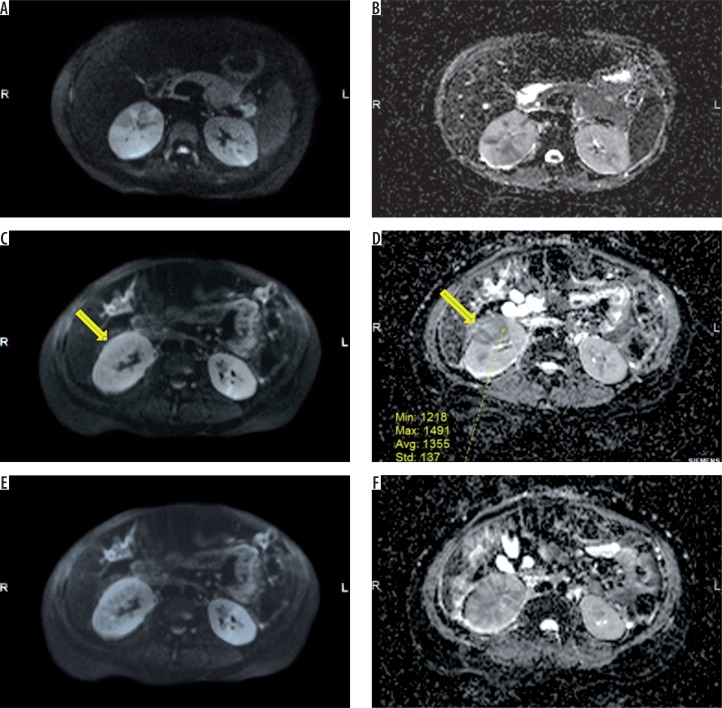
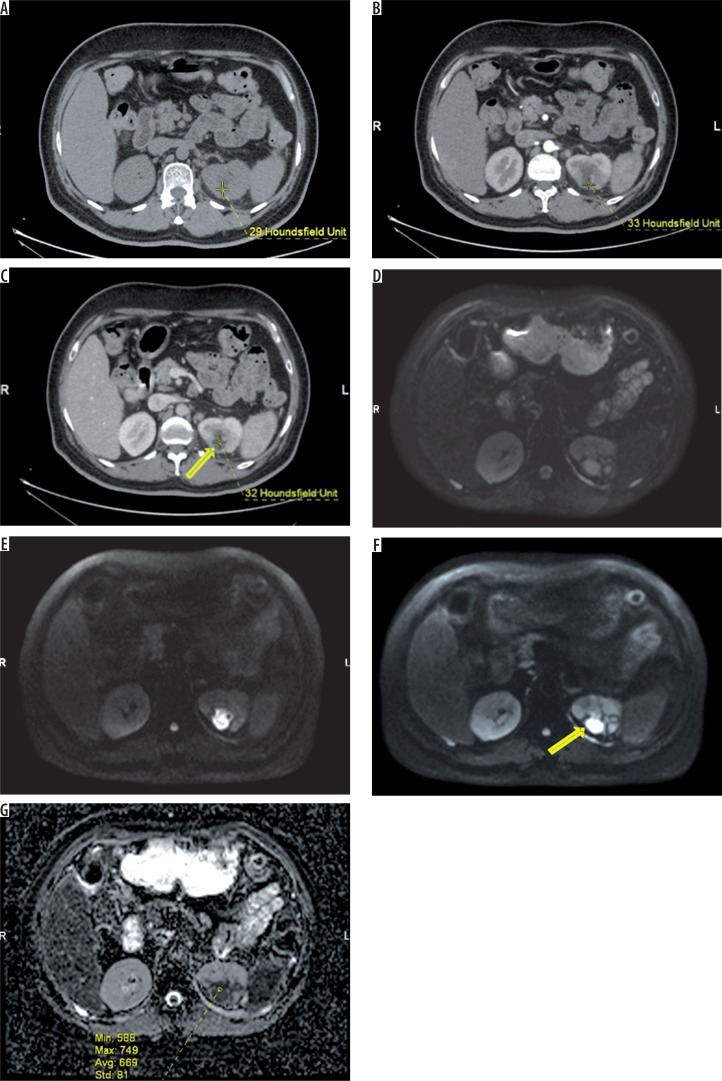
Applications of diffusion-weighted magnetic resonance imaging outside the brain have gained increasing importance in recent years, and recent studies have shown the usage of diffusion-weighted (DW) imaging in diagnosing pyelonephritis based on renal cortical and medullary apparent diffusion coefficient (ADC) values. The aim of this study was to assess the validity of DW magnetic resonance (MR) imaging in comparison with contrast-enhanced computed tomography (CECT) in diagnosing pyelonephritis.
A cross-sectional observational study was conducted for a period of six months in a tertiary hospital in Coimbatore. All patients with clinical and laboratory diagnosis of acute pyelonephritis, who were referred for radiological imaging (CECT), were taken into the study. Out of 112 patients with a clinical and laboratorial diagnosis of acute pyelonephritis (APN), who underwent both DW MR and CECT, diagnosis of APN was made in 100 patients based on CECT, while in 12 cases the investigation (CECT) was negative. Finally, these 100 patients were included in the study. The validity of DW MR imaging in diagnosing APN was assessed by deriving sensitivity, specificity, and positive and negative predictive value in comparison with CECT findings.
The validity report of DW MR imaging in the detection of APN showed a very high sensitivity (96-100%) and specificity (86-90%) and very low false positives (6-10%) and negatives (< 5%), and it also showed that in the areas of affected renal parenchyma ADC values were consistently lower compared to unaffected renal parenchyma.
Based on the generated hypothesis, DW MR imaging of the kidneys seems to be highly sensitive and specific for the detection of focal or diffuse infections within the kidney in comparison with CECT.
近年来,扩散加权磁共振成像在脑外的应用日益重要,近期研究表明扩散加权(DW)成像可基于肾皮质和髓质表观扩散系数(ADC)值用于诊断肾盂肾炎。本研究的目的是评估DW磁共振(MR)成像与对比增强计算机断层扫描(CECT)相比在诊断肾盂肾炎方面的有效性。
在哥印拜陀的一家三级医院进行了为期六个月的横断面观察性研究。所有临床和实验室诊断为急性肾盂肾炎且被转诊进行放射学成像(CECT)的患者均纳入研究。在112例临床和实验室诊断为急性肾盂肾炎(APN)且接受了DW MR和CECT检查的患者中,基于CECT诊断出100例APN,而12例检查(CECT)结果为阴性。最后,这100例患者被纳入研究。通过与CECT结果比较得出敏感性、特异性以及阳性和阴性预测值,来评估DW MR成像在诊断APN方面的有效性。
DW MR成像检测APN的有效性报告显示出非常高的敏感性(96 - 100%)和特异性(86 - 90%),以及非常低的假阳性(6 - 10%)和假阴性(< 5%),并且还表明在受影响的肾实质区域,ADC值与未受影响的肾实质相比始终较低。
基于所提出的假设,与CECT相比,肾脏的DW MR成像在检测肾脏内的局灶性或弥漫性感染方面似乎具有高度的敏感性和特异性。