Department of Clinical Radiology and Nuclear Medicine, University Medical Center Mannheim, Mannheim, Germany.
Department of Radiology, Munich University Hospitals, LMU, Munich, Germany.
PLoS One. 2020 Apr 23;15(4):e0231495. doi: 10.1371/journal.pone.0231495. eCollection 2020.
To examine potential gadolinium (Gd) accumulation in the brain of healthy mice after long-term oral administration of Gd-containing food pellets and to investigate whether Gd leads to adverse central nervous system (CNS) effects, specifically focussing on locomotor impairment in Gd exposed compared to control animals.
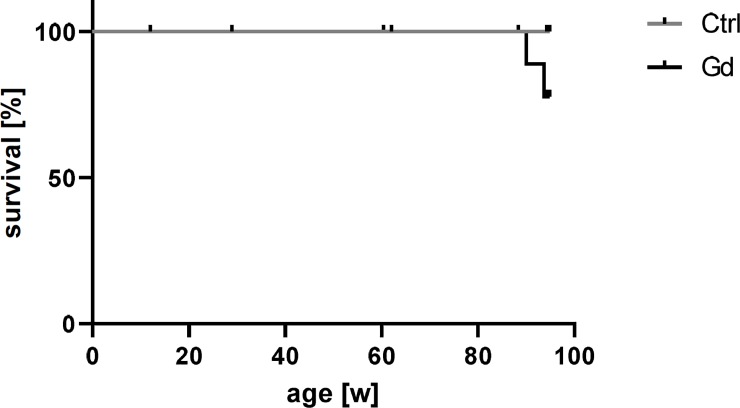
The local Animal Experimental Ethics Committee approved all procedures and applications. Fifteen female C57Bl/6 mice were orally exposed to a daily intake of 0.57 mmol Gd chloride/ kg body weight over a period of 90 weeks from the age of 4 weeks on. Gd-free, but otherwise equivalent experimental diets were given to the control group (N = 13). The animals were monitored daily by animal caretakers regarding any visible signs of distress and evaluated clinically every four weeks for the first 60 weeks and afterwards every two weeks for a better temporal resolution of potential long-term effects regarding impairment of motor performance and loss of body weight. The individual Gd content was measured using mass spectrometry in a sub-cohort of N = 6 mice.
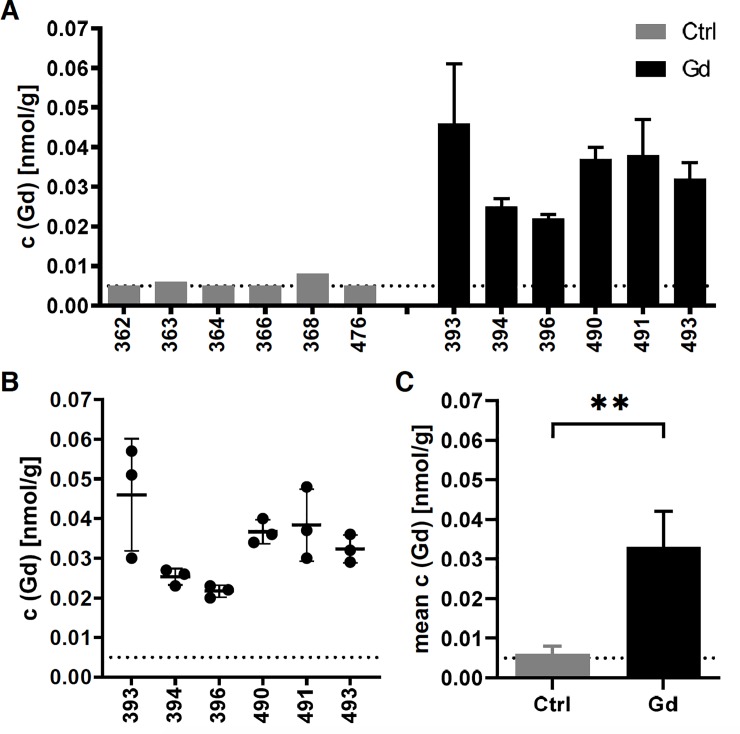
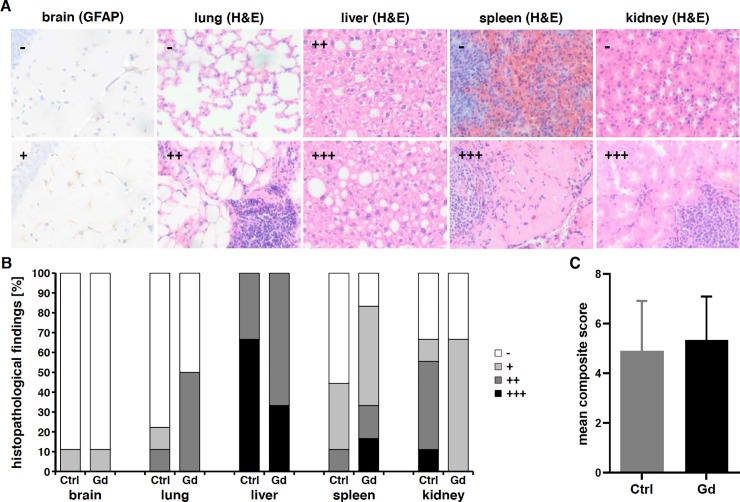
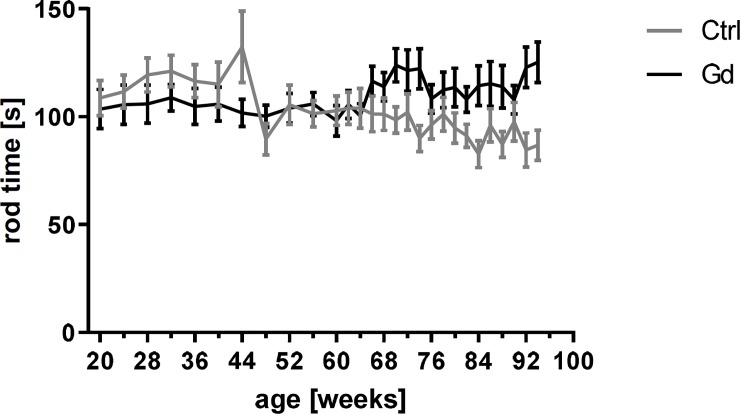
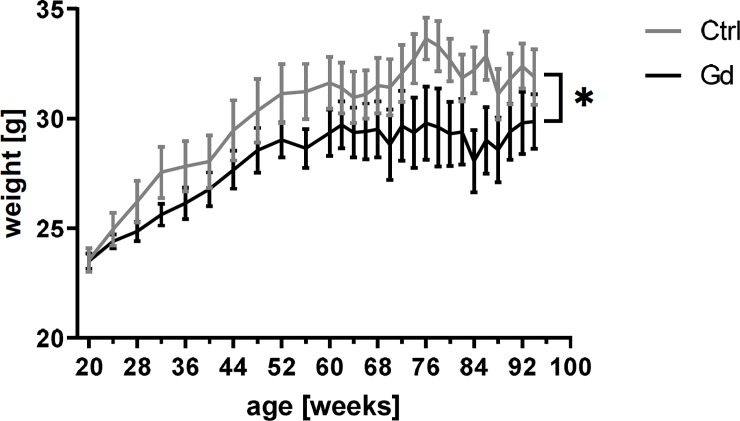
The absolute brain Gd levels of the Gd-exposed mice were significantly increased compared to control mice (0.033± 0.009 vs. 0.006± 0.002 nmol Gd/ g brain tissue). Long-term oral Gd exposure over almost the entire life-span did not lead to adverse CNS effects including locomotor changes (rotarod performance, p = 0.1467) in healthy mice throughout the study period. Gd-exposed mice showed less increased body weight compared to control mice during the study period (p = 0.0423). Histopathological alterations, such as hepatocellular vacuolization due to fatty change in the liver and a loss of nucleated cells in the red pulp of the spleen, were found in peripheral organs of both groups.
Low levels of intracerebral Gd caused by chronic oral exposure over almost the entire life span of mice did not lead to alterations in locomotor abilities in healthy mice throughout the normal aging process.
研究长期口服含钆食物丸后健康小鼠大脑中潜在的钆积累情况,并探讨钆是否会导致不良的中枢神经系统(CNS)效应,特别是聚焦于暴露于钆的动物与对照组动物相比运动功能障碍。
当地动物实验伦理委员会批准了所有程序和应用。15 只雌性 C57Bl/6 小鼠从 4 周龄开始,每天口服 0.57mmol Gd 氯化物/kg 体重,持续 90 周。对照组(N=13)给予不含 Gd、但其他方面等效的实验饮食。动物护理人员每天监测动物是否有任何明显的不适迹象,并在前 60 周每四周临床评估一次,之后每两周评估一次,以更好地检测潜在的长期运动表现受损和体重减轻的影响。使用质谱法在亚组 N=6 只小鼠中测量个体 Gd 含量。
与对照组相比,暴露于 Gd 的小鼠的大脑 Gd 含量绝对值明显增加(0.033±0.009 与 0.006±0.002 nmol Gd/g 脑组织)。在近整个生命周期中,长期口服 Gd 暴露并未导致健康小鼠的中枢神经系统不良影响,包括运动变化(转棒性能,p=0.1467)。在整个研究期间,暴露于 Gd 的小鼠的体重增加幅度低于对照组。在研究期间,两组的外周器官均发现组织学改变,如肝脏的肝细胞空泡化和脾脏红髓有核细胞丢失。
在正常衰老过程中,慢性口服暴露几乎在整个小鼠生命周期内导致的低水平脑内 Gd 并未导致健康小鼠运动能力的改变。