Institute of Bioanalytical Chemistry, Faculty of Chemistry and Mineralogy, University of Leipzig, Deutscher Platz 5, 04103 Leipzig, Germany.
Center for Biotechnology and Biomedicine, University of Leipzig, Deutscher Platz 5, 04103 Leipzig, Germany.
Molecules. 2020 Apr 21;25(8):1925. doi: 10.3390/molecules25081925.
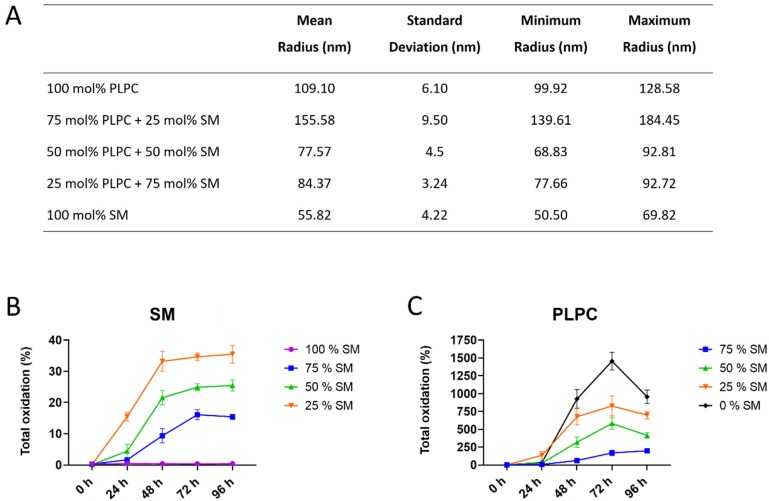
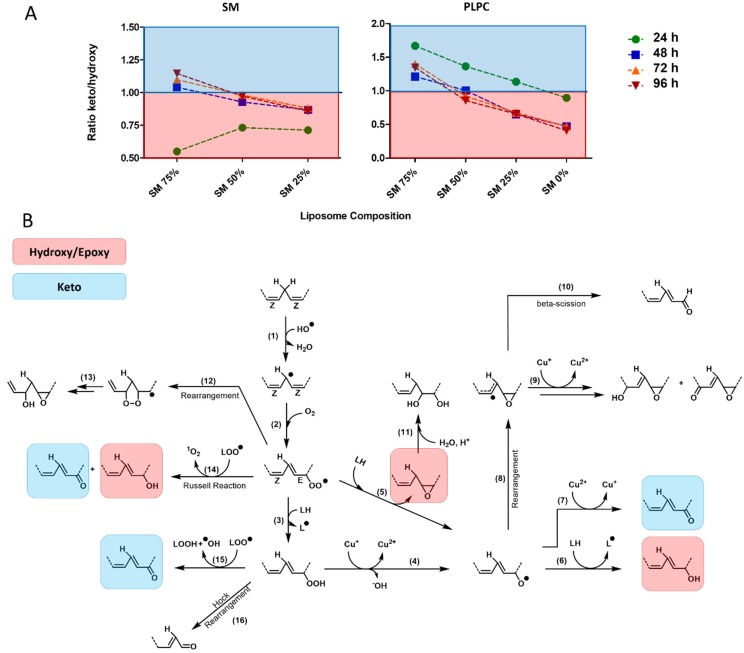
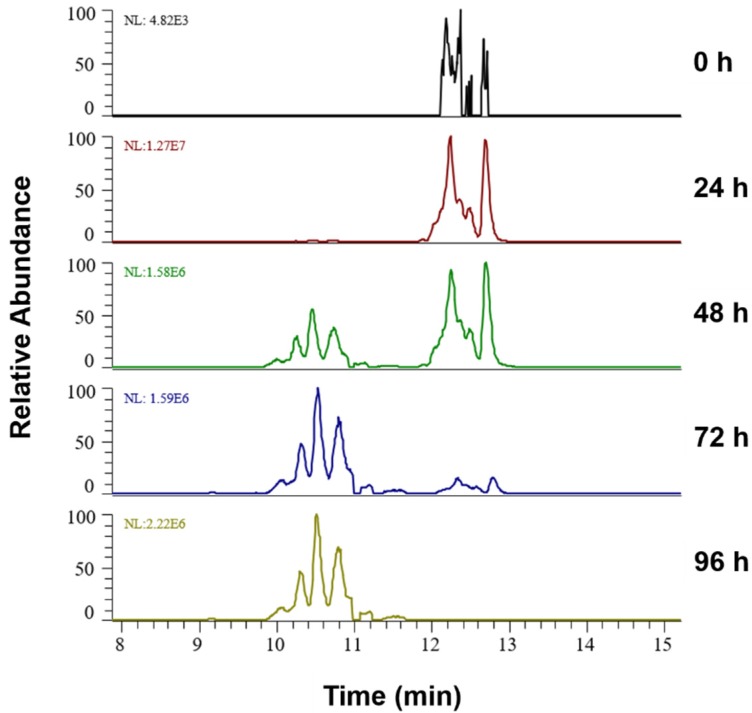
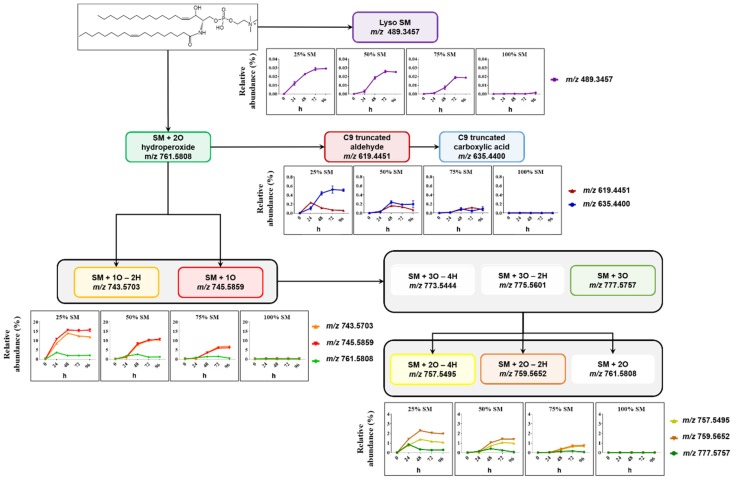
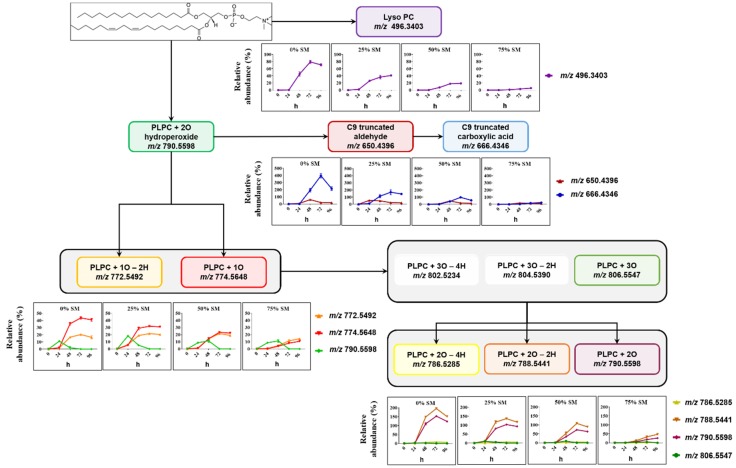
Free radical driven lipid peroxidation is a chain reaction which can lead to oxidative degradation of biological membranes. Propagation vs. termination rates of peroxidation in biological membranes are determined by a variety of factors including fatty acyl chain composition, presence of antioxidants, as well as biophysical properties of mono- or bilayers. Sphingomyelins (SMs), a class of sphingophospholipids, were previously described to inhibit lipid oxidation most probably via the formation of H-bond network within membranes. To address the "antioxidant" potential of SMs, we performed LC-MS/MS analysis of model SM/glycerophosphatidylcholine (PC) liposomes with different SM fraction after induction of radical driven lipid peroxidation. Increasing SM fraction led to a strong suppression of lipid peroxidation. Electrochemical oxidation of non-liposomal SMs eliminated the observed effect, indicating the importance of membrane structure for inhibition of peroxidation propagation. High resolution MS analysis of lipid peroxidation products (LPPs) observed in in vitro oxidized SM/PC liposomes allowed to identify and relatively quantify SM- and PC-derived LPPs. Moreover, mapping quantified LPPs to the known pathways of lipid peroxidation allowed to demonstrate significant decrease in mono-hydroxy(epoxy) LPPs relative to mono-keto derivatives in SM-rich liposomes. The results presented here illustrate an important property of SMs in biological membranes, acting as "biophysical antioxidant". Furthermore, a ratio between mono-keto/mono-hydroxy(epoxy) oxidized species can be used as a marker of lipid peroxidation propagation in the presence of different antioxidants.
自由基引发的脂质过氧化是一个链式反应,可导致生物膜的氧化降解。生物膜中过氧化的增殖与终止速率由多种因素决定,包括脂肪酸链组成、抗氧化剂的存在以及单层或双层的生物物理性质。神经鞘磷脂(SMs)是一类神经鞘磷脂,先前被描述为通过在膜内形成氢键网络来抑制脂质氧化,这可能是由于其具有抗氧化特性。为了研究 SMs 的“抗氧化”潜力,我们对不同 SM 分数的模型 SM/甘油磷酸胆碱(PC)脂质体进行了 LC-MS/MS 分析,这些模型 SM/甘油磷酸胆碱(PC)脂质体在自由基引发的脂质过氧化诱导后。随着 SM 分数的增加,脂质过氧化受到强烈抑制。非脂质体 SMs 的电化学氧化消除了观察到的效果,表明膜结构对抑制过氧化增殖的重要性。对体外氧化 SM/PC 脂质体中观察到的脂质过氧化产物(LPPs)进行高分辨率 MS 分析,可识别和相对定量 SM 和 PC 衍生的 LPPs。此外,将定量的 LPPs 映射到已知的脂质过氧化途径,表明在富含 SM 的脂质体中,相对于单酮衍生物,单羟基(环氧)LPPs 的含量显著降低。本研究结果说明了 SMs 在生物膜中作为“生物物理抗氧化剂”的重要特性。此外,在存在不同抗氧化剂的情况下,单酮/单羟基(环氧)氧化产物的比例可作为脂质过氧化增殖的标志物。