Independence Blue Cross Cardiovascular Research Center, Lewis Katz School of Medicine at Temple University, Philadelphia, PA, United States.
Center for Metabolic Disease, Lewis Katz School of Medicine at Temple University, Philadelphia, PA, United States.
Front Immunol. 2020 Apr 9;11:639. doi: 10.3389/fimmu.2020.00639. eCollection 2020.
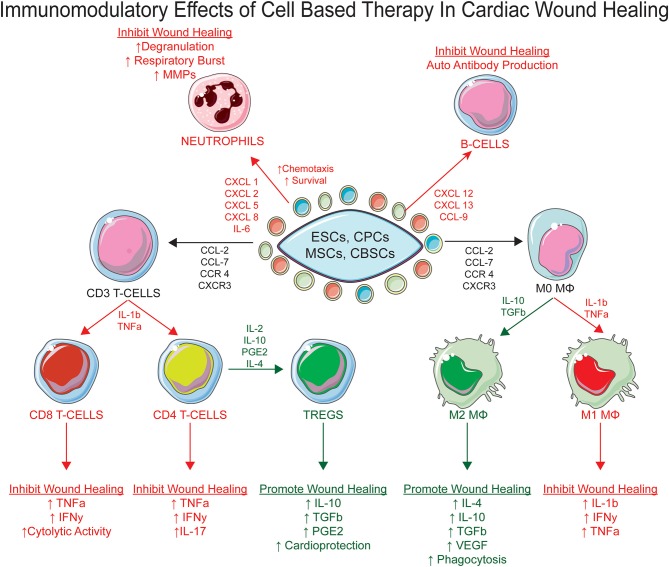
Cardiovascular Disease (CVD) is a leading cause of mortality within the United States. Current treatments being administered to patients who suffered a myocardial infarction (MI) have increased patient survival, but do not facilitate the replacement of damaged myocardium. Recent studies demonstrate that stem cell-based therapies promote myocardial repair; however, the poor engraftment of the transferred stem cell populations within the infarcted myocardium is a major limitation, regardless of the cell type. One explanation for poor cell retention is attributed to the harsh inflammatory response mounted following MI. The inflammatory response coupled to cardiac repair processes is divided into two distinct phases. The first phase is initiated during ischemic injury when necrosed myocardium releases Danger Associated Molecular Patterns (DAMPs) and chemokines/cytokines to induce the activation and recruitment of neutrophils and pro-inflammatory M1 macrophages (MΦs); in turn, facilitating necrotic tissue clearance. During the second phase, a shift from the M1 inflammatory functional phenotype to the M2 anti-inflammatory and pro-reparative functional phenotype, permits the resolution of inflammation and the establishment of tissue repair. T-regulatory cells (Tregs) are also influential in mediating the establishment of the pro-reparative phase by directly regulating M1 to M2 MΦ differentiation. Current studies suggest CD4+ T-lymphocyte populations become activated when presented with autoantigens released from the injured myocardium. The identity of the cardiac autoantigens or paracrine signaling molecules released from the ischemic tissue that directly mediate the phenotypic plasticity of T-lymphocyte populations in the post-MI heart are just beginning to be elucidated. Stem cells are enriched centers that contain a diverse paracrine secretome that can directly regulate responses within neighboring cell populations. Previous studies identify that stem cell mediated paracrine signaling can influence the phenotype and function of immune cell populations , but how stem cells directly mediate the inflammatory microenvironment of the ischemic heart is poorly characterized and is a topic of extensive investigation. In this review, we summarize the complex literature that details the inflammatory microenvironment of the ischemic heart and provide novel insights regarding how paracrine mediated signaling produced by stem cell-based therapies can regulate immune cell subsets to facilitate pro-reparative myocardial wound healing.
心血管疾病 (CVD) 是美国的主要死亡原因。目前对心肌梗死 (MI) 患者的治疗方法提高了患者的生存率,但不能促进受损心肌的替代。最近的研究表明,基于干细胞的疗法可促进心肌修复;然而,无论细胞类型如何,在梗死心肌中移植的干细胞群体的植入不良是一个主要限制因素。细胞保留不良的一个解释归因于 MI 后发生的严重炎症反应。与心脏修复过程相关的炎症反应分为两个不同的阶段。第一阶段是在缺血性损伤时启动的,当坏死的心肌释放危险相关分子模式 (DAMPs) 和趋化因子/细胞因子以诱导中性粒细胞和促炎 M1 巨噬细胞 (MΦ) 的激活和募集时;反过来,促进坏死组织清除。在第二阶段,从 M1 炎症功能表型向 M2 抗炎和促修复功能表型的转变,允许炎症的消退和组织修复的建立。调节性 T 细胞 (Treg) 通过直接调节 M1 向 M2 MΦ 分化,在介导修复阶段的建立中也具有重要作用。目前的研究表明,当遇到来自受损心肌的自身抗原时,CD4+T 淋巴细胞群被激活。释放自缺血组织的心脏自身抗原或旁分泌信号分子的身份,这些分子直接介导 MI 后 T 淋巴细胞群的表型可塑性,刚刚开始阐明。干细胞是富含旁分泌分泌组的中心,可直接调节邻近细胞群体的反应。先前的研究表明,干细胞介导的旁分泌信号可以影响免疫细胞群体的表型和功能,但是干细胞如何直接调节缺血心脏的炎症微环境的特征描述很差,是一个广泛研究的课题。在这篇综述中,我们总结了详细描述缺血性心脏炎症微环境的复杂文献,并提供了关于基于干细胞的疗法产生的旁分泌介导信号如何调节免疫细胞亚群以促进修复性心肌伤口愈合的新见解。