Asefa Adane, Zewudie Ameha, Henok Andualem, Mamo Yitagesu, Nigussie Tadesse
Department of Public Health, College of Health Science, Mizan-Tepi University, Mizan-Aman, Ethiopia.
Department of Pharmacy, College of Health Science, Mizan-Tepi University, Mizan-Aman, Ethiopia.
Psychiatry J. 2020 Apr 12;2020:6486030. doi: 10.1155/2020/6486030. eCollection 2020.
Diabetes mellitus and depression are very common diseases worldwide, and the prevalence rates of both conditions are increasing rapidly. Depression among patients with diabetes mellitus results in poor glycemic control through different mechanisms. Besides, the coexistence of a chronic medical illness with depression reduces the probability of recognizing and treating depression. The study is aimed at assessing the prevalence and factors associated with depression among adults with diabetes mellitus.
A hospital-based cross-sectional study was conducted among adult diabetes mellitus patients on follow-up in Mizan-Tepi University Teaching Hospital and Tepi General Hospital. A consecutive sampling technique was employed to recruit the study participants, and data were collected through face-to-face interview and medical chart review. Depression was measured using Patient Health Questionnaire-nine (PHQ-9). Binary logistic regression analysis was done and a value of less than 0.05 was used as a level of significance.
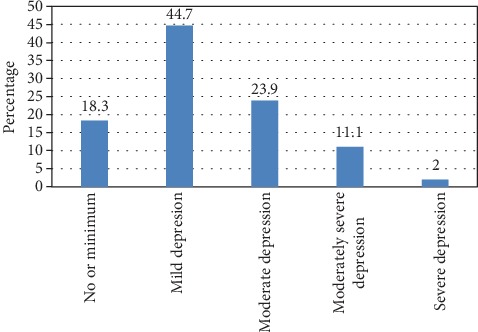
The prevalence of depression among study participants was 37.0% (95% CI 32.0%-42.0%). The majority (44.7%) of the patients had mild depression, while only 2% had severe depression. Being male (AOR = 1.92, 95% CI: 1.15-3.22), urban residence (AOR = 3.02, 95% CI: 1.57-5.78), single marital status (AOR = 7.72, 95% CI: 3.6-16.53), duration of diabetes mellitus 5 years and more (AOR = 2.00, 95% CI: 1.21-3.5), and having sexual dysfunction ( = 3.55, 95% CI: 2.13-5.91) were associated with increased odds of depression among diabetes mellitus patients.
The prevalence of depression among diabetes mellitus was high. Therefore, the patients should be thoroughly screened for this comorbid condition, and the significant factors should be addressed during routine follow-up.
糖尿病和抑郁症是全球非常常见的疾病,且这两种疾病的患病率都在迅速上升。糖尿病患者中的抑郁症通过不同机制导致血糖控制不佳。此外,慢性疾病与抑郁症并存会降低识别和治疗抑郁症的可能性。本研究旨在评估成年糖尿病患者中抑郁症的患病率及相关因素。
在米赞-泰皮大学教学医院和泰皮综合医院对成年糖尿病患者进行了一项基于医院的横断面研究。采用连续抽样技术招募研究参与者,并通过面对面访谈和病历审查收集数据。使用患者健康问卷-9(PHQ-9)测量抑郁症。进行二元逻辑回归分析,以小于0.05的值作为显著性水平。
研究参与者中抑郁症的患病率为37.0%(95%置信区间32.0%-42.0%)。大多数(44.7%)患者患有轻度抑郁症,而只有2%患有重度抑郁症。男性(比值比=1.92,95%置信区间:1.15-3.22)、城市居住(比值比=3.02,95%置信区间:1.57-5.78)、单身婚姻状况(比值比=7.72,95%置信区间:3.6-16.53)、糖尿病病程5年及以上(比值比=2.00,95%置信区间:1.21-3.5)以及存在性功能障碍(比值比=3.55,95%置信区间:2.13-5.91)与糖尿病患者患抑郁症的几率增加有关。
糖尿病患者中抑郁症的患病率很高。因此,应对患者进行这种合并症的全面筛查,并在常规随访期间关注这些重要因素。