Laboratory of Experimental Medicine and Paediatrics, Faculty of Medicine and Health Sciences, University of Antwerp, Antwerp, Belgium; Infla-Med Research Consortium of Excellence, University of Antwerp, Antwerp, Belgium.
Laboratory of Experimental Medicine and Paediatrics, Faculty of Medicine and Health Sciences, University of Antwerp, Antwerp, Belgium; Infla-Med Research Consortium of Excellence, University of Antwerp, Antwerp, Belgium; Antwerp University Hospital, Edegem, Belgium.
EBioMedicine. 2020 Apr;54:102725. doi: 10.1016/j.ebiom.2020.102725. Epub 2020 Apr 21.
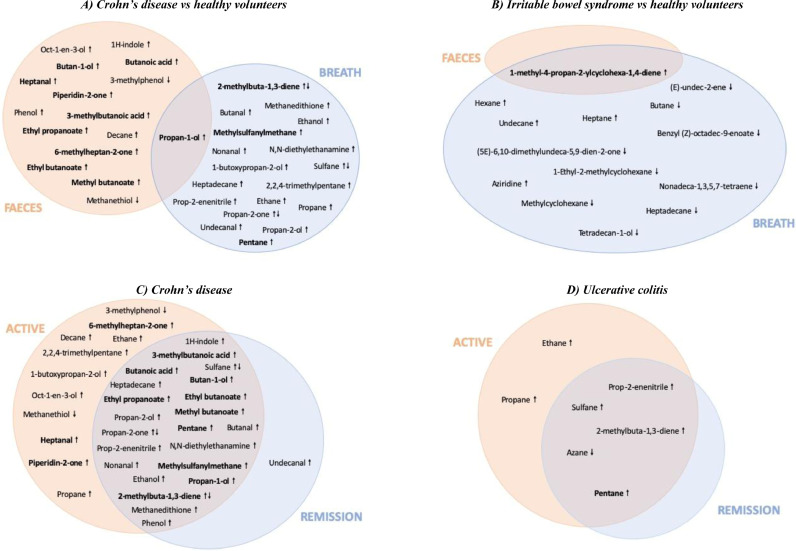
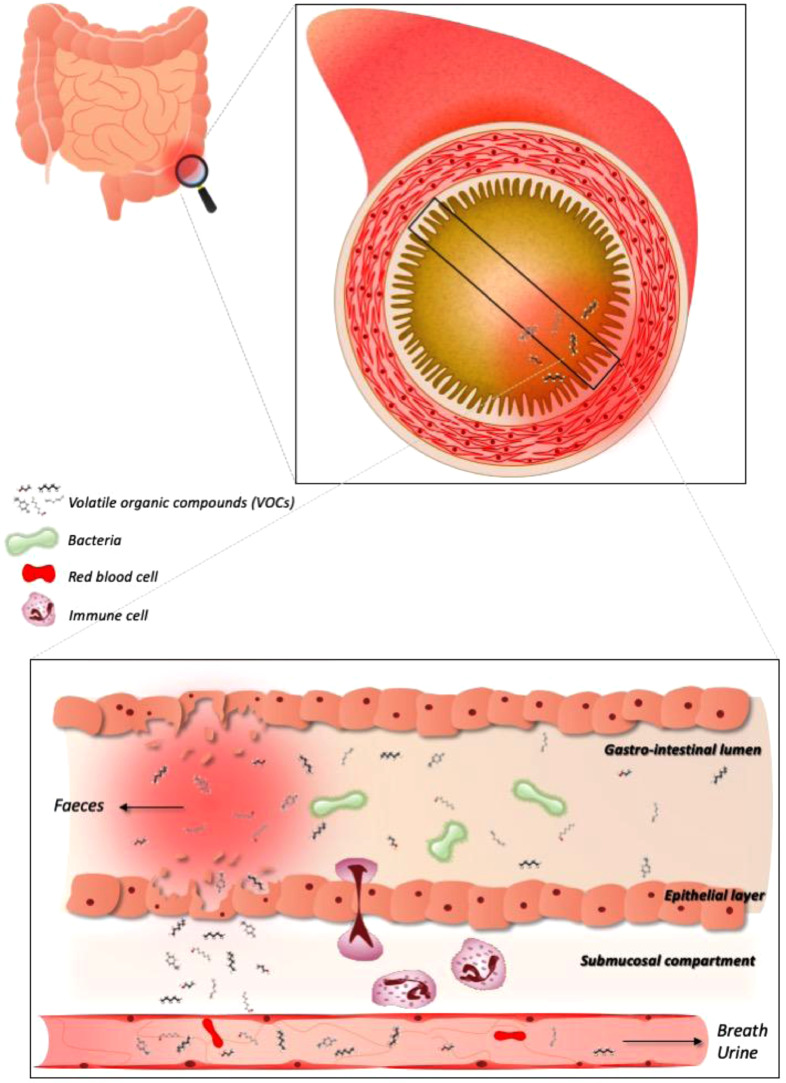
Volatile organic compounds (VOCs) are produced by the human metabolism, inflammation and gut microbiota and form the basis of innovative volatomics research. VOCs detected through breath and faecal analysis hence serve as attractive, non-invasive biomarkers for diagnosing and monitoring irritable bowel syndrome (IBS) and inflammatory bowel disease (IBD). This review describes the clinical applicability of volatomics in discriminating between IBS, IBD and healthy volunteers with acceptable accuracy in breath (70%-100%) and faecal (58%-85%) samples. Promising compounds are propan-1-ol for diagnosing and monitoring of IBD patients, and 1-methyl-4-propan-2-ylcyclohexa-1,4-diene as biomarker for IBS diagnosis. However, these VOCs often seem to be related to inflammation and probably will need to be used in conjunction with other clinical evidence. Furthermore, three interventional studies underlined the potential of VOCs in predicting treatment outcome and patient follow-up. This shows great promise for future use of VOCs as non-invasive breath and faecal biomarkers in personalised medicine. However, properly designed studies that correlate VOCs to IBD/IBS pathogenesis, while taking microbial influences into account, are still key before clinical implementation can be expected.
挥发性有机化合物 (VOCs) 是由人体代谢、炎症和肠道微生物群产生的,它们构成了创新的挥发物研究的基础。通过呼吸和粪便分析检测到的 VOCs 因此成为诊断和监测肠易激综合征 (IBS) 和炎症性肠病 (IBD) 的有吸引力的非侵入性生物标志物。本综述描述了挥发物在区分 IBS、IBD 和健康志愿者方面的临床应用,在呼吸 (70%-100%) 和粪便 (58%-85%) 样本中具有可接受的准确性。有前途的化合物是用于诊断和监测 IBD 患者的 1-丙醇,以及用于 IBS 诊断的 1-甲基-4-异丙基环己-1,4-二烯。然而,这些 VOC 似乎通常与炎症有关,可能需要与其他临床证据结合使用。此外,三项干预研究强调了 VOC 在预测治疗效果和患者随访方面的潜力。这为未来将 VOC 作为个性化医学中的非侵入性呼吸和粪便生物标志物的使用提供了很大的希望。然而,在临床实施之前,仍然需要设计适当的研究,将 VOC 与 IBD/IBS 的发病机制相关联,并考虑微生物的影响。