Mahalingam Thirega, Chen Weidong, Rajapakse Chandima Shashikala, Somachandra Kandangamuwa Pathirannahalage, Attanayake Renuka Nilmini
Department of Plant and Molecular Biology, University of Kelaniya, Kelaniya 11600, Sri Lanka.
United States Department of Agriculture-Agriculture Research Service (USDA-ARS), Grain Legume Genetics and Physiology Research Unit, Washington State University, Pullman, WA 99164, USA.
Pathogens. 2020 Apr 22;9(4):306. doi: 10.3390/pathogens9040306.
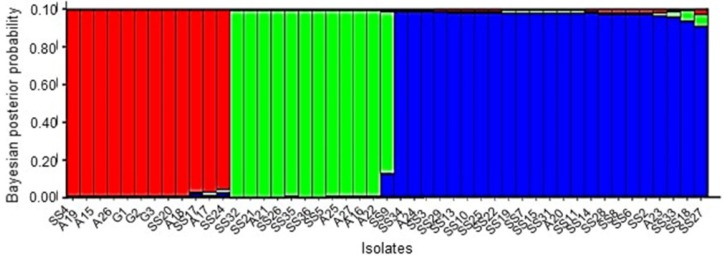
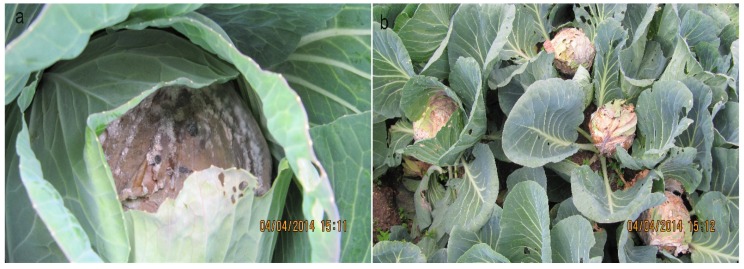
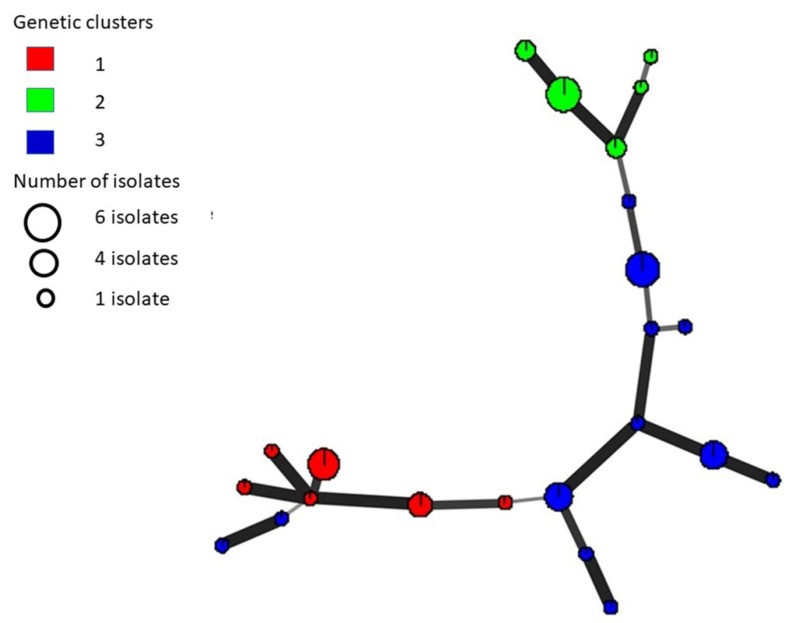
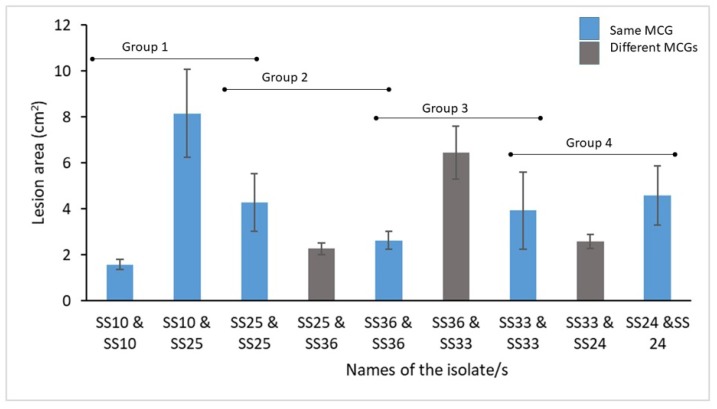
is an important fungal pathogen on many economically important crops including cabbage worldwide. Even though population structure and genetic diversity of is well studied in temperate climatic conditions, only a few studies have been conducted in tropical countries. It is also not clear whether the populations are clonal or recombining in the tropics. In filling this information gap, 47 isolates of were collected from commercial cabbage ( L.) fields in Nuwara Eliya district of Sri Lanka, where the disease has been previously reported. All the isolates were subjected to genetic diversity study using mycelial compatibility grouping and microsatellite markers. Fourteen mycelial compatibility groups (MCGs) and 23 multilocus haplotypes (MLHs) were recorded. Mean expected heterozygosity of the population was 0.56. MLHs were weakly correlated with MCGs. Population genetic structure analysis and principal coordinates identified three genetic clusters. Genetic recombination was inferred within each genetic cluster when isolates were subjected to clone correction. There was evidence of multiple infections on single plant as detected by the presence of more than one MCG on each cabbage plant. However, multiple infections did not increase the disease severity in detached leaf assay. We found high genetic diversity and recombination of population in a tropical country, Sri Lanka. Importance of detecting genetic structure when inferring recombination was also highlighted.
是一种重要的真菌病原体,可感染全球许多包括卷心菜在内的经济作物。尽管在温带气候条件下对其种群结构和遗传多样性进行了充分研究,但在热带国家仅开展了少数研究。热带地区的种群是克隆的还是重组的也不清楚。为填补这一信息空白,从斯里兰卡努沃勒埃利耶地区的商业卷心菜(甘蓝)田中采集了47株该病菌的分离株,此前该地区已报道过这种病害。所有分离株都通过菌丝体相容性分组和微卫星标记进行了遗传多样性研究。记录到14个菌丝体相容性组(MCG)和23个多位点单倍型(MLH)。该种群的平均预期杂合度为0.56。MLH与MCG呈弱相关。种群遗传结构分析和主坐标分析确定了三个遗传簇。当对分离株进行克隆校正时,推断每个遗传簇内存在基因重组。通过每株卷心菜上存在多个MCG检测到单株上有多次感染的证据。然而,在离体叶片试验中,多次感染并未增加病害严重程度。我们发现,在热带国家斯里兰卡,该病菌种群具有高遗传多样性和重组现象。还强调了在推断重组时检测遗传结构的重要性。