Lehner Miller S, de Paula Júnior Trazilbo J, Del Ponte Emerson M, Mizubuti Eduardo S G, Pethybridge Sarah J
School of Integrative Plant Science, Plant Pathology & Plant-Microbe Biology Section, Cornell University, Geneva, New York, United States of America.
Empresa de Pesquisa Agropecuária de Minas Gerais (EPAMIG), Viçosa, Minas Gerais, Brazil.
PLoS One. 2017 Mar 15;12(3):e0173915. doi: 10.1371/journal.pone.0173915. eCollection 2017.
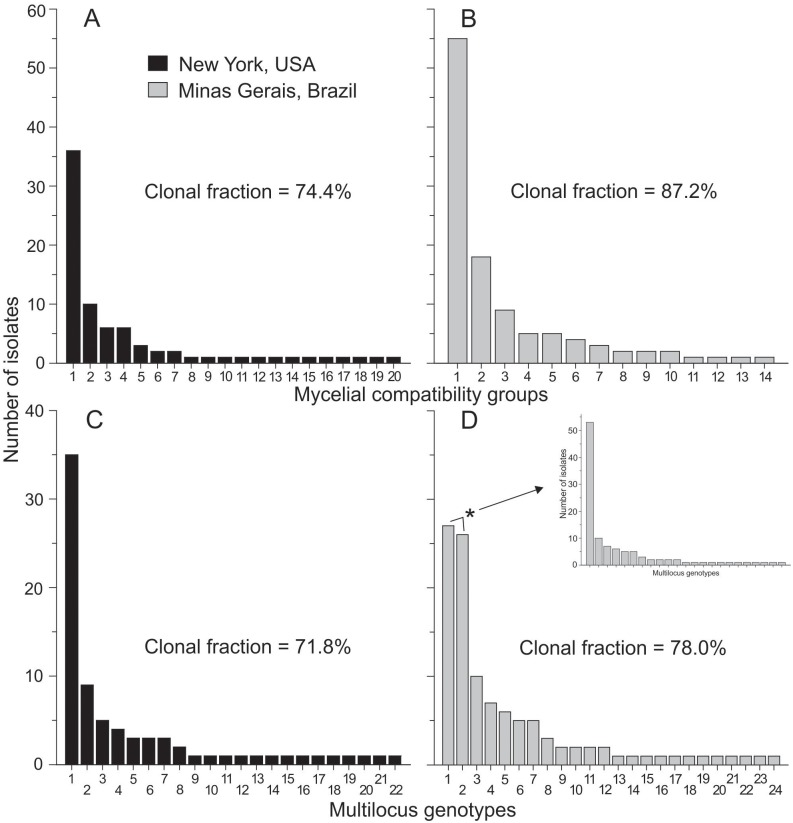
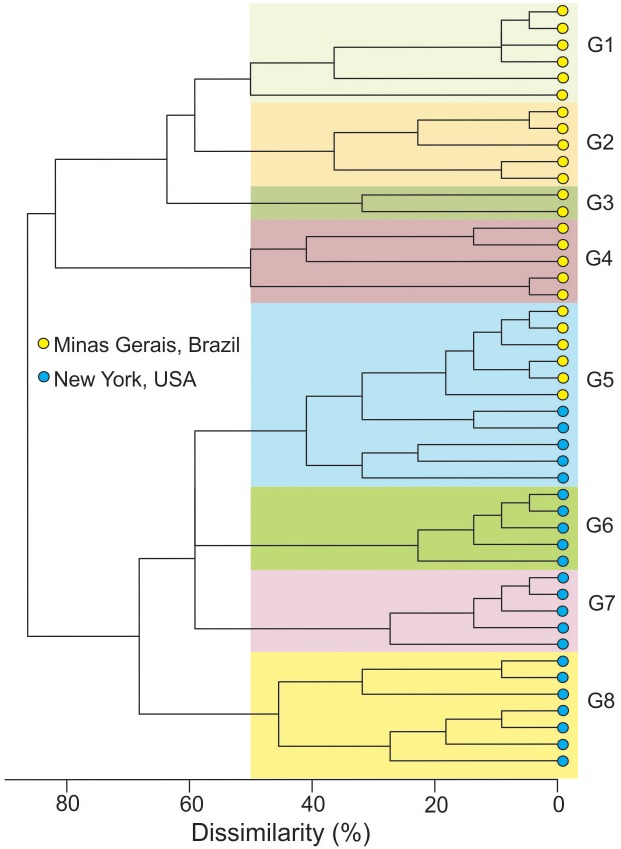
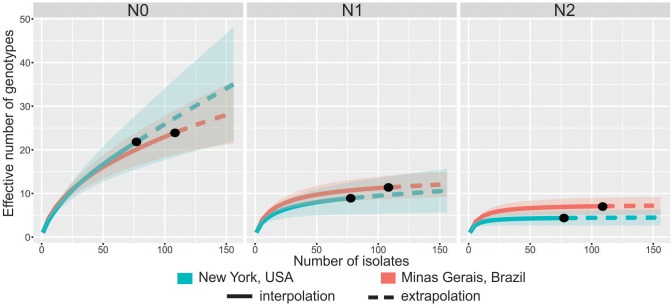
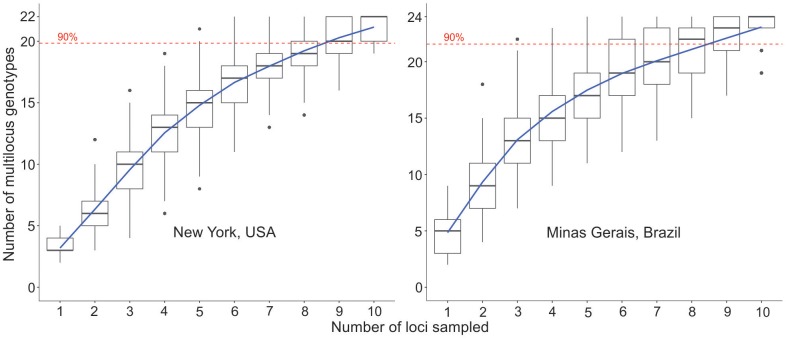
Sclerotinia sclerotiorum populations from tropical agricultural zones have been suggested to be more variable compared to those from temperate zones. However, no data were available comparing populations from both zones using the same set of markers. In this study, we compared S. sclerotiorum populations from the United States of America (USA, temperate) and southeast Brazil (tropical) using the frequency of mycelial compatibility groups (MCGs) and 13 microsatellite (SSR) markers. Populations were sourced from diseased plants within leguminous crops in New York, USA (NY; n = 78 isolates), and Minas Gerais State, Brazil (MG; n = 109). Twenty MCGs were identified in NY and 14 were previously reported in MG. The effective number of genotypes based on Hill's number of order 0, which corresponded to the number of multilocus genotypes (MLGs) were 22 (95% CI = 15.6-28.4) and 24 (95% CI = 18.9-29.1) in NY and MG, respectively. Clonal fractions of MLGs were 71.8% (NY) and 78.0% (MG). The effective number of genotypes based on Hill's number of orders 1 and 2 in NY were 8.9 (95% CI = 5.2-12.6) and 4.4 (95% CI = 2.6-6.1), respectively. For MG these indices were 11.4 (95% CI = 8.7-14.1) and 7.1 (95% CI = 5.1-9.0), respectively. There were no significant differences of allelic richness, private allelic richness, gene diversity, effective number of alleles and genotype evenness between the NY and MG populations. The populations were differentiated, with 29% of total variance attributed to differences between them and G''ST and Jost's D indices higher than 0.50. Cluster analysis revealed dissimilarity higher than 80% among most MLGs from both populations. Different alleles segregated in the populations but both had similar levels of genotypic variability.
与温带地区的核盘菌群体相比,热带农业区的核盘菌群体被认为具有更高的变异性。然而,目前尚无使用同一组标记对这两个地区的群体进行比较的数据。在本研究中,我们利用菌丝体亲和群(MCGs)的频率和13个微卫星(SSR)标记,对来自美利坚合众国(美国,温带)和巴西东南部(热带)的核盘菌群体进行了比较。群体样本分别取自美国纽约州(NY;n = 78个分离株)和巴西米纳斯吉拉斯州(MG;n = 109个分离株)豆科作物的患病植株。在纽约州鉴定出20个MCGs,而在米纳斯吉拉斯州此前已报道过14个。基于希尔0阶数的基因型有效数量,即对应多位点基因型(MLGs)的数量,在纽约州和米纳斯吉拉斯州分别为22个(95%置信区间 = 15.6 - 28.4)和24个(95%置信区间 = 18.9 - 29.1)。MLGs的克隆比例在纽约州为71.8%,在米纳斯吉拉斯州为78.0%。基于希尔1阶数和2阶数,纽约州的基因型有效数量分别为8.9个(95%置信区间 = 5.2 - 12.6)和4.4个(95%置信区间 = 2.6 - 6.1)。对于米纳斯吉拉斯州,这些指数分别为11.4个(95%置信区间 = 8.7 - 14.1)和7.1个(95%置信区间 = 5.1 - 9.0)。纽约州和米纳斯吉拉斯州群体之间的等位基因丰富度、私有等位基因丰富度、基因多样性、等位基因有效数量和基因型均匀度均无显著差异。这两个群体存在分化,总变异的29%归因于它们之间的差异,且G''ST和乔斯特D指数高于0.50。聚类分析显示,两个群体中大多数MLGs之间的差异度高于80%。群体中存在不同的等位基因分离,但两者具有相似水平的基因型变异性。