Public Health Policy Evaluation Unit, School of Public Health, Imperial College London, London, UK
Department of Public Health, University "Federico II" of Naples, Naples, Italy.
BMJ Open Diabetes Res Care. 2020 Apr;8(1). doi: 10.1136/bmjdrc-2019-001061.
The associated risk of vascular disease following diagnosis of type 2 diabetes in people previously identified as having pre-diabetes in real-world settings is unknown. We examined the presence of microvascular and macrovascular disease in individuals with newly diagnosed type 2 diabetes by glycemic status within 3 years before diagnosis.
We identified 159 736 individuals with newly diagnosed type 2 diabetes from the UK Clinical Practice Research Datalink database in England between 2004 and 2017. We used logistic regression models to compare presence of microvascular (retinopathy and nephropathy) and macrovascular (acute coronary syndrome, cerebrovascular and peripheral arterial disease) disease at the time of type 2 diabetes diagnosis by prior glycemic status.
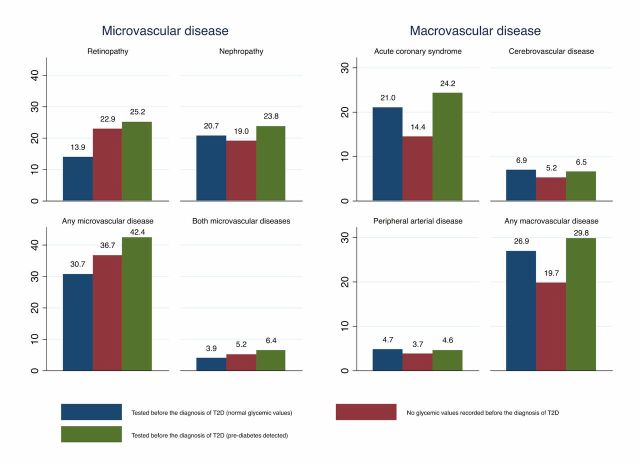
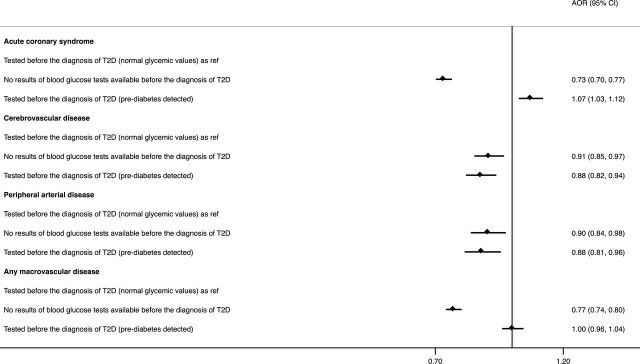
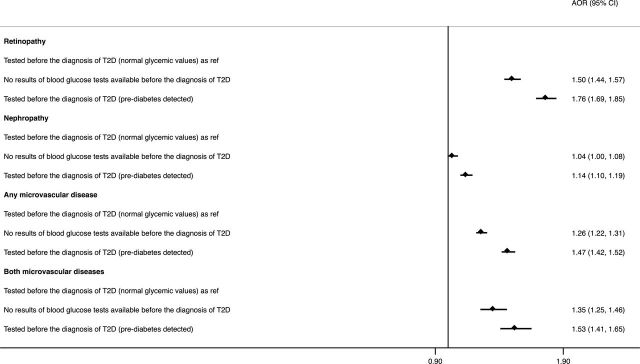
Half of the study population (49.9%) had at least one vascular disease, over one-third (37.4%) had microvascular disease, and almost a quarter (23.5%) had a diagnosed macrovascular disease at the time of type 2 diabetes diagnosis.Compared with individuals with glycemic values within the normal range, those detected with pre-diabetes before the diagnosis had 76% and 14% increased odds of retinopathy and nephropathy (retinopathy: adjusted OR (AOR) 1.76, 95% CI 1.69 to 1.85; nephropathy: AOR 1.14, 95% CI 1.10 to 1.19), and 7% higher odds of the diagnosis of acute coronary syndrome (OR 1.07, 95% CI 1.03 to 1.12) in fully adjusted models at time of diabetes diagnosis.
Microvascular and macrovascular diseases are detected in 37%-24% of people with newly diagnosed type 2 diabetes. Pre-diabetes before diagnosis of type 2 diabetes is associated with increased odds of microvascular disease and acute coronary syndrome. Detection of pre-diabetes might represent an opportunity for reducing the burden of microvascular and macrovascular disease through heightened attention to screening for vascular complications.
在真实环境中,先前被诊断为糖尿病前期的人群中,2 型糖尿病诊断后发生血管疾病的相关风险尚不清楚。我们通过诊断前 3 年内的血糖状态,检查了新诊断为 2 型糖尿病患者的微血管和大血管疾病的发生情况。
我们从英格兰的英国临床实践研究数据链数据库中,于 2004 年至 2017 年间,确定了 159736 名新诊断为 2 型糖尿病的患者。我们使用逻辑回归模型,通过先前的血糖状态,比较了 2 型糖尿病诊断时微血管(视网膜病变和肾病)和大血管(急性冠状动脉综合征、脑血管病和外周动脉疾病)疾病的存在情况。
研究人群的一半(49.9%)至少有一种血管疾病,超过三分之一(37.4%)有微血管疾病,近四分之一(23.5%)在诊断为 2 型糖尿病时已确诊大血管疾病。与血糖值在正常范围内的患者相比,在诊断前被检出糖尿病前期的患者,其视网膜病变和肾病的发病风险分别增加了 76%和 14%(视网膜病变:校正比值比(OR)1.76,95%置信区间[CI] 1.69 至 1.85;肾病:OR 1.14,95%CI 1.10 至 1.19),且在完全校正模型中,在诊断为糖尿病时,其急性冠状动脉综合征的诊断风险增加了 7%(OR 1.07,95%CI 1.03 至 1.12)。
新诊断为 2 型糖尿病的患者中,有 37%-24%检测出微血管和大血管疾病。在诊断为 2 型糖尿病之前,糖尿病前期与微血管疾病和急性冠状动脉综合征的发病风险增加有关。在诊断前发现糖尿病前期可能代表着一个机会,可以通过加强对血管并发症的筛查,来降低微血管和大血管疾病的负担。