Division of Gastroenterology, Department of Medicine, University of Miami Miller School of Medicine, Miami, Florida, USA.
Center for Computational Biology and Bioinformatics, The Scripps Research Institute-Florida, Jupiter, Florida, USA.
Inflamm Bowel Dis. 2020 May 12;26(6):797-808. doi: 10.1093/ibd/izaa085.
Patients with inflammatory bowel disease (IBD) have intestinal inflammation and are treated with immune-modulating medications. In the face of the coronavirus disease-19 pandemic, we do not know whether patients with IBD will be more susceptible to infection or disease. We hypothesized that the viral entry molecules angiotensin I converting enzyme 2 (ACE2) and transmembrane serine protease 2 (TMPRSS2) are expressed in the intestine. We further hypothesized that their expression could be affected by inflammation or medication usage.
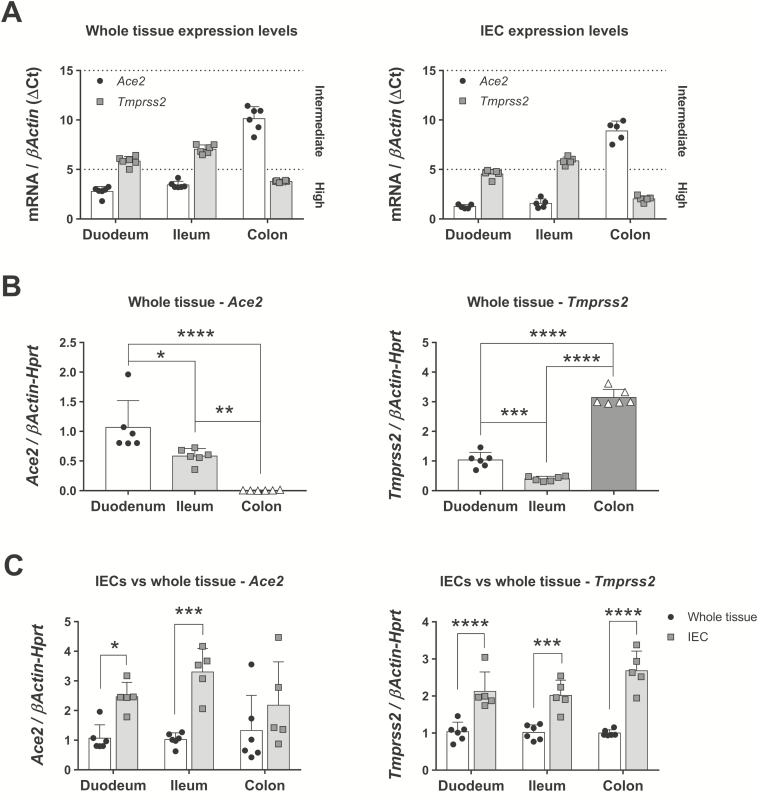
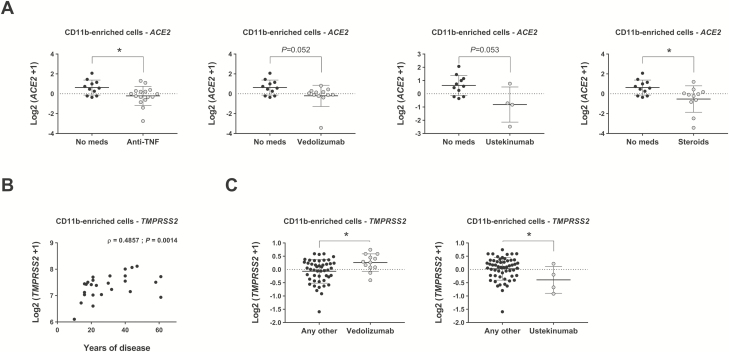
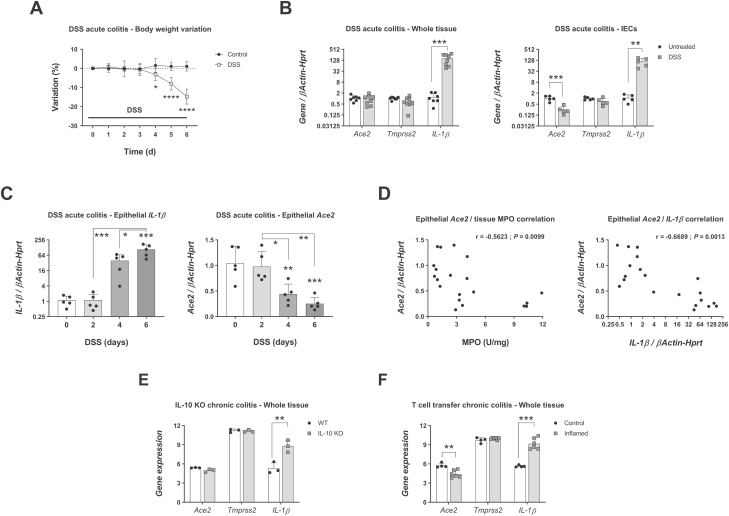
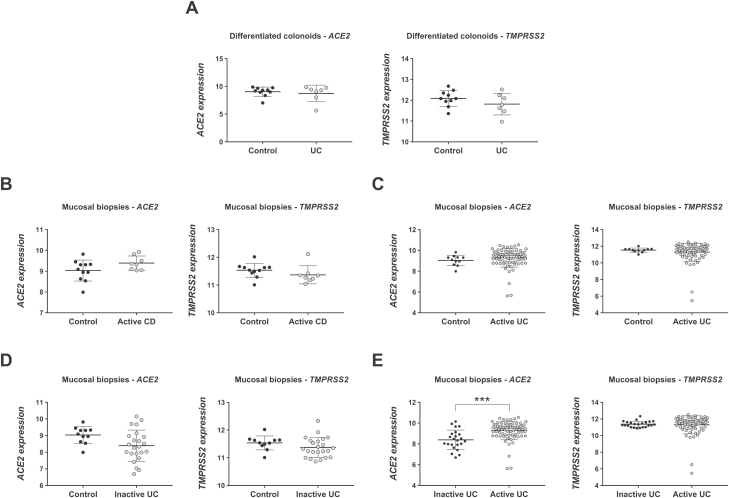
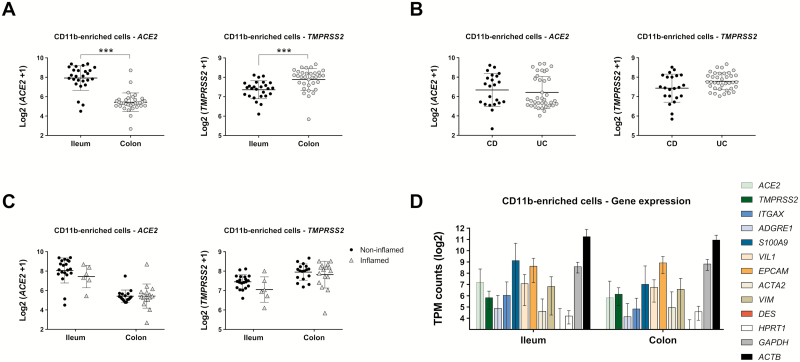
We examined the expression of Ace2 and Tmprss2 by quantitative polymerase chain reacion in animal models of IBD. Publicly available data from organoids and mucosal biopsies from patients with IBD were examined for expression of ACE2 and TMPRSS2. We conducted RNA sequencing for CD11b-enriched cells and peripheral and lamina propria T-cells from well-annotated patient samples.
ACE2 and TMPRSS2 were abundantly expressed in the ileum and colon and had high expression in intestinal epithelial cells. In animal models, inflammation led to downregulation of epithelial Ace2. Expression of ACE2 and TMPRSS2 was not increased in samples from patients with compared with those of control patients. In CD11b-enriched cells but not T-cells, the level of expression of ACE2 and TMPRSS2 in the mucosa was comparable to other functional mucosal genes and was not affected by inflammation. Anti-tumor necrosis factor drugs, vedolizumab, ustekinumab, and steroids were linked to significantly lower expression of ACE2 in CD11b-enriched cells.
The viral entry molecules ACE2 and TMPRSS2 are expressed in the ileum and colon. Patients with IBD do not have higher expression during inflammation; medical therapy is associated with lower levels of ACE2. These data provide reassurance for patients with IBD.
炎症性肠病(IBD)患者存在肠道炎症,并接受免疫调节药物治疗。在应对 2019 年冠状病毒病(COVID-19)大流行之际,我们尚不清楚 IBD 患者是否更容易受到感染或发病。我们假设病毒进入分子血管紧张素转换酶 2(ACE2)和跨膜丝氨酸蛋白酶 2(TMPRSS2)在肠道中表达。我们进一步假设它们的表达可能受到炎症或药物使用的影响。
我们通过定量聚合酶链反应检查 IBD 动物模型中 Ace2 和 Tmprss2 的表达。检查来自 IBD 患者类器官和黏膜活检的公共可用数据,以确定 ACE2 和 TMPRSS2 的表达情况。我们对来自标记良好的患者样本的 CD11b 富集细胞以及外周和固有层 T 细胞进行 RNA 测序。
ACE2 和 TMPRSS2 在回肠和结肠中大量表达,并在肠道上皮细胞中高表达。在动物模型中,炎症导致上皮细胞 Ace2 的下调。与对照患者相比,来自患者的样本中 ACE2 和 TMPRSS2 的表达并未增加。在 CD11b 富集细胞中,但不是 T 细胞中,ACE2 和 TMPRSS2 的表达水平与其他功能黏膜基因相当,且不受炎症影响。抗肿瘤坏死因子药物、vedolizumab、ustekinumab 和类固醇与 CD11b 富集细胞中 ACE2 的表达显著降低相关。
病毒进入分子 ACE2 和 TMPRSS2 在回肠和结肠中表达。炎症期间 IBD 患者的表达水平没有增加;药物治疗与 ACE2 水平降低有关。这些数据为 IBD 患者提供了保证。