Department of Public Health and Prevention Sciences, School of Health Sciences, Baldwin Wallace University, Berea, OH, USA.
Department of Geography, University of California Santa Barbara (UCSB), Santa Barbara, CA, USA.
Sci Total Environ. 2020 Aug 1;728:138884. doi: 10.1016/j.scitotenv.2020.138884. Epub 2020 Apr 22.
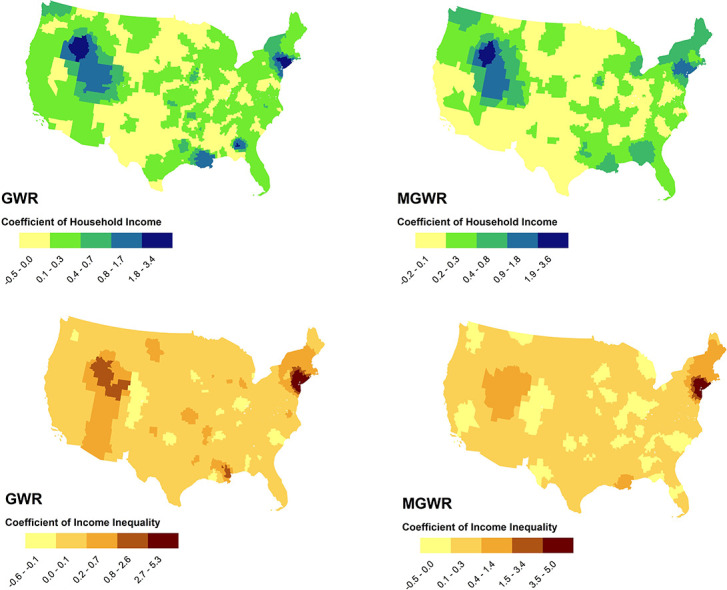
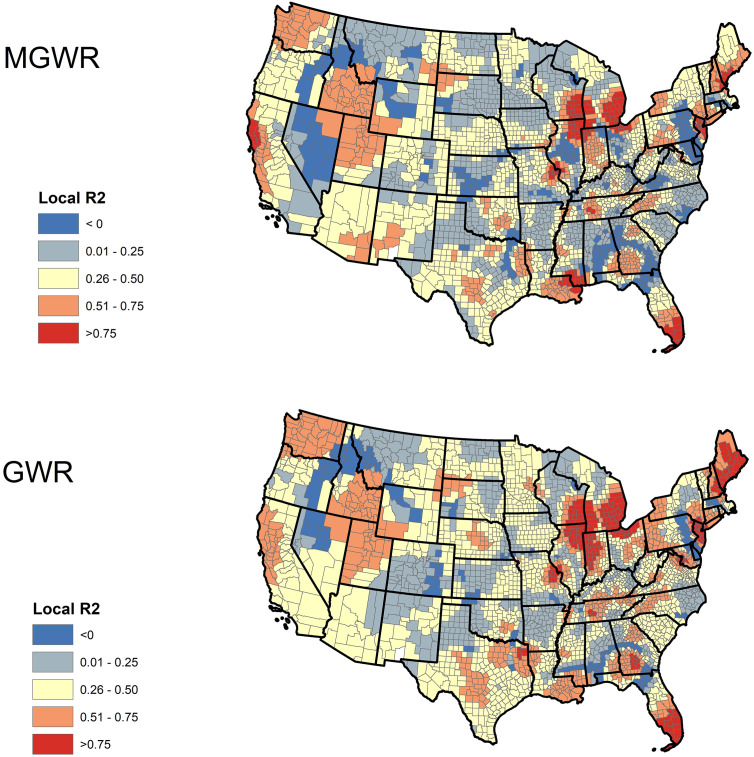
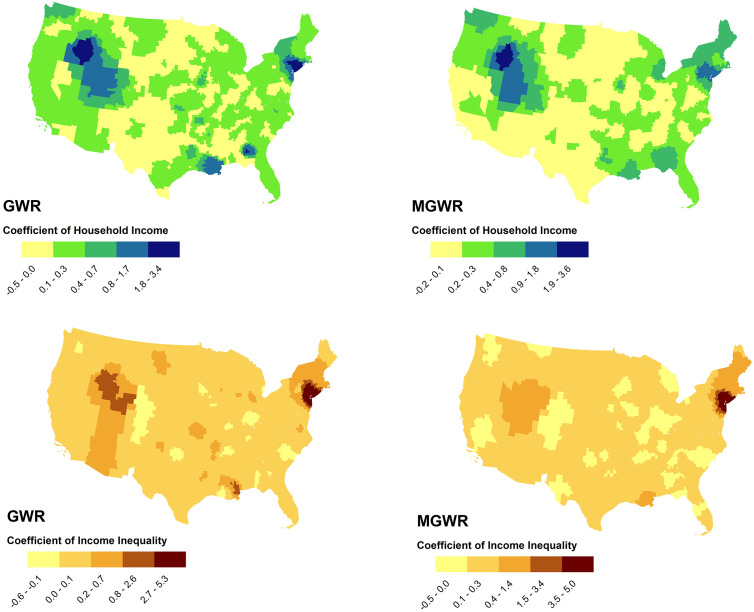
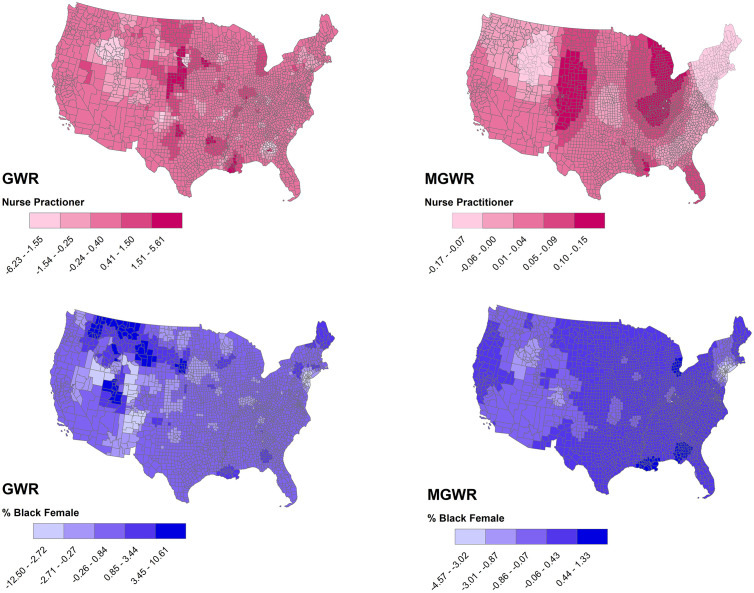
During the first 90 days of the COVID-19 outbreak in the United States, over 675,000 confirmed cases of the disease have been reported, posing unprecedented socioeconomic burden to the country. Due to inadequate research on geographic modeling of COVID-19, we investigated county-level variations of disease incidence across the continental United States. We compiled a geodatabase of 35 environmental, socioeconomic, topographic, and demographic variables that could explain the spatial variability of disease incidence. Further, we employed spatial lag and spatial error models to investigate spatial dependence and geographically weighted regression (GWR) and multiscale GWR (MGWR) models to locally examine spatial non-stationarity. The results suggested that even though incorporating spatial autocorrelation could significantly improve the performance of the global ordinary least square model, these models still represent a significantly poor performance compared to the local models. Moreover, MGWR could explain the highest variations (adj. R: 68.1%) with the lowest AICc compared to the others. Mapping the effects of significant explanatory variables (i.e., income inequality, median household income, the proportion of black females, and the proportion of nurse practitioners) on spatial variability of COVID-19 incidence rates using MGWR could provide useful insights to policymakers for targeted interventions.
在美国 COVID-19 疫情爆发的头 90 天里,已报告超过 67.5 万例确诊病例,给该国带来了前所未有的社会经济负担。由于对 COVID-19 地理建模的研究不足,我们调查了美国大陆各县的疾病发病率差异。我们编制了一个包含 35 个环境、社会经济、地形和人口变量的地理数据库,这些变量可以解释疾病发病率的空间变化。此外,我们还采用了空间滞后和空间误差模型来研究空间依赖性,以及地理加权回归 (GWR) 和多尺度 GWR (MGWR) 模型来局部检查空间非平稳性。结果表明,尽管纳入空间自相关可以显著提高全局普通最小二乘模型的性能,但与局部模型相比,这些模型的表现仍然很差。此外,MGWR 可以用最低的 AICc 解释最高的变化(adj. R:68.1%)。使用 MGWR 对收入不平等、家庭中位数收入、黑人女性比例和执业护士比例等显著解释变量对 COVID-19 发病率空间变化的影响进行映射,可以为政策制定者提供有针对性的干预措施提供有用的见解。