Froud Robert, Grant Mary, Burton Kim, Foss Jonathan, Ellard David R, Seers Kate, Smith Deb, Barillec Mariana, Patel Shilpa, Haywood Kirstie, Underwood Martin
1Warwick Clinical Trials Unit, Warwick Medical School, University of Warwick, Gibbet Hill Road, Coventry, CV4 7AL UK.
2Institute of Health Sciences, Kristiania University College, Prinsens Gate 7-9, 0152 Oslo, Norway.
Pilot Feasibility Stud. 2020 Apr 22;6:49. doi: 10.1186/s40814-020-00581-6. eCollection 2020.
Working in good jobs is associated with good health. High unemployment rates are reported in those disabled with musculoskeletal pain. Supported employment interventions work well for helping people with mental health difficulties to gain and retain employment. With adaptation, these may be useful for people with chronic pain. We aimed to develop and explore the feasibility of delivering such an adapted intervention.
We developed an intervention and recruited unemployed people with chronic pain from NHS pain clinics and employment services. We trained case managers to assess participants and match them to six-week work placements in the Midlands and provide ongoing support to them and their managers. Participants attended a two-day work preparation session prior to placement. Outcome measures included quality of life at baseline, six- weeks, 14-weeks, and six-months, and return to work at 14-weeks and six-months. We held focus groups or interviews with stakeholders to examine acceptability and experiences of the intervention.
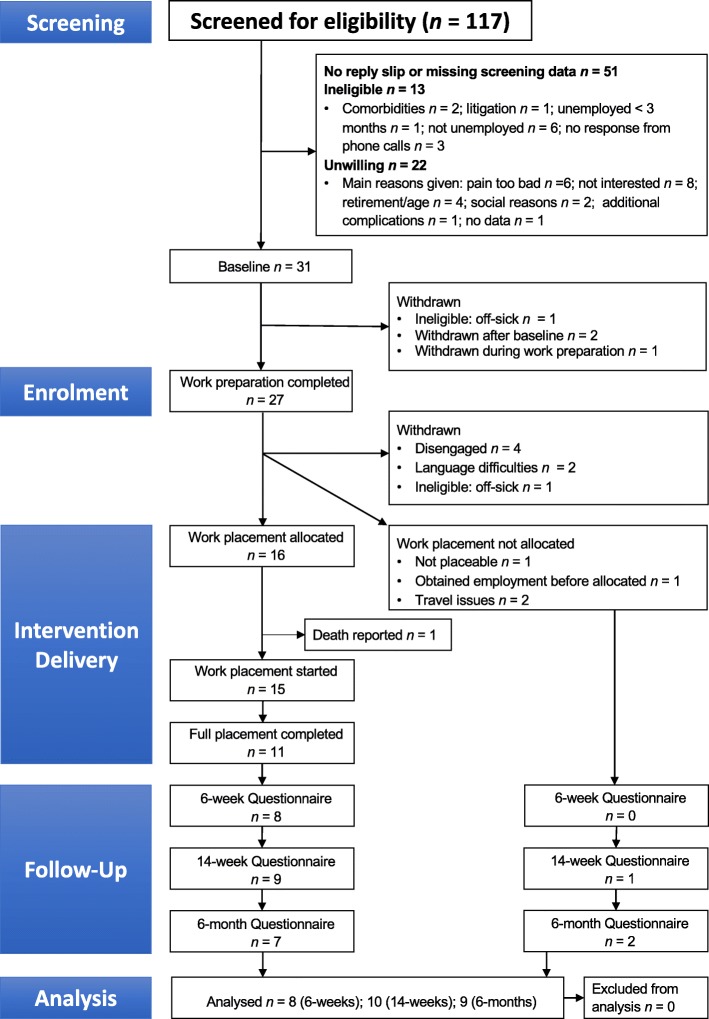
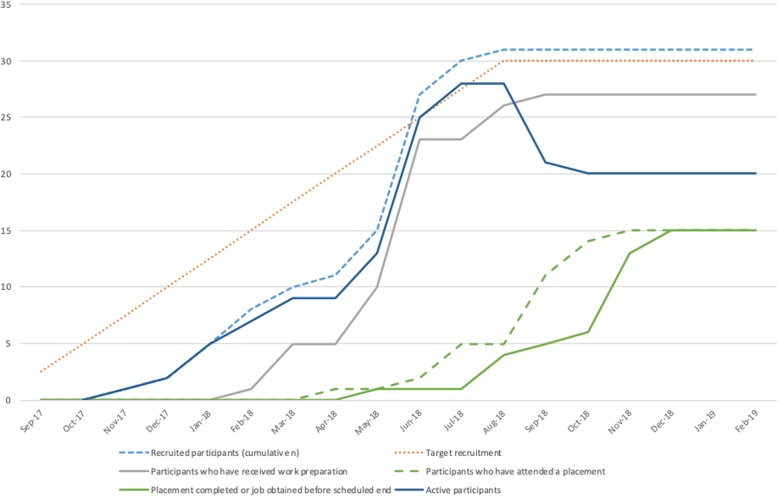
We developed an intervention consisting of work preparation sessions, work experience placements, and individualised employment support. We enrolled 31 people; 27 attended work preparation sessions, and 15 attended placements. Four of our participants started jobs during the study period. We are aware of two others starting jobs shortly after cessation of follow-up. We experienced challenges to recruitment in one area where we had many and diverse placement opportunities and good recruitment in another area where we had a smaller range of placement opportunities. All stakeholders found the intervention acceptable, and it was valued by those given a placement. While there was some disappointment among those not placed, this group still valued the work preparation sessions.
The developed intervention was acceptable to participants and partners. Trialling the developed intervention could be feasible with attention to three main processes. To ensure advanced availability of a sufficiently wide range of work placements in each area, multiple partners would be needed. Multiple recruitment sites and focus on employment services will yield better recruitment rates than reliance on NHS pain clinics. Maintaining an adequate follow-up response rate will likely require additional approaches with more than the usual effort.
从事好工作与健康状况良好相关。据报告,患有肌肉骨骼疼痛的残疾人失业率较高。支持性就业干预措施在帮助有心理健康问题的人获得并维持就业方面效果良好。经过调整后,这些措施可能对慢性疼痛患者有用。我们旨在开发并探索实施这种调整后的干预措施的可行性。
我们开发了一种干预措施,并从国民保健服务体系(NHS)疼痛诊所和就业服务机构招募了患有慢性疼痛的失业人员。我们培训了个案经理,以便对参与者进行评估,并为他们匹配在中部地区为期六周的工作实习机会,并为他们及其经理提供持续支持。参与者在实习前参加了为期两天的工作准备课程。结果指标包括基线、六周、十四周和六个月时的生活质量,以及十四周和六个月时的重返工作岗位情况。我们与利益相关者进行了焦点小组讨论或访谈,以考察该干预措施的可接受性和体验。
我们开发了一种由工作准备课程、工作经验实习和个性化就业支持组成的干预措施。我们招募了31人;27人参加了工作准备课程,15人参加了实习。我们的四名参与者在研究期间开始工作。我们知道另外两人在随访结束后不久也开始工作。在一个有许多不同实习机会的地区,我们在招募方面遇到了挑战;而在另一个实习机会范围较小的地区,我们的招募情况较好。所有利益相关者都认为该干预措施是可接受的,并且得到实习机会的人对其评价很高。虽然未获得实习机会的人有些失望,但这组人仍然重视工作准备课程。
所开发的干预措施为参与者和合作伙伴所接受。关注三个主要流程,对所开发的干预措施进行试验可能是可行的。为确保每个地区都有足够广泛的工作实习机会提前可供选择,将需要多个合作伙伴。多个招募地点并专注于就业服务将比仅依赖NHS疼痛诊所产生更高的招募率。要保持足够的随访回复率,可能需要采取额外的方法并付出比平常更多的努力。