Institute of Applied Health Research, University of Birmingham, Birmingham, UK.
School of Demography, The Australian National University, Canberra, Australian Capital Territory, Australia.
BMJ Glob Health. 2020 Mar 29;5(3):e002096. doi: 10.1136/bmjgh-2019-002096. eCollection 2020.
Multimorbidity is a health issue of increasing importance worldwide, and is likely to become particularly problematic in low-income countries (LICs) as they undergo economic, demographic and epidemiological transitions. Knowledge of the burden and consequences of multimorbidity in LICs is needed to inform appropriate interventions.
A cross-sectional household survey collected data on morbidities and frailty, disability, quality of life and physical performance on individuals aged over 40 years of age living in the Nouna Health and Demographic Surveillance System area in northwestern Burkina Faso. We defined multimorbidity as the occurrence of two or more conditions, and evaluated the prevalence of and whether this was concordant (conditions in the same morbidity domain of communicable, non-communicable diseases (NCDs) or mental health (MH)) or discordant (conditions in different morbidity domains) multimorbidity. Finally, we fitted multivariable regression models to determine associated factors and consequences of multimorbidity.
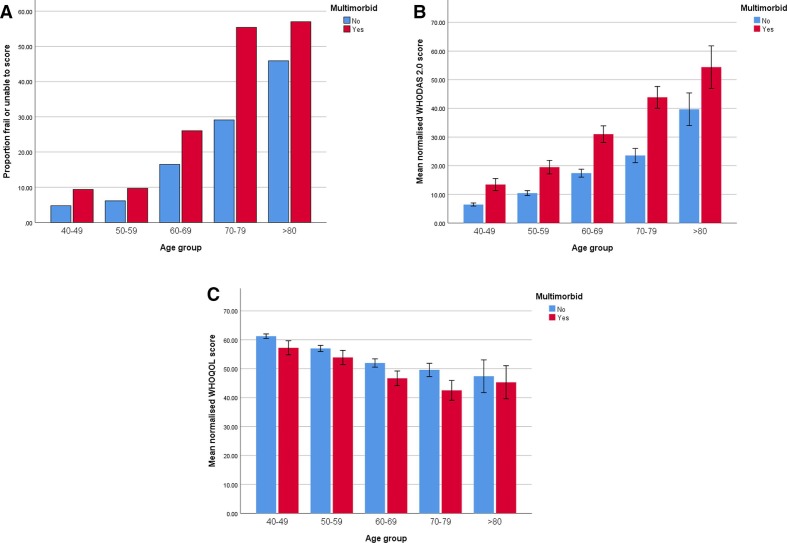
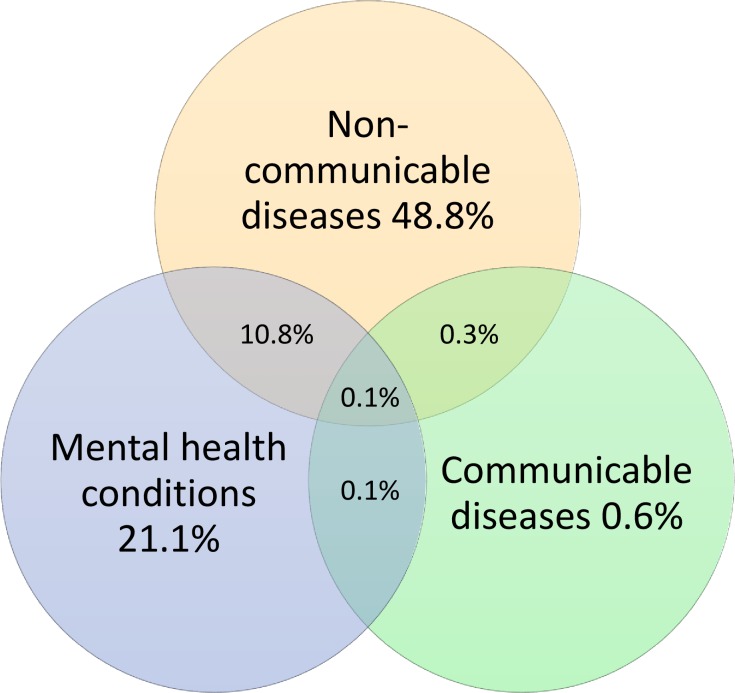
Multimorbidity was present in 22.8 (95% CI, 21.4 to 24.2) of the study population; it was more common in females, those who are older, single, more educated, and wealthier. We found a similar prevalence of discordant 11.1 (95% CI, 10.1 to 12.2) and concordant multimorbidity 11.7 (95% CI, 10.6 to 12.8). After controlling for age, sex, marital status, education, and wealth, an increasing number of conditions was strongly associated with frailty, disability, low quality of life, and poor physical performance. We found no difference in the association between concordant and discordant multimorbidity and outcomes, however people who were multimorbid with NCDs alone had better outcomes than those with multimorbidity with NCDs and MH disorders or MH multimorbidity alone.
Multimorbidity is prevalent in this poor, rural population and is associated with markers of decreased physical performance and quality of life. Preventative and management interventions are needed to ensure that health systems can deal with increasing multimorbidity and its downstream consequences.
全球范围内,多种疾病共存(multimorbidity)是一个日益重要的健康问题,而且随着低收入国家(LICs)经历经济、人口和流行病学的转变,这种问题可能会变得尤为突出。为了制定恰当的干预措施,有必要了解 LICs 中多种疾病共存的负担和后果。
一项横断面家庭调查收集了居住在布基纳法索西北部努纳健康和人口监测系统地区的 40 岁以上人群的疾病、衰弱、残疾、生活质量和身体表现数据。我们将多种疾病共存定义为两种或多种疾病同时存在,并评估其患病率以及是否一致(传染病、非传染性疾病(NCDs)或心理健康(MH)的同一疾病领域的疾病)或不一致(不同疾病领域的疾病)共存。最后,我们拟合了多变量回归模型,以确定多种疾病共存的相关因素及其后果。
研究人群中 22.8%(95%CI,21.4 至 24.2)存在多种疾病共存;女性、年龄较大、单身、受教育程度较高和较富裕的人群中更为常见。我们发现,不一致的多种疾病共存(11.1%,95%CI,10.1 至 12.2)和一致的多种疾病共存(11.7%,95%CI,10.6 至 12.8)的患病率相似。在控制年龄、性别、婚姻状况、教育程度和财富后,疾病数量的增加与衰弱、残疾、生活质量低和身体表现差密切相关。我们发现,一致和不一致的多种疾病共存与结局之间没有差异,但是仅患有 NCD 的多种疾病患者的结局要好于同时患有 NCD 和 MH 障碍或仅患有 MH 多种疾病的患者。
在这个贫穷的农村人群中,多种疾病共存很常见,且与身体机能下降和生活质量下降的标志物有关。需要采取预防和管理干预措施,以确保卫生系统能够应对不断增加的多种疾病共存及其下游后果。