Witham Miles D, Davies Justine I, Bärnighausen Till, Bountogo Mamadou, Manne-Goehler Jennifer, Payne Collin F, Ouermi Lucienne, Sie Ali, Siedner Mark J, Harling Guy
AGE Research Group, NIHR Newcastle Biomedical Research Centre, Newcastle University, Newcastle, UK.
MRC/Wits Rural Public Health & Health Transitions Research Unit (Agincourt), University of the Witwatersrand, Johannesburg, South Africa.
Wellcome Open Res. 2019 Sep 11;4:135. doi: 10.12688/wellcomeopenres.15455.1. eCollection 2019.
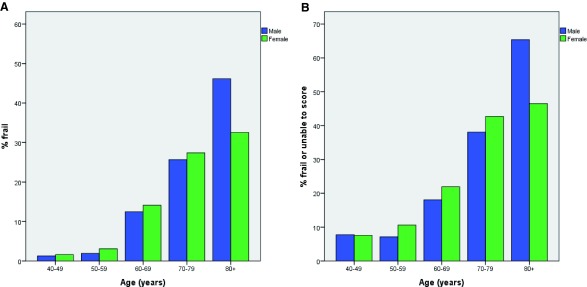
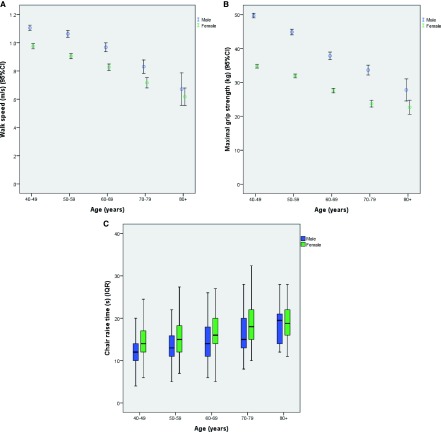
Little is known about the prevalence of frailty and about normal values for physical performance among older individuals in low-income countries, in particular those in sub-Saharan Africa. We describe the prevalence of phenotypic frailty, and values and correlates of several physical performance measures in a cohort of middle-aged and older people living in rural Burkina Faso, one of the world's poorest communities. We analysed data collected from participants aged over 40 in Nouna district, Burkina Faso. We measured handgrip strength, four metre walk speed, chair rise time, and derived the Fried frailty score based on grip strength, gait speed, body mass index, self-reported exhaustion, and physical activity. Frailty and physical performance indicators were then correlated with health and sociodemographic variables including comorbid disease, marital status, age, sex, wealth and activity impairment. Our sample included 2973 individuals (1503 women), mean age 54 years. 1207 (43%) were categorised as non-frail, 1324 (44%) as prefrail, 212 (7%) as frail, and 167 (6%) were unable to complete all five frailty score components. Lower grip strength, longer chair stand time, lower walk speed and prevalence of frailty rose with age. Frailty was more common in women than men (8% vs 6%, p=0.01) except in those aged 80 and over. Frailty was strongly associated with impairment of activities of daily living and with lower wealth, being widowed, diabetes mellitus, hypertension, and self-reported diagnoses of tuberculosis or heart disease. With the exception of grip strength, which was higher in women than prior international normative values, women had greater deficits than men in physical performance. Phenotypic frailty and impaired physical performance were associated as expected with female sex, co-morbidities, increasing age and impaired activities of daily living. These results support the use of frailty measurements for classification of ageing related syndromes in this setting.
对于低收入国家,尤其是撒哈拉以南非洲地区的老年人,人们对衰弱的患病率以及身体机能的正常值了解甚少。我们描述了生活在布基纳法索农村的中老年人队列中表型衰弱的患病率、几种身体机能测量指标的值及其相关因素,布基纳法索农村是世界上最贫困的社区之一。我们分析了从布基纳法索努纳地区40岁以上参与者收集的数据。我们测量了握力、4米步行速度、从椅子上起身的时间,并根据握力、步态速度、体重指数、自我报告的疲惫感和身体活动得出弗里德衰弱评分。然后将衰弱和身体机能指标与健康及社会人口统计学变量相关联,这些变量包括合并症、婚姻状况、年龄、性别、财富和活动障碍。我们的样本包括2973人(1503名女性),平均年龄54岁。1207人(43%)被归类为非衰弱,1324人(44%)为衰弱前期,212人(7%)为衰弱,167人(6%)无法完成所有五项衰弱评分指标。握力降低、从椅子上起身的时间延长、步行速度减慢以及衰弱的患病率随年龄增长而上升。除80岁及以上人群外,衰弱在女性中比男性更常见(8%对6%,p = 0.01)。衰弱与日常生活活动受损以及较低的财富水平、丧偶、糖尿病、高血压以及自我报告的结核病或心脏病诊断密切相关。除了女性的握力高于先前的国际标准值外,女性在身体机能方面的缺陷比男性更大。正如预期的那样,表型衰弱和身体机能受损与女性性别、合并症、年龄增长以及日常生活活动受损有关。这些结果支持在这种情况下使用衰弱测量来对与衰老相关的综合征进行分类。