IRD, Cirad, Univ Montpellier, IPME, Montpellier, France.
INERA, Laboratoire de Phytopathologie, LMI PathoBios, Bobo-Dioulasso, Burkina Faso.
PLoS One. 2020 Apr 27;15(4):e0232115. doi: 10.1371/journal.pone.0232115. eCollection 2020.
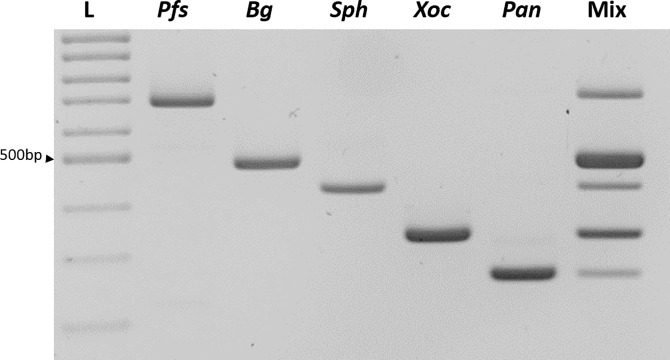
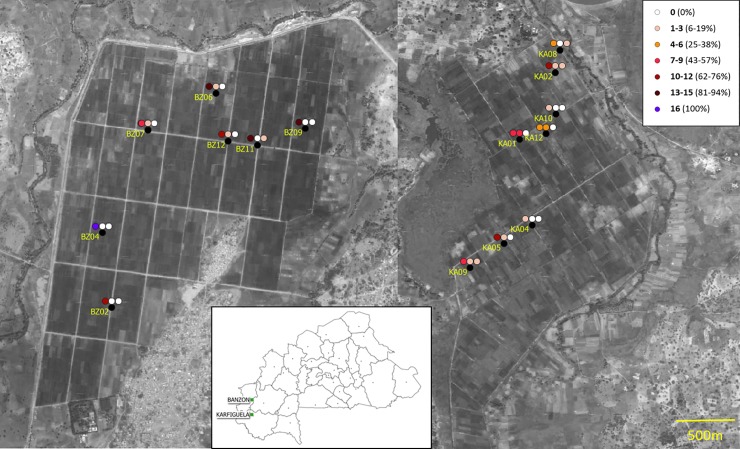
Crop diseases are responsible for considerable yield losses worldwide and particularly in sub-Saharan Africa. To implement efficient disease control measures, detection of the pathogens and understanding pathogen spatio-temporal dynamics is crucial and requires the use of molecular detection tools, especially to distinguish different pathogens causing more or less similar symptoms. We report here the design a new molecular diagnostic tool able to simultaneously detect five bacterial taxa causing important diseases on rice in Africa: (1) Pseudomonas fuscovaginae, (2) Xanthomonas oryzae, (3) Burkholderia glumae and Burkholderia gladioli, (4) Sphingomonas and (5) Pantoea species. This new detection tool consists of a multiplex PCR, which is cost effective and easily applicable. Validation of the method is presented through its application on a global collection of bacterial strains. Moreover, sensitivity assessment for the detection of all five bacteria is reported to be at 0.5 ng DNA by μl. As a proof of concept, we applied the new molecular detection method to a set of 256 rice leaves collected from 16 fields in two irrigated areas in western Burkina Faso. Our results show high levels of Sphingomonas spp. (up to 100% of tested samples in one field), with significant variation in the incidence between the two sampled sites. Xanthomonas oryzae incidence levels were mostly congruent with bacterial leaf streak (BLS) and bacterial leaf blight (BLB) symptom observations in the field. Low levels of Pantoea spp. were found while none of the 256 analysed samples was positive for Burkholderia or Pseudomonas fuscovaginae. Finally, many samples (up to 37.5% in one studied field) were positive for more than one bacterium (co-infection). Documenting co-infection levels are important because of their drastic consequences on epidemiology, evolution of pathogen populations and yield losses. The newly designed multiplex PCR for multiple bacterial pathogens of rice is a significant improvement for disease monitoring in the field, thus contributing to efficient disease control and food safety.
作物病害在全球范围内造成了相当大的产量损失,特别是在撒哈拉以南非洲地区。为了实施有效的病害控制措施,检测病原体并了解病原体的时空动态至关重要,这需要使用分子检测工具,特别是用于区分引起或多或少相似症状的不同病原体。我们在此报告一种新的分子诊断工具的设计,该工具能够同时检测在非洲引起水稻重要病害的五种细菌分类群:(1)Pseudomonas fuscovaginae,(2)Xanthomonas oryzae,(3)Burkholderia glumae 和 Burkholderia gladioli,(4)Sphingomonas 和(5)Pantoea 种。这种新的检测工具由多重 PCR 组成,具有成本效益且易于应用。通过对全球细菌菌株的应用,对该方法的验证进行了介绍。此外,还报告了所有五种细菌的检测灵敏度评估,其值为 0.5 ng DNA/μl。作为概念验证,我们将新的分子检测方法应用于从布基纳法索西部两个灌溉区的 16 个田间采集的 256 片水稻叶片。我们的结果显示 Sphingomonas spp. 水平较高(在一个田间的测试样本中高达 100%),两个采样点之间的发病率存在显著差异。Xanthomonas oryzae 的发病率水平与田间的细菌性条斑病(BLS)和细菌性叶枯病(BLB)症状观察基本一致。Pantoea spp. 的水平较低,而在分析的 256 个样本中没有一个为 Burkholderia 或 Pseudomonas fuscovaginae 阳性。最后,许多样本(在一个研究的田间高达 37.5%)为多种细菌(混合感染)阳性。记录混合感染水平很重要,因为它们对流行病学、病原体种群的进化和产量损失有严重影响。针对水稻多种细菌病原体的新设计多重 PCR 是田间病害监测的重大改进,有助于实施有效的病害控制和食品安全。