Department of Medical Physiology. School of Medicine, University of Granada, 18071 Granada, Spain.
PROmoting FITness and Health through Physical Activity Research Group (PROFITH), Department of Physical Education and Sports, Faculty of Sport Sciences, University of Granada, 18071 Granada, Spain.
Nutrients. 2020 Apr 23;12(4):1186. doi: 10.3390/nu12041186.
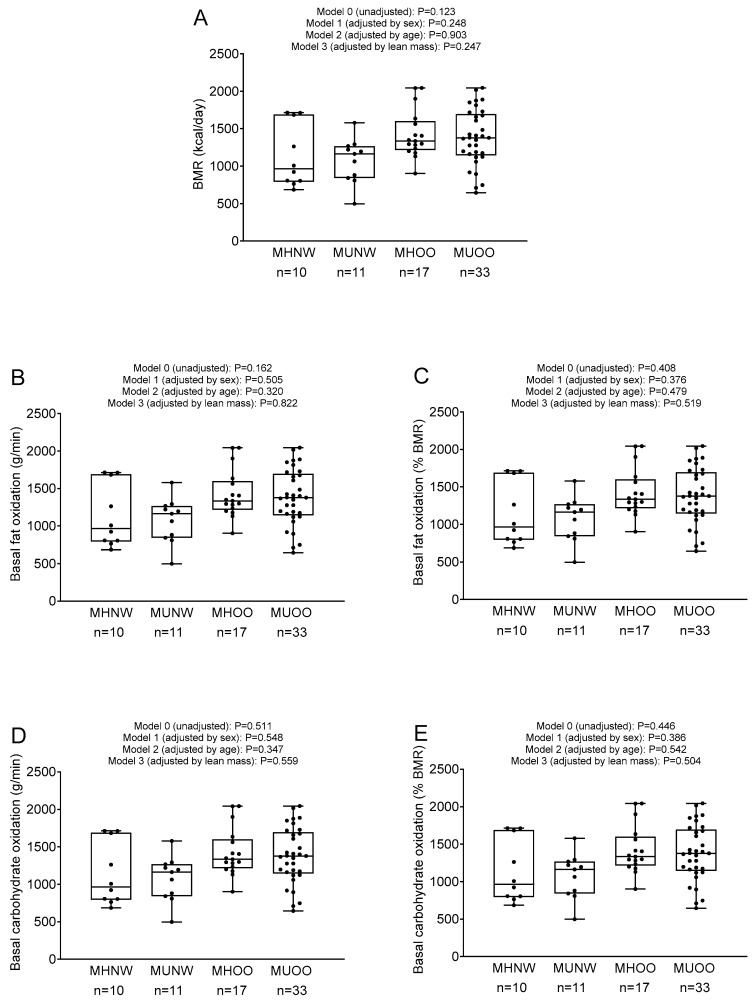
This cross-sectional study aimed to examine the association of basal metabolic rate (BMR) and basal fat and carbohydrate oxidation (BFox and BCHox, respectively) with cardiometabolic risk factors and insulin sensitivity in sedentary middle-aged adults. A total of 71 healthy sedentary adults (37 women) aged 40-65 years participated in the current study. Data were collected during the baseline assessments of the FIT-AGEING randomized controlled trial. BMR was measured via indirect calorimetry, and BFox and BCHox estimated by stoichiometric equations. Blood pressure, glucose, insulin, total cholesterol, high-density lipoprotein cholesterol, low-density lipoprotein cholesterol, and triglycerides plasma levels were selected as cardiometabolic risk factors and assessed following standard procedures. We observed positive associations of BMR with plasma insulin and the homeostatic model assessment of insulin resistance index (HOMA; all < 0.05) which were attenuated or disappeared after controlling by sex, age, and/or lean mass. There were positive associations between BFox and the quantitative insulin sensitivity check index (QUICKI; < 0.015), while negative associations were noted between BFox and plasma insulin and HOMA ( < 0.015). There was a significant negative association between BCHox with QUICKI ( < 0.01), whereas significant positive relationships were obtained when BCHox was associated with plasma insulin and HOMA ( < 0.01). These associations persisted in almost all cases when controlling by sex, age and/or lean mass. No further relationships were found when BMR, BFox, and BCHox were associated with other cardiometabolic risk factors. In conclusion, our study findings support that greater BFox and lower BCHox are related to improved insulin sensitivity, whereas BMR seems to be not associated with neither cardiometabolic risk nor insulin sensitivity in sedentary middle-aged adults. Further intervention studies are necessary to well-understand the physiological mechanism implied in this relationship.
本横断面研究旨在探讨基础代谢率(BMR)和基础脂肪及碳水化合物氧化(分别为 BFox 和 BCHox)与久坐中年成年人的心血管代谢风险因素和胰岛素敏感性的关系。共有 71 名健康的久坐成年人(37 名女性)参加了这项研究,年龄在 40-65 岁之间。数据是在 FIT-AGEING 随机对照试验的基线评估期间收集的。通过间接测热法测量 BMR,通过化学计量方程估计 BFox 和 BCHox。血压、血糖、胰岛素、总胆固醇、高密度脂蛋白胆固醇、低密度脂蛋白胆固醇和甘油三酯血浆水平被选为心血管代谢风险因素,并按照标准程序进行评估。我们观察到 BMR 与血浆胰岛素和稳态模型评估的胰岛素抵抗指数(HOMA;均<0.05)呈正相关,这些相关性在控制性别、年龄和/或瘦体重后减弱或消失。BFox 与定量胰岛素敏感性检查指数(QUICKI;<0.015)呈正相关,而 BFox 与血浆胰岛素和 HOMA 呈负相关(<0.015)。BCHox 与 QUICKI 呈显著负相关(<0.01),而 BCHox 与血浆胰岛素和 HOMA 呈显著正相关(<0.01)。当控制性别、年龄和/或瘦体重时,几乎所有情况下都存在这种关联。当 BMR、BFox 和 BCHox 与其他心血管代谢风险因素相关时,没有发现进一步的关系。总之,我们的研究结果支持,更大的 BFox 和更低的 BCHox 与改善的胰岛素敏感性相关,而 BMR 似乎与久坐中年成年人的心血管代谢风险或胰岛素敏感性无关。需要进一步的干预研究来充分理解这种关系所隐含的生理机制。