Barrubés Laura, Babio Nancy, Hernández-Alonso Pablo, Toledo Estefania, Ramírez Sabio Judith B, Estruch Ramón, Ros Emilio, Fitó Montserrat, Alonso-Gómez Angel M, Fiol Miquel, Lapetra Jose, Serra-Majem Lluís, Pintó Xavier, Ruiz-Canela Miguel, Corella Dolores, Castañer Olga, Macías-González Manuel, Salas-Salvadó Jordi
Universitat Rovira i Virgili, Departament de Bioquímica i Biotecnologia, Unitat de Nutrició Humana, Hospital Universitari San Joan de Reus, Institut d'Investigació Pere Virgili (IISPV), 43201 Reus, Spain.
Consorcio CIBER, M.P. Fisiopatología de la Obesidad y Nutrición (CIBERObn), Instituto de Salud Carlos III (ISCIII), 28029 Madrid, Spain.
J Clin Med. 2020 Apr 23;9(4):1215. doi: 10.3390/jcm9041215.
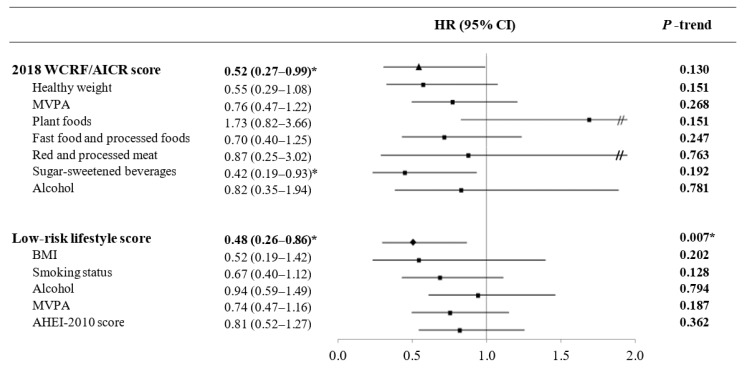
Limited longitudinal studies have been conducted to evaluate colorectal cancer (CRC) incidence based on the updated 2018 World Cancer Research Fund/American Institute for Cancer Research (WCRF/AICR) recommendations or other global lifestyle indices, and none in aged populations at high cardiovascular risk. We aimed to assess the association between CRC incidence and adherence to two emerging lifestyles indices (2018 WCRF/AICR score and another low-risk lifestyle (LRL) score comprising smoking status, alcohol consumption, physical activity, diet, and body mass index) in the Spanish PREvencion con DIeta MEDiterranea (PREDIMED) cohort. We studied 7216 elderly men and women at high cardiovascular risk. The 2018 WCRF/AICR and LRL scores were calculated. Multivariable Cox proportional regression models were fitted to estimate the HRs (hazard ratios) and 95% confidence intervals (CIs) for incident CRC events. During a median interquartile range (IQR) follow-up of 6.0 (4.4-7.3) years, 97 CRC events were considered. A significant linear association was observed between each 1-point increment in the WCRF/AICR score (score range from 0 to 7) and CRC risk (HR (95% CI) = 0.79 (0.63-0.99)). Similarly, each 1-point increment in the LRL score (score range from 0 to 5) was associated with a 22% reduction in CRC risk (0.78 (0.64-0.96)). Adhering to emergent lifestyle scores might substantially reduce CRC incidence in elderly individuals. Further longitudinal studies, which take different lifestyle indexes into account, are warranted in the future.
目前仅有少数纵向研究基于2018年世界癌症研究基金会/美国癌症研究学会(WCRF/AICR)的最新建议或其他全球生活方式指数来评估结直肠癌(CRC)发病率,而针对心血管疾病高风险老年人群的此类研究尚无开展。我们旨在评估西班牙预防地中海饮食(PREDIMED)队列中,CRC发病率与两种新兴生活方式指数(2018年WCRF/AICR评分以及另一种包含吸烟状况、饮酒量、身体活动、饮食和体重指数的低风险生活方式(LRL)评分)的依从性之间的关联。我们研究了7216名心血管疾病高风险的老年男性和女性。计算了2018年WCRF/AICR和LRL评分。采用多变量Cox比例回归模型来估计CRC事件的风险比(HRs)和95%置信区间(CIs)。在中位四分位数间距(IQR)为6.0(4.4 - 7.3)年的随访期间,共发生了97例CRC事件。观察到WCRF/AICR评分(评分范围为0至7)每增加1分与CRC风险之间存在显著的线性关联(HR(95%CI)= 0.79(0.63 - 0.99))。同样,LRL评分(评分范围为0至5)每增加1分与CRC风险降低22%相关(0.78(0.64 - 0.96))。坚持新兴生活方式评分可能会大幅降低老年个体的CRC发病率。未来有必要开展进一步的纵向研究,纳入不同的生活方式指数。