Institute for Inflammation Control, Korea University, Seoul 02841, Korea.
Shinpoong Pharmaceutical Company, Ansan 15610, Korea.
Int J Mol Sci. 2020 Apr 23;21(8):2990. doi: 10.3390/ijms21082990.
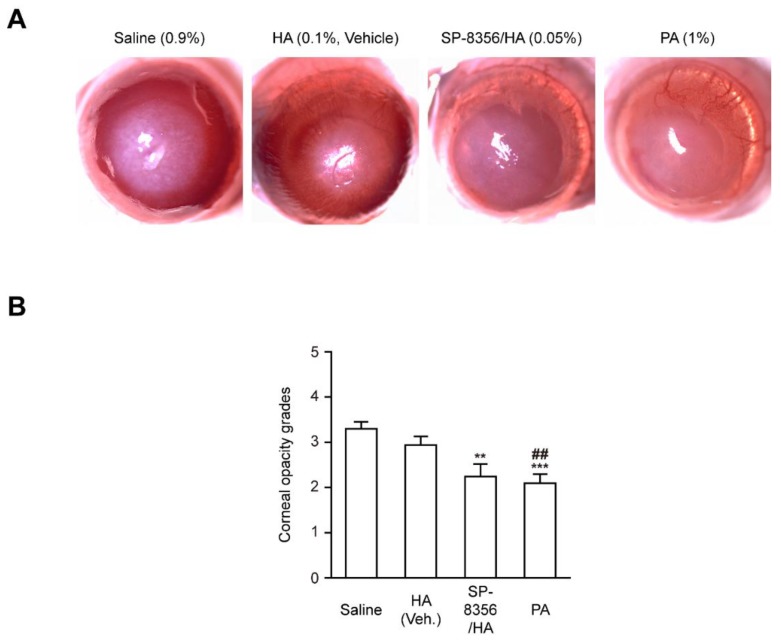
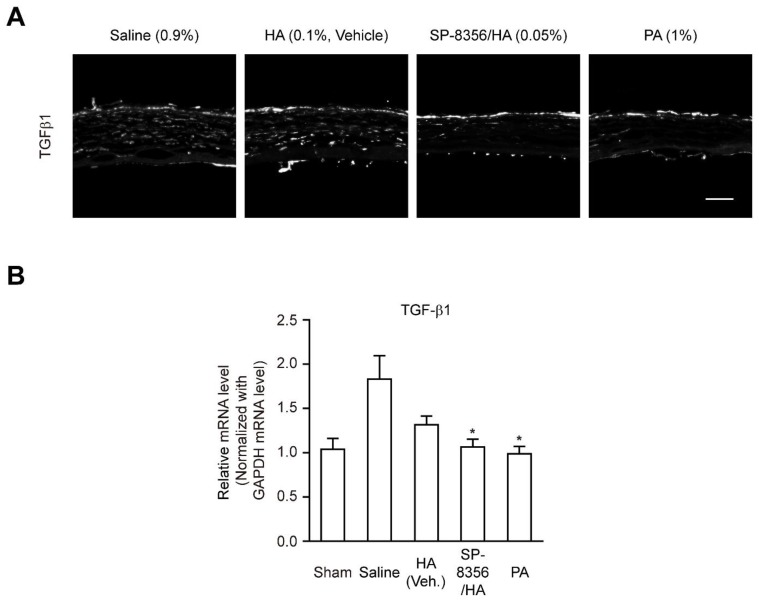
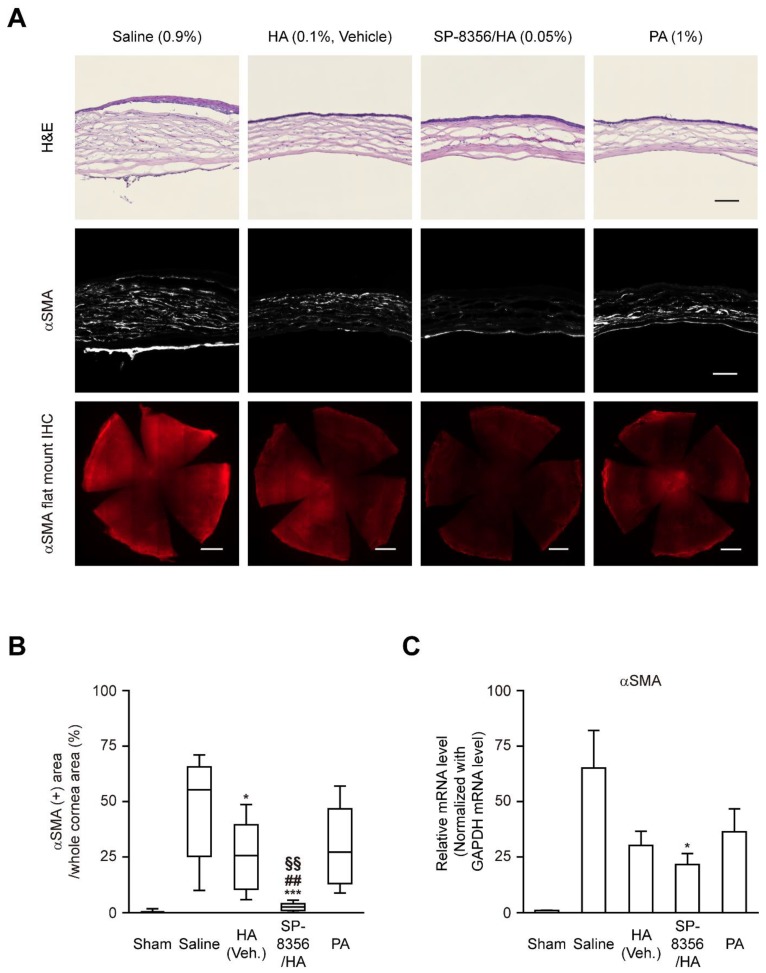
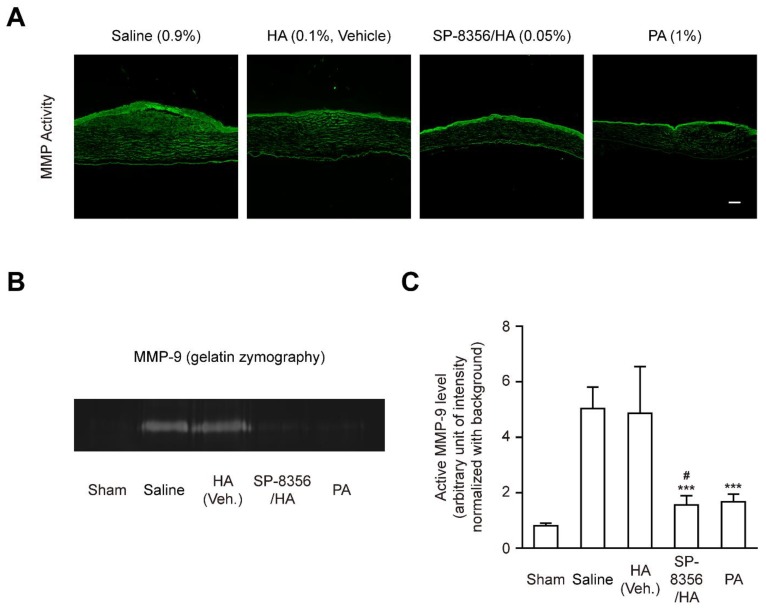
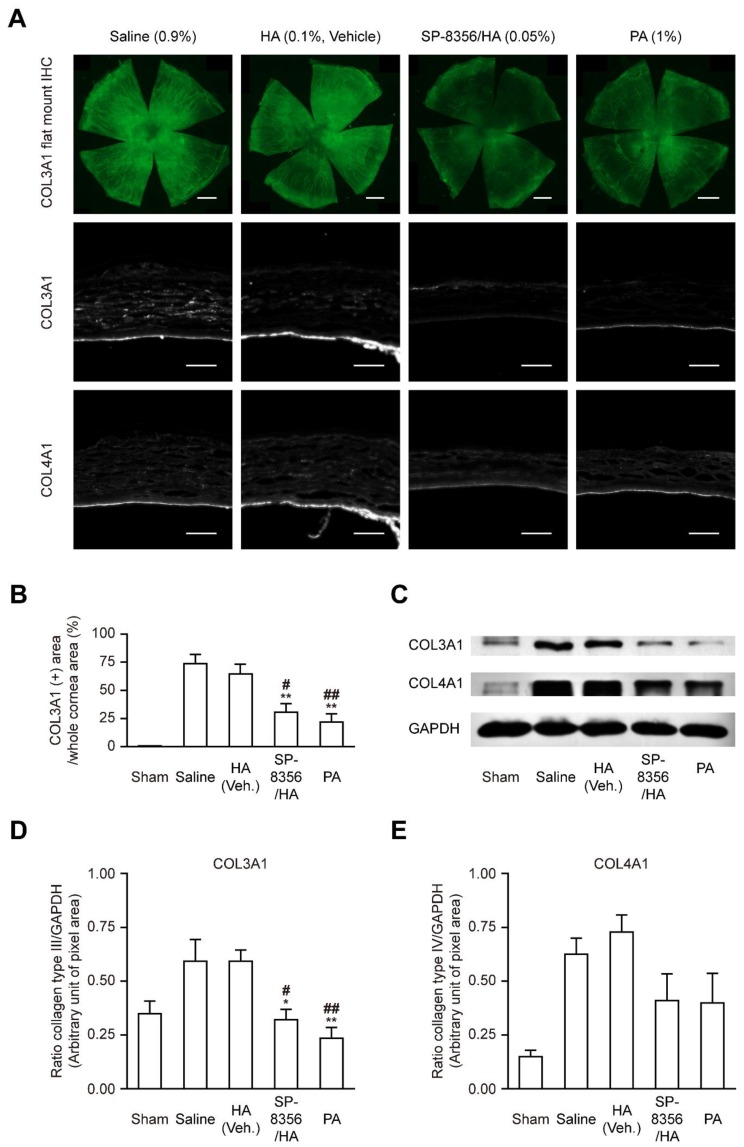
The corneal fibrotic responses to corneal damage often lead to severe corneal opacification thereby resulting in severe visual impairment or even blindness. The persistence of corneal opacity depends heavily on the activity of corneal myofibroblast. Myofibroblasts are opaque and synthesize a disorganized extracellular matrix (ECM) and thus promoting opacification. Cluster of differentiation 147 (CD147), a member of the immunoglobulin superfamily, is known to play important roles in the differentiation process from fibroblast to myofibroblast in damaged cornea and may therefore be an effective target for treatment of corneal opacity. Here, we examined the therapeutic efficacy of novel CD147 inhibiting verbenone derivative SP-8356 ((1S,5R)-4-(3,4-dihydroxy-5-methoxystyryl)-6,6-dimethylbicyclo[3.1.1]hept-3-en-2-one) on corneal fibrosis. Topical SP-8356 significantly reduced corneal haze and fibrosis in the alkali-burned cornea. In detail, SP-8356 inhibited both alpha-smooth muscle actin (α-SMA) expressing myofibroblast and its ECM-related products, such as matrix-metalloproteinase-9 and collagen type III and IV. Similar to SP-8356, topical corticosteroid (prednisolone acetate, PA) also reduced the ECM-related products and opacification. However, prednisolone acetate failed to decrease the population of α-SMA-positive corneal myofibroblast. In conclusion, SP-8356 is capable enough to prevent corneal haze by preventing pathological fibrosis after severe corneal damage. Therefore, SP-8356 could be a potentially promising therapeutic drug for corneal fibrosis.
角膜纤维化反应对角膜损伤常导致严重的角膜混浊,从而导致严重的视力损害甚至失明。角膜混浊的持续存在在很大程度上取决于角膜肌成纤维细胞的活性。肌成纤维细胞不透明,并合成无序的细胞外基质(ECM),从而促进混浊。CD147(分化群 147)是免疫球蛋白超家族的一员,已知在受损角膜中从成纤维细胞向肌成纤维细胞的分化过程中发挥重要作用,因此可能是治疗角膜混浊的有效靶点。在这里,我们研究了新型 CD147 抑制马鞭草酮衍生物 SP-8356((1S,5R)-4-(3,4-二羟基-5-甲氧基苯乙烯基)-6,6-二甲基双环[3.1.1]庚-3-烯-2-酮)对角膜纤维化的治疗效果。局部 SP-8356 可显著减轻碱烧伤角膜的混浊和纤维化。具体而言,SP-8356 抑制了表达α-平滑肌肌动蛋白(α-SMA)的肌成纤维细胞及其 ECM 相关产物,如基质金属蛋白酶-9 和胶原 III 和 IV。与 SP-8356 相似,局部皮质类固醇(醋酸泼尼松龙,PA)也减少了 ECM 相关产物和混浊。然而,醋酸泼尼松龙未能减少α-SMA 阳性角膜肌成纤维细胞的数量。总之,SP-8356 能够通过防止严重角膜损伤后的病理性纤维化来预防角膜混浊。因此,SP-8356 可能是一种有前途的治疗角膜纤维化的药物。