Department of Epidemiology and Biostatistics Dornsife School of Public Health Drexel University Philadelphia PA.
Department of Biostatistics School of Public Health University of Alabama at Birmingham AL.
J Am Heart Assoc. 2020 May 5;9(9):e016556. doi: 10.1161/JAHA.120.016556. Epub 2020 Apr 28.
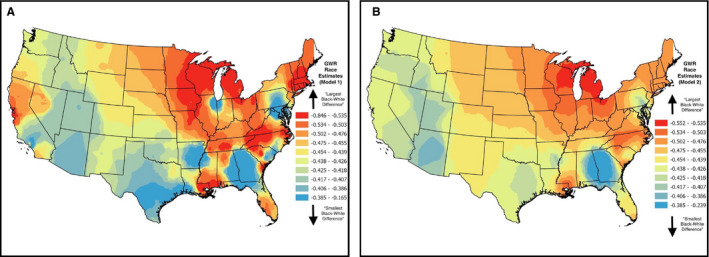
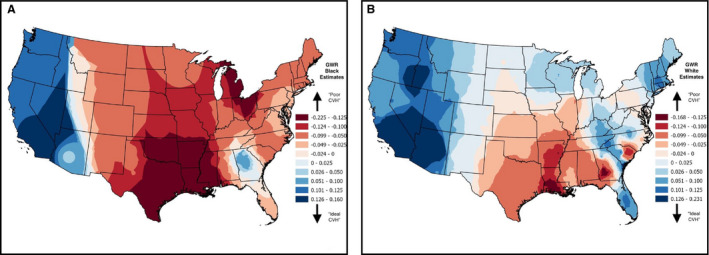
Background Cardiovascular health (CVH) disparities between blacks and whites have persisted in the United States for some time, and although there have been remarkable improvements in addressing cardiovascular disease, it still remains the leading cause of death in the United States. In addition, well-documented disparities are unfortunately widening incidence gaps across certain regions of the United States. Our focus was on answering the following questions: (1) How much spatial heterogeneity exists in the racial differences in CVH between blacks and whites across this country? and (2) Is the spatial heterogeneity in the racial differences significantly explained by living in the Stroke Belt? Methods and Results To explore the spatial patterning in the racial differences in CVH between blacks and whites across the country, we used geographically weighted regression methods, which result in local estimates of the racial differences in CVH. Using data from the REGARDS (Reasons for Geographic and Racial Differences in Stroke) Study, we found significant spatial patterning in these racial differences, even beyond the well-known Stroke Belt and Stroke Buckle. All of the estimated differences indicated blacks consistently having diminishing CVH compared with whites, where this difference was largely noted in pockets of the Stroke Belt and Stroke Buckle, in addition to moderate to large disparities noted in the Great Lakes region, portions of the Northeast, and along the West coast. Conclusions Efforts to improve CVH and ultimately reduce disparities between blacks and whites require culturally competent methods, with a strong focus on geography-based interventions and policies.
背景
在美国,黑人和白人之间的心血管健康(CVH)差异已经存在了一段时间,尽管在解决心血管疾病方面已经取得了显著的进展,但它仍然是美国的主要死因。此外,不幸的是,在美国某些地区,有据可查的差异正在扩大发病率差距。我们的重点是回答以下问题:(1)全国范围内,黑人和白人之间 CVH 种族差异的空间异质性有多大?(2)居住在中风带是否能显著解释 CVH 种族差异的空间异质性?
方法和结果
为了探索全国范围内黑人和白人之间 CVH 种族差异的空间格局,我们使用了地理加权回归方法,该方法可以得出 CVH 种族差异的局部估计值。我们使用来自 REGARDS(中风的地理和种族差异原因)研究的数据,发现这些种族差异存在显著的空间模式,甚至超出了众所周知的中风带和中风扣。所有估计的差异都表明,与白人相比,黑人的 CVH 持续下降,除了中风带和中风扣的一些地区,在大湖地区、东北部部分地区和西海岸地区也注意到了中等至较大的差异。
结论
改善 CVH 并最终减少黑人和白人之间的差距需要采用文化上有能力的方法,重点关注基于地理的干预措施和政策。