Miller Gregory E, Chen Edith, Yu Tianyi, Brody Gene H
Institute for Policy Research and Department of Psychology Northwestern University Evanston IL.
Center for Family Research University of Georgia Athens GA.
J Am Heart Assoc. 2020 May 5;9(9):e015698. doi: 10.1161/JAHA.119.015698. Epub 2020 Apr 28.
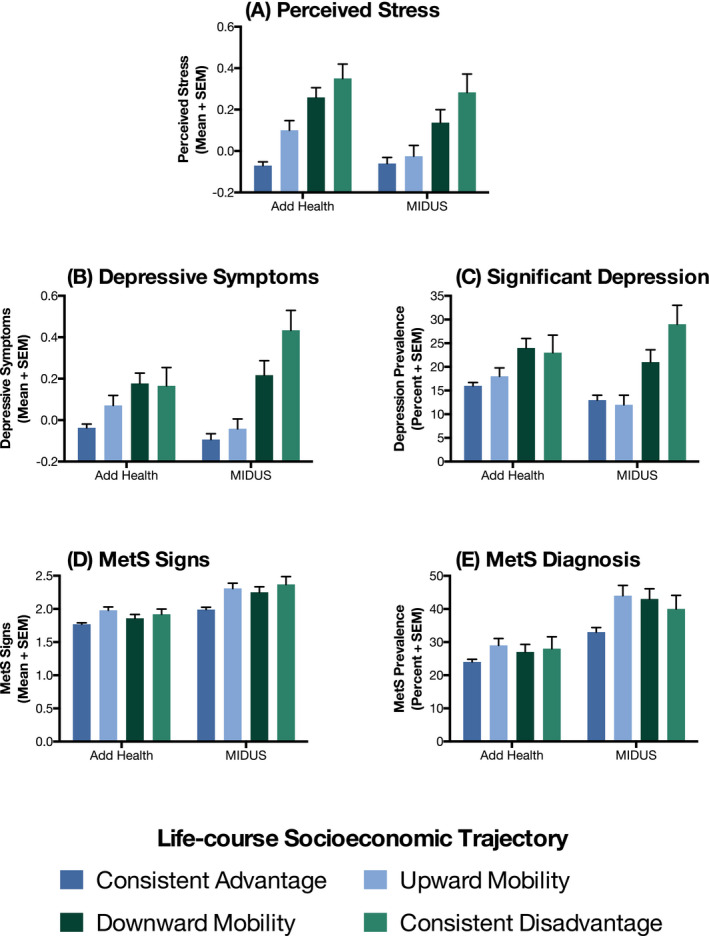
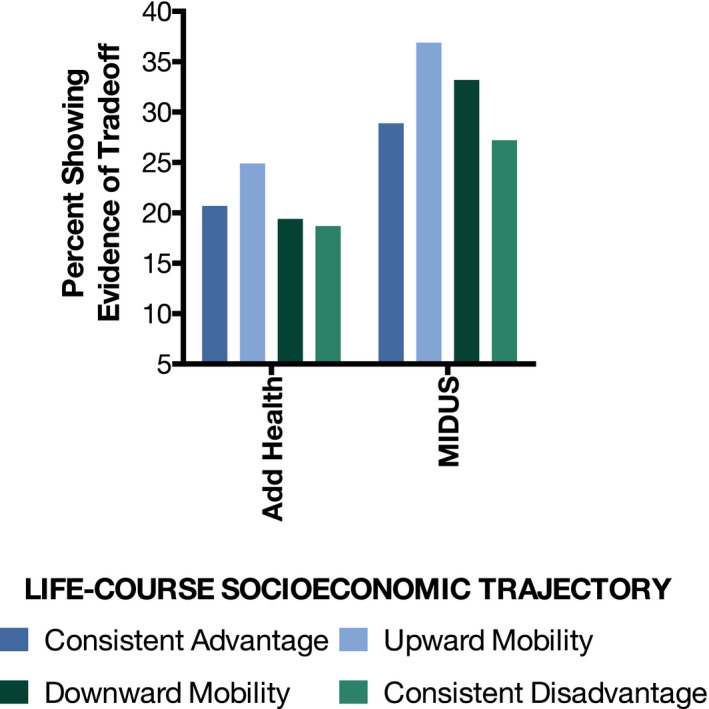
Background People with higher socioeconomic status generally enjoy better cardiovascular health across the life course than those with lower status. However, recent studies of upward mobility, where a child goes on to achieve higher socioeconomic status than his or her parents, suggest that it entails a tradeoff between better psychological well-being and worse cardiometabolic health. In this study, we consider further evidence of this tradeoff in 2 multidecade studies, asking how upward income mobility relates to subsequent perceived stress, depressive symptoms, and metabolic syndrome. We ask parallel questions about downward mobility. Finally, given shifting patterns of mobility in recent generations, we also consider whether mobility's association with health outcomes differs for individuals born in the middle and later parts of the 20th century. Methods and Results We analyzed prospective data from Add Health (National Longitudinal Study of Adolescent Health; N=7542) and MIDUS (Midlife in the United States Study; N=1877). In both studies, evidence of the tradeoff was observed. Upward mobility presaged lower perceived stress and fewer depressive symptoms, in combination with higher metabolic syndrome rates. In contrast, downward mobility presaged worse outcomes on all health indicators. The magnitude of the mobility-health associations was similar across cohorts. Conclusions These findings provide evidence that upward income mobility is associated with a tradeoff between well-being and cardiometabolic health. The similarity of the findings across cohorts suggests that this tradeoff is a generalized consequence of ascending the socioeconomic hierarchy, at least for Americans born in the middle and later parts of the 20th century.
社会经济地位较高的人在一生中通常比社会经济地位较低的人享有更好的心血管健康。然而,最近关于向上流动的研究表明,向上流动意味着在更好的心理健康和更差的心脏代谢健康之间进行权衡,向上流动是指一个孩子的社会经济地位超过其父母。在本研究中,我们在两项长达数十年的研究中进一步考察了这种权衡的证据,探讨收入向上流动与随后的感知压力、抑郁症状和代谢综合征之间的关系。我们也提出了关于向下流动的类似问题。最后,鉴于近几代人流动模式的变化,我们还考虑了对于20世纪中叶及后期出生的个体,流动与健康结果之间的关联是否存在差异。
我们分析了来自“青少年健康纵向研究”(Add Health;N = 7542)和“美国中年研究”(MIDUS;N = 1877)的前瞻性数据。在这两项研究中,均观察到了权衡的证据。向上流动预示着较低的感知压力和较少的抑郁症状,但同时代谢综合征发生率较高。相比之下,向下流动预示着在所有健康指标上都会出现更差的结果。不同队列中流动与健康之间关联的程度相似。
这些发现提供了证据,表明收入向上流动与幸福感和心脏代谢健康之间的权衡有关。不同队列研究结果的相似性表明,这种权衡是社会经济地位上升的普遍结果,至少对于20世纪中叶及后期出生的美国人来说是如此。