Department of Precision Medicine & Biostatistics, Yonsei University Wonju College of Medicine, Wonju 26426, Korea.
Center of Biomedical Data Science, Yonsei University Wonju College of Medicine, Wonju 26426, Korea.
Int J Environ Res Public Health. 2020 Apr 24;17(8):2946. doi: 10.3390/ijerph17082946.
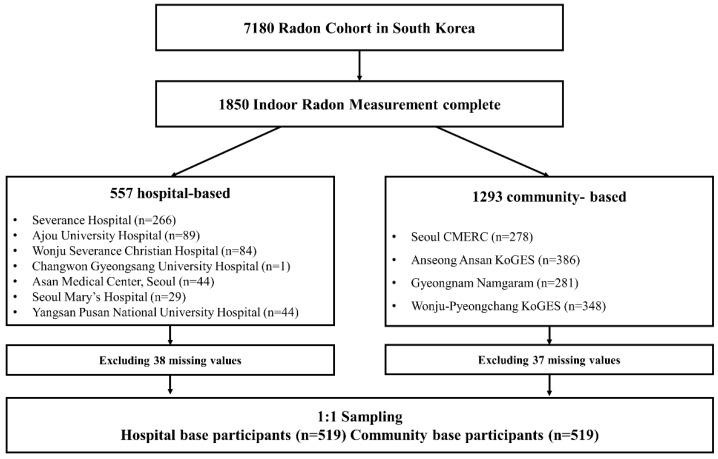
Residential radon exposure and cigarette smoking are the two most important risk factors for lung cancer. The combined effects thereof were evaluated in a multi-center matched case-control study in South Korea. A total of 1038 participants were included, comprising 519 non-small cell lung cancer cases and 519 age- and sex- matched community-based controls. Residential radon levels were measured for all participants. Multivariate logistic regression was used to calculate odds ratios (OR) for lung cancer according to radon exposure (high ≥ 100 Bq/m vs. low < 100 Bq/m), smoking status, and combinations of the two after adjusting for age, sex, indoor hours, and other housing information. The median age of the participants was 64 years, and 51.3% were women. The adjusted ORs (95% confidence intervals [CIs]) for high radon and cigarette smoking were 1.56 (1.03-2.37) and 2.53 (1.60-3.99), respectively. When stratified according to combinations of radon exposure and smoking status, the adjusted ORs (95% CIs) for lung cancer in high-radon non-smokers, low-radon smokers, and high-radon smokers were 1.40 (0.81-2.43), 2.42 (1.49-3.92), and 4.27 (2.14-8.52), respectively, with reference to low-radon non-smokers. Both residential radon and cigarette smoking were associated with increased odds for lung cancer, and the difference in ORs according to radon exposure was much greater in smokers than in non-smokers.
住宅氡暴露和吸烟是肺癌的两个最重要的危险因素。在韩国的一项多中心匹配病例对照研究中评估了它们的联合效应。共纳入 1038 名参与者,包括 519 名非小细胞肺癌病例和 519 名年龄和性别匹配的社区对照。对所有参与者进行住宅氡水平测量。采用多变量逻辑回归,根据氡暴露(高≥100 Bq/m 与低<100 Bq/m)、吸烟状况以及两者的组合,调整年龄、性别、室内时间和其他住房信息后,计算肺癌的比值比(OR)。参与者的中位年龄为 64 岁,51.3%为女性。调整后的高氡和吸烟的 OR(95%置信区间[CI])分别为 1.56(1.03-2.37)和 2.53(1.60-3.99)。根据氡暴露和吸烟状况的组合进行分层,高氡非吸烟者、低氡吸烟者和高氡吸烟者的肺癌调整 OR(95%CI)分别为 1.40(0.81-2.43)、2.42(1.49-3.92)和 4.27(2.14-8.52),与低氡非吸烟者相比。住宅氡和吸烟均与肺癌发生的几率增加相关,且根据氡暴露的 OR 差异在吸烟者中比在非吸烟者中更大。