Institute of Human Nutrition Sciences, Warsaw University of Life Sciences (SGGW-WULS), Nowoursynowska 159C, 02-776 Warsaw, Poland.
Nutrients. 2020 Apr 24;12(4):1200. doi: 10.3390/nu12041200.
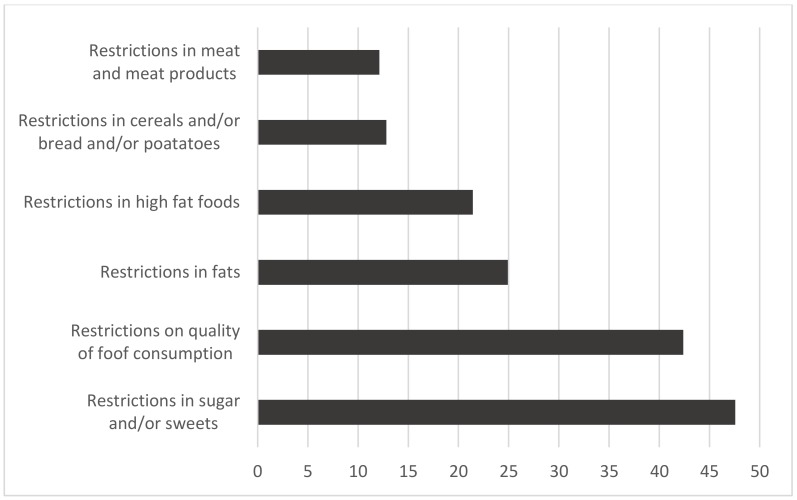
Understanding the factors that coexist with healthy and unhealthy eating behaviors is prevalent and important for public health. The aim of this study was to investigate the associations between food involvement, eating restrictions, and dietary patterns in a representative sample of Polish adults. The study was conducted among a group of 1007 adults. Questions with the answers yes or no were used to obtain the data regarding eating restrictions. Data relating to food involvement were obtained with the Food Involvement Scale (FIS). Questions from the Beliefs and Eating Habits questionnaire were used to measure the frequency of consumption of different food groups. Five dietary patterns (DPs) were derived using principal component analysis (PCA), i.e., 'Fruit and vegetables', 'Wholemeal food', 'Fast foods and sweets', 'Fruit and vegetable juices' and "Meat and meat products'. In each of the DPs, three groups of participants were identified based on tertile distribution with the upper tertile denoting the most frequent consumption. Nearly two-thirds of the study sample declared some restrictions in food consumption. The probability of implementing restrictions in consumption of foods high in sugar, fat and high-fat foods increased in the upper tertile of 'Fruit and vegetables' and 'Wholemeal' DPs. Moreover, the probability of implementing restrictions in consumption of meat and high-starch products increased in 'Wholemeal' DP. The probability of using eating restrictions decreased in the upper tertile of 'Fast foods and sweets' and Meat and meat products' DPs. In conclusion, individuals characterized by high food involvement were more inclined to use eating restrictions than individuals with lower food involvement. Their DPs were also healthier compared to those of individuals manifesting low food involvement. Therefore, promoting personal commitment to learning about and experiencing food may be an effective way of inducing a change of eating habits, and therefore a healthier diet.
了解与健康和不健康饮食行为共存的因素对于公共卫生至关重要。本研究旨在调查波兰成年人代表性样本中食物投入、饮食限制和饮食模式之间的关联。该研究在一组 1007 名成年人中进行。使用是或否的问题来获取有关饮食限制的数据。使用食物投入量表(FIS)获得与食物投入相关的数据。使用信念和饮食习惯问卷中的问题来衡量不同食物组的消费频率。使用主成分分析(PCA)得出了五种饮食模式(DPs),即“水果和蔬菜”、“全麦食品”、“快餐和甜食”、“水果和蔬菜汁”和“肉类和肉类产品”。在每个 DP 中,根据三分位分布确定了三组参与者,上三分位表示最频繁的消费。研究样本中近三分之二的人表示对食物消费有一些限制。在“水果和蔬菜”和“全麦”DP 的上三分位,摄入高糖、高脂肪和高脂肪食物的限制消费的可能性增加。此外,在“全麦”DP 中,限制消费肉类和高淀粉产品的可能性增加。在“快餐和甜食”和“肉类和肉类产品”DP 的上三分位,使用饮食限制的可能性降低。总之,食物投入高的个体比食物投入低的个体更倾向于使用饮食限制。与食物投入低的个体相比,他们的 DP 也更健康。因此,促进个人对学习和体验食物的承诺可能是一种有效的方法,可以诱导饮食习惯的改变,从而实现更健康的饮食。